



| HEADLINE |

|

Full text of Turkey-Saudi Arabia-Pakistan defence pact
Published : Wednesday, 21 October, 2026 at 3:50 PM
Observer Online Report


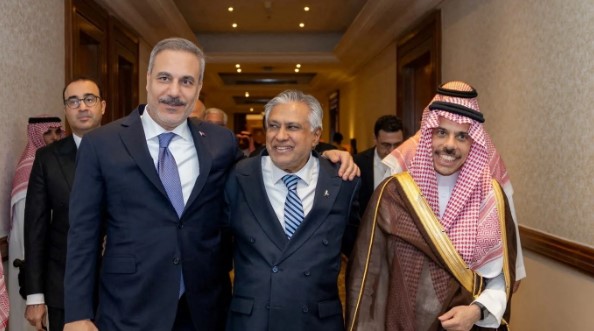
Collected Photo
Turkey has submitted the full text of the Mecca Joint Defence Agreement with Saudi Arabia and Pakistan to parliament for ratification, paving the way for a trilateral defence alliance that commits the three countries to mutual assistance in the event of an externally originating armed attack.
Signed in August, the 16-article pact considers an armed attack against any one of the three signatories an attack against all, requiring the other parties to provide immediate assistance using available means, including military capabilities.
The agreement, obtained by Middle East Eye and published on Tuesday, does not identify any specific country or region as a threat. Instead, it emphasises the protection of the signatories’ independence, sovereignty, territorial integrity and internationally recognised borders.
Article 1 requires the parties to cooperate in safeguarding one another’s sovereignty and territorial integrity. If any member’s borders, sovereignty or territorial integrity are threatened or endangered, the other parties must use all necessary means to address the threat.
Article 2 states that an externally originating armed attack against any signatory shall be considered an attack against all three countries. The parties must immediately assist the country under attack, using the means of mutual assistance available to them.
However, the scope and nature of the assistance will be determined following an objective assessment of the support required and the resources available. The provision also refers to the right of self-defence under Article 51 of the United Nations Charter.
Defence and security cooperation
Beyond mutual defence, the agreement provides for closer cooperation in defence, defence industries and security, including the development of military capabilities and coordination among the three countries’ armed forces.
Article 4 requires regular consultations on international security matters and cooperation in developing individual and joint measures to protect vital interests and national security.
The signatories have also pledged to strengthen cooperation against terrorism in all its forms and manifestations that undermine regional and international stability and security.
Under Article 6, the countries will promote personnel exchanges among defence institutions, joint training programmes, military exercises and other activities aimed at improving the interoperability of their armed forces in both peacetime and wartime.
Joint defence production and technology sharing
Article 7 focuses on strengthening the defence capabilities of the three countries through technology sharing, joint research and development, and collaborative production.
The parties will encourage joint defence production, undertake research projects involving specialised technologies, train personnel and exchange expertise in defence research, development and innovation.
The agreement also allows cooperation in other defence-industrial areas agreed upon by the signatories.
Strategic committee and Saudi-based secretariat
Article 8 establishes a Strategic Political and Defence Committee comprising the foreign ministers, defence ministers and chiefs of general staff of the three countries.
The committee will provide strategic direction for joint defence, expand security cooperation and address obstacles to implementing the agreement. It will meet twice a year, with the host country rotating among the signatories.
The leaders of the three countries may also meet annually if considered necessary. The committee can establish subcommittees and negotiate additional agreements or protocols to implement specific areas of cooperation.
It is also authorised, with the consensus of the three core parties, to approve procedures governing the accession of additional members.
A secretariat headquartered in Saudi Arabia will support the committee. Its secretary-general will serve a three-year term, with the position rotating among the three founding countries. The first secretary-general will be a Pakistani citizen.
The agreement states that the new framework will not affect the work of existing military cooperation committees among the signatories.
Intelligence sharing and logistical support
Under Article 9, the three countries will share intelligence through mutually agreed secure channels while observing information security, data protection and confidentiality requirements.
Article 10 provides for reciprocal logistical support in peacetime, wartime and other emergencies, subject to the availability and compatibility of the required services.
Such support may include weapons, ammunition, fuel, spare parts and other equipment.
The pact also establishes rules for classified information. Article 13 requires the parties to protect confidential documents and information, prohibits sharing them with states, companies or individuals outside the signatories, and restricts access to authorised personnel with the appropriate security clearance.
Ratification, duration and withdrawal
The agreement will be ratified according to the domestic procedures of each signatory. It will enter into force on the date the final instrument of ratification is deposited with the secretariat of the Strategic Political and Defence Committee.
Article 16 states that the pact will remain in force indefinitely, without a fixed expiry date.
However, a signatory may withdraw only after 10 years have elapsed from the agreement’s entry into force. It must notify the other parties in writing through diplomatic channels at least three months before withdrawal.
Withdrawal or termination will not affect activities and projects agreed upon before the relevant date. Obligations to protect classified information will also continue after a country withdraws or the agreement ends.
Any dispute over the interpretation or implementation of the pact must be settled amicably through consultations and discussions among the parties. Amendments require consultations and unanimous agreement among the three core signatories.
The agreement was signed in three original copies in Turkish, Arabic and English, with all three texts declared equally authentic. In the event of differences in interpretation, the English text will prevail.
Turkey’s submission of the pact to parliament marks a step towards its domestic ratification. The agreement’s entry into force, however, depends on the completion of ratification procedures by all three countries and the deposit of the final ratification instrument.
-AH

Loading...
Loading...
Also read





Editor : Iqbal Sobhan Chowdhury
Published by the Editor on behalf of the Observer Ltd. from Globe Printers, 24/A, New Eskaton Road, Ramna, Dhaka.
Editorial, News and Commercial Offices : Aziz Bhaban (2nd floor), 93, Motijheel C/A, Dhaka-1000.
Phone: PABX- 41053001-06; Advertisement: 41053012; 01793317829, 01550707291, E-mail: [email protected], [email protected] Online: email: [email protected] 41053014; 01550707297 Advertisement: 01550707296


