



| HEADLINE |

|

Dried fish industry suffers setback in Chalan Beel
Published : Saturday, 24 October, 2026 at 12:00 AM
Our Correspondent


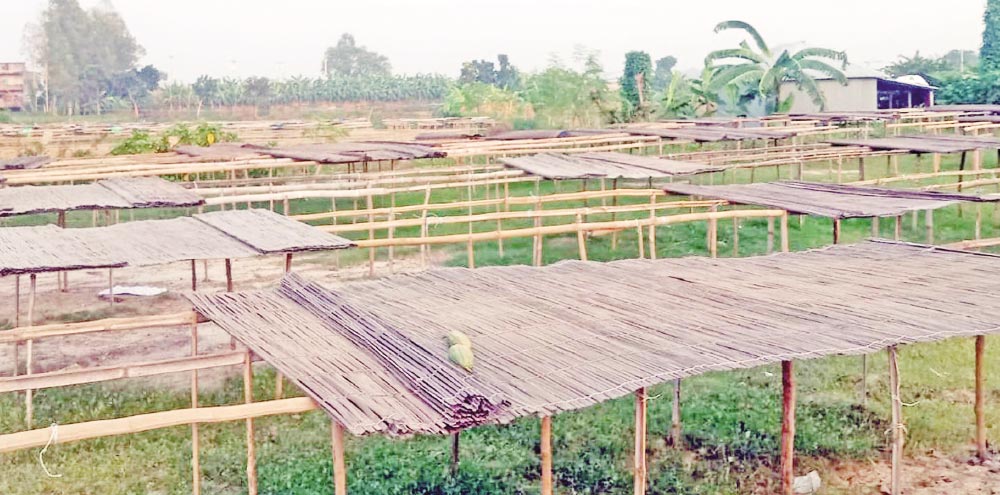 BARAIGRAM, NATORE, Oct 23: This year's monsoon did not bring the traditional ebb and flow of waves to the historic Chalan Beel. The adverse behaviour of nature has affected one of the country's largest water flows.
On one hand, there is an extreme lack of expected water, and on the other, a thick layer of water hyacinth stretching for miles across the beel�"crushed between these two millstones, the breeding of indigenous fish in the floodplains, rivers, canals and water bodies of Chalan Beel has been severely hampered. As a result, Chalan Beel, once known as a traditional treasury of fish, is now experiencing an acute scarcity of indigenous fish. This has had a direct negative impact on the dried fish industry centred on Chalan Beel.
Due to the lack of raw fish, dried fish processing yards are shutting down one after another, leaving traders, fishermen and nearly two thousand working families in extreme distress.
According to sources at the Fisheries Department, a target has been set to produce approximately 400 and a half metric tons (mt) of dried fish worth about Tk 45 crore in 275 temporary processing yards in Chalan Beel this season. To achieve this target, about 1,500 mt of raw fish are required. But even in the peak season, fishermen are not catching enough fish in their nets, so it is not possible to produce even half of the target amount of dried fish. As a result, yard owners, who have invested large sums of capital, are now bewildered at the prospect of losses.
Nur Hossain, a trader from Sathia who has set up processing yards in the Chamta area of Baraigram, said that last year about 1,000 to 1,200 maunds of dried fish were produced in his two yards, but this year there has been an acute crisis of fresh fish. The same situation prevails in other yards across Chalan Beel. The artisans who usually come to Chalan Beel to make dried fish buy various species of fish including punti, tengra, kholshe, chela, koi, shing, boal and shol and make dried fish at the yards. Generally, three kilograms of fresh fish are dried to produce one kilogramme of dried fish, which is sold at Tk 900 to Tk 1,800 per kilogramme depending on quality. But this year, due to lower fish production, yard owners are uncertain about how they will repay their advance loans. This crisis has also affected employment. Nearly two thousand families of women and male workers involved in dried fish production in Chalan Beel earn their living by working at the yards for daily wages of Tk 450 to Tk 550. As the yards continue to close, they have fallen into extreme financial hardship.
Because of the superior quality of the freshwater dried fish of Chalan Beel, there is huge demand for it at home and abroad. The high-quality dried fish processed here is exported for expatriate Bangladeshis living in various countries including America, England, Canada, Malaysia, Saudi Arabia, Qatar and Dubai. Moreover, this dried fish is sold at high prices in markets in Dhaka, Chattogram, Rajshahi, Rangpur and Saidpur within the country.
But Eklach Mia, a dried fish trader in Saidpur, and local exporters have said that this year even half of the demand cannot be met, as a result of which export operations abroad are on the verge of completely stopping.
After the Banpara-Hatikumrul highway was opened, a huge fish wholesale market developed at Mohishluti in Chalan Beel, which played a special role in expanding business through improved communication. However, the main problem now is the extreme shortage of fish and the lack of government support. Yard owners allege that because they cannot get low-interest loans from banks, they are forced to borrow capital from moneylenders and advance lenders at high interest. Due to the indifference and lack of proper guidance of the Fisheries Department, this important industry, which has faced natural disaster, is now suffering from an existential crisis.
In this regard, Nusrat Jahan, UNO of Tarash, said that if excessive water hyacinth accumulates, it can disrupt the natural flow of water as well as shrink fish breeding and roaming grounds. To increase the breeding of indigenous fish in Chalan Beel, local people and relevant departments must work in coordination.

Loading...
Loading...
Also read



Editor : Iqbal Sobhan Chowdhury
Published by the Editor on behalf of the Observer Ltd. from Globe Printers, 24/A, New Eskaton Road, Ramna, Dhaka.
Editorial, News and Commercial Offices : Aziz Bhaban (2nd floor), 93, Motijheel C/A, Dhaka-1000.
Phone: PABX- 41053001-06; Advertisement: 41053012; 01793317829, 01550707291, E-mail: [email protected], [email protected] Online: email: [email protected] 41053014; 01550707297 Advertisement: 01550707296


