



| HEADLINE |

|
When Saraswati speaks for the silenced
DU's Mass Communication students turn Puja pavilion into a quiet protest against violence, mobocracy and attacks on the press
Published : Saturday, 24 January, 2026 at 12:00 AM
DU Correspondent


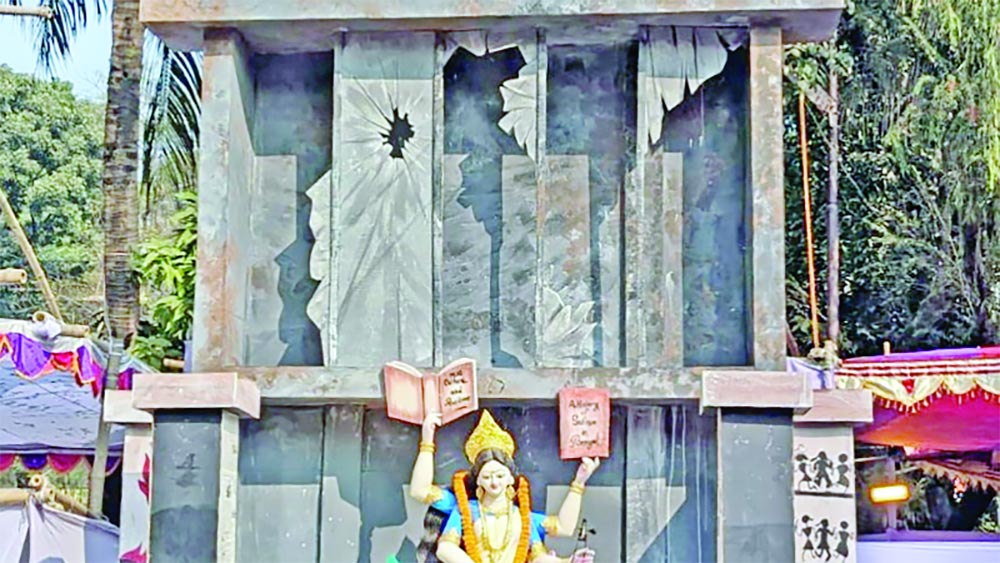 Amid the rhythmic chants, soft glow of lights, and fragrance of flowers marking Saraswati Puja at Dhaka University, one pavilion quietly asked visitors to pause, reflect, and listen. Designed by students of the Department of Mass Communication and Journalism (MCJ), the pavilion stood apart-not in colour or grandeur, but in conscience.
This year, as Saraswati Puja was celebrated across 76 pavilions organised by Jagannath Hall and other departments, the MCJ pavilion drew attention for its unconventional design and powerful theme: anti-mobocracy. Shaped to resemble recently burned media offices, it protested arson attacks on two leading national outlets, turning worship into a statement for press freedom.
Charred walls, broken glass, and soot-stained signage of a fictional "Daily Journalism Gazette" recreated the haunting imagery of violence against newsrooms. Placed in front stood the idol of Saraswati--the goddess of knowledge--symbolically asserting that attacks on journalism are attacks on knowledge itself.
Organisers said the idea reflected journalism's responsibility to serve the public and seek truth. "When journalists and media institutions become targets of violence for doing their duty, it threatens not only a profession but the democratic future of society," one student explained.
Shrabasti Bandyopadhyay, a student organiser, described the pavilion as a broader call against oppression. "We did not speak only about silenced pens or burned newspapers," she said. "We wanted to speak against all forms of injustice-from exploited workers to innocent children killed under ruins in conflict zones. The message is clear: not war, but peace; not mobs, but justice."
The idol held two books: Mob Culture & Resilience, highlighting threats from violent mob justice, and A History of Sufism in Bengal, evoking Bengal's pluralistic, peaceful traditions. By merging devotion with dissent, the MCJ students transformed Saraswati Puja into more than a ritual, reminding visitors that knowledge flourishes only where free expression survives-and that even in celebration, silence can speak loudest when it carries truth.
Loading...
Loading...



Editor : Iqbal Sobhan Chowdhury
Published by the Editor on behalf of the Observer Ltd. from Globe Printers, 24/A, New Eskaton Road, Ramna, Dhaka.
Editorial, News and Commercial Offices : Aziz Bhaban (2nd floor), 93, Motijheel C/A, Dhaka-1000.
Phone: PABX- 41053001-06; Advertisement: 41053012; 01793317829, 01550707291, E-mail: [email protected], [email protected] Online: email: [email protected] 41053014; 01550707297 Advertisement: 01550707296
Published by the Editor on behalf of the Observer Ltd. from Globe Printers, 24/A, New Eskaton Road, Ramna, Dhaka.
Editorial, News and Commercial Offices : Aziz Bhaban (2nd floor), 93, Motijheel C/A, Dhaka-1000.
Phone: PABX- 41053001-06; Advertisement: 41053012; 01793317829, 01550707291, E-mail: [email protected], [email protected] Online: email: [email protected] 41053014; 01550707297 Advertisement: 01550707296


