



| HEADLINE |

|
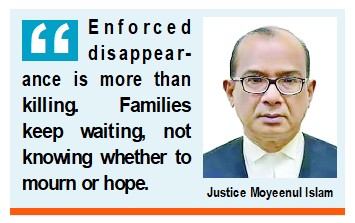
Enforced disappearance is more than killing: Justice Moyeenul


 Enforced disappearances, institutional silence and a weak rights protection framework dominated a seminar organised by the Bangladesh Institute of Law and International Affairs (BILIA) on Saturday, as jurists and rights defenders painted a stark picture of Bangladesh's human rights record and urged urgent reforms.
The seminar, titled "State of Human Rights in Bangladesh: An Overview," brought together former judges, commission members, civil society activists and diplomats at BILIA's Dhanmondi auditorium. Speakers said the human cost of past abuses remains deep, while accountability and legal safeguards are still fragile.
Former Justice Moyeenul Islam Chowdhury, ex-chairman of the Commission of Inquiry on Enforced Disappearances, addressed the programme as chief guest. He said enforced disappearance inflicts a pain that does not end.
"Enforced disappearance is more than killing," he told the audience. "Families keep waiting, not knowing whether to mourn or hope. That uncertainty is a lifelong punishment."
He said many victims were branded as criminals to justify abuses. "This narrative was deliberately created," he said. "It helped normalise violations and silence questions."
The remarks set the tone for a candid discussion that mixed legal analysis with lived experience.
Former commission member Justice Md Farid Ahmed Shibli said the scale of disappearances showed systemic failure rather than isolated wrongdoing. "When the same pattern repeats again and again, it is no longer accidental," he said. "It reflects how institutions were used."
Sazzad Hossain, another former member of the commission, said the biggest challenge now is restoring trust. "People lost faith in justice because they saw no consequences," he said. "Without accountability, rights remain only words on paper."
The seminar also focused on the legal and institutional framework meant to protect citizens.
Noor Khan Liton, former commission member and rights activist, criticised the National Human Rights Commission Act of 2009, saying it lacks teeth. "The commission was designed to observe, not to act," he said. "Without enforcement power, it cannot protect anyone."
Taskin Fahmina, director of rights organisation Odhikar, said civic space shrank sharply in recent years. "Human rights work was treated as a threat," she said. "Defenders were intimidated, and facts were denied."
She added that documentation remains crucial. "If we stop recording abuses, history will be rewritten," she said.
Dr Muhammad Ekramul Haque, secretary of BILIA, said the institute organised the seminar to encourage honest reflection. "We cannot move forward without acknowledging where we failed," he said. "Law must serve people, not power."
He stressed that international human rights commitments must be reflected in domestic practice. "Treaties are not decorations," he said. "They are promises."
Ambassador M Maroof Zaman, director of BILIA, said the discussion was timely amid changing political realities. "Transitions open windows," he said. "The question is whether we use them to fix institutions or repeat old habits."
He said human rights should not be viewed as a partisan issue. "This is about dignity," he said. "It concerns every citizen."
Several speakers pointed to the role of the judiciary, saying past compliance with executive pressure weakened rights protection.
"Courts must stand as the last shield," said Justice Shibli. "When that shield bends, citizens are left exposed."
Participants also emphasised the need for reform beyond rhetoric. They called for independent investigations, stronger commissions, protection for whistleblowers and space for civil society to operate freely.
The seminar ended with a shared message: the wounds of enforced disappearances and other abuses will not heal without truth and accountability.
"As a nation, we owe families answers," Justice Chowdhury said in closing. "Without justice, there can be no real closure."
The event served as both a warning and a call - that human rights, once eroded, demand sustained effort to rebuild, not silence or denial.
Loading...
Loading...
Also read



Editor : Iqbal Sobhan Chowdhury
Published by the Editor on behalf of the Observer Ltd. from Globe Printers, 24/A, New Eskaton Road, Ramna, Dhaka.
Editorial, News and Commercial Offices : Aziz Bhaban (2nd floor), 93, Motijheel C/A, Dhaka-1000.
Phone: PABX- 41053001-06; Advertisement: 41053012; 01793317829, 01550707291, E-mail: [email protected], [email protected] Online: email: [email protected] 41053014; 01550707297 Advertisement: 01550707296
Published by the Editor on behalf of the Observer Ltd. from Globe Printers, 24/A, New Eskaton Road, Ramna, Dhaka.
Editorial, News and Commercial Offices : Aziz Bhaban (2nd floor), 93, Motijheel C/A, Dhaka-1000.
Phone: PABX- 41053001-06; Advertisement: 41053012; 01793317829, 01550707291, E-mail: [email protected], [email protected] Online: email: [email protected] 41053014; 01550707297 Advertisement: 01550707296


