



| HEADLINE |

|

Govt must fortify macro stability as structural strains intensify: CPD
Published : Thursday, 5 March, 2026 at 12:00 AM
Business Correspondent


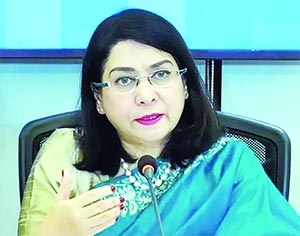 The Centre for Policy Dialogue (CPD) on Wednesday delivered a resonant call to the newly elected government: move swiftly to secure macroeconomic stability or risk deeper structural fissures across banking, revenue, and investment.
At a high-profile roundtable in Dhaka, jointly organised with an English daily, policymakers, economists, and business leaders spoke in one voice-stabilise first, reform deeper, and enforce discipline without hesitation. The mood was urgent, the message unequivocal.
Dr Fahmida Khatun, Executive Director of CPD, set the tone with a sobering assessment. Inflationary pressures, narrowing fiscal space, banking fragility, and faltering tax mobilisation, she argued, are not isolated tremors but interwoven vulnerabilities threatening
the economy's core. Fiscal and monetary policies must move in concert. Central bank autonomy must be safeguarded. Structural reforms-in revenue administration, loan recovery, and exchange rate management-must accelerate with purpose.
"Stability cannot be cosmetic," she cautioned. "It must be institutional."
Defaulted loans, she warned, remain a stubborn fault line. Without decisive action to cleanse bank balance sheets and restore financial discipline, private investment will struggle to revive. As Bangladesh advances toward LDC graduation, she added, the nation must redouble efforts to diversify exports beyond garments and elevate productivity to withstand global competition.
Prime Minister's Adviser on Finance and Planning, Dr Rashed Al Mahmud Titumir, attending as chief guest, acknowledged the strains but struck a tone of calibrated confidence. The government, he said, is committed to restoring stability through disciplined budgeting, targeted social protection, and institutional strengthening. Reform must be steady and inclusive-balancing macro stability with social equity.
From the export frontier, Mahmud Hasan Khan, President of the Bangladesh Garment Manufacturers and Exporters Association (BGMEA), underscored the centrality of the ready-made garment sector to export earnings. Yet the industry faces mounting cost pressures-from energy shortages to shifting global demand and tightening financing conditions. Predictable policies, smoother credit access, and reliable infrastructure, he stressed, are essential to sustain competitiveness in global markets.
Industrialist AK Azad, Vice President of the International Chamber of Commerce Bangladesh and Managing Director of Ha-Meem Group, was forthright. Economic recovery, he argued, will remain elusive unless large loan defaulters are brought firmly under discipline. Soaring non-performing loans-particularly in state-owned banks-are crowding out genuine entrepreneurs. Liquidity support alone, without accountability, will not reignite industrial momentum.
Veteran business leaders echoed similar concerns. Shams Mahmud cited policy unpredictability and regulatory delays as impediments to private sector expansion. Syed Almas Kabir emphasised digital transformation and technology investment to drive productivity gains. Asif Ibrahim called for export diversification and trade facilitation reforms to mitigate dependency risks, while Fahim Mashroor highlighted the employment potential of startups and digital platforms-if financing access and regulatory support improve.
Policy analysts, including Mashrur Reaz and Dr Siddiq Ahmed, advocated coherent medium-term planning grounded in data transparency and institutional accountability. Reform fatigue, they warned, must not follow electoral transition.
The roundtable's collective verdict was emphatic: macroeconomic stability is not optional-it is foundational. Control inflation decisively. Reinforce revenue mobilisation. Restore banking discipline. Diversify exports. Rebuild investor confidence through rule-based governance.
Participants signalled that the new government faces narrowing fiscal space and little time for hesitation. The decisions taken now, they stressed, will determine whether Bangladesh regains its economic stride or slips into a protracted cycle of structural strain.

Loading...
Loading...
Also read



Editor : Iqbal Sobhan Chowdhury
Published by the Editor on behalf of the Observer Ltd. from Globe Printers, 24/A, New Eskaton Road, Ramna, Dhaka.
Editorial, News and Commercial Offices : Aziz Bhaban (2nd floor), 93, Motijheel C/A, Dhaka-1000.
Phone: PABX- 41053001-06; Advertisement: 41053012; 01793317829, 01550707291, E-mail: [email protected], [email protected] Online: email: [email protected] 41053014; 01550707297 Advertisement: 01550707296
Published by the Editor on behalf of the Observer Ltd. from Globe Printers, 24/A, New Eskaton Road, Ramna, Dhaka.
Editorial, News and Commercial Offices : Aziz Bhaban (2nd floor), 93, Motijheel C/A, Dhaka-1000.
Phone: PABX- 41053001-06; Advertisement: 41053012; 01793317829, 01550707291, E-mail: [email protected], [email protected] Online: email: [email protected] 41053014; 01550707297 Advertisement: 01550707296


