



| HEADLINE |

|
Fuel crisis causes widespread disruptions in districts
* Pumps closed by day, fuel sold at inflated prices at night
* Farmers complain about high production cost, fear crop loss
Published : Saturday, 28 March, 2026 at 12:00 AM
Our Correspondents


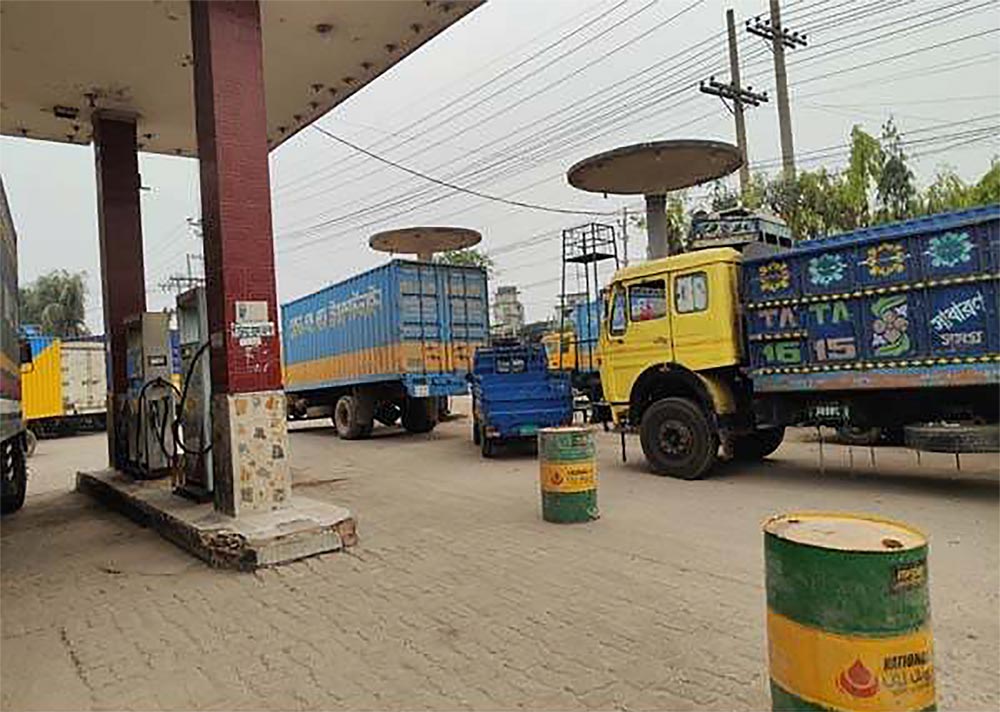
Acute shortages of petrol, octane, and diesel - coupled with manipulation by vested groups - have pushed motorcyclists, farmers, transport workers, and low income residents into dire hardship in different districts of the country including Khulna, Narayanganj, and Rajshahi.
A spot visit revealed that filling stations often claim 'no fuel' during the day, only to sell limited quantities after dusk. Within hours, supplies are declared exhausted, forcing consumers to wait in long queues without success. Meanwhile, in the open market, fuel is being sold freely at inflated rates - Tk 180 to Tk 200 per litre. Allegations abound that only those willing to pay extra are given priority. Unlicensed retailers operate openly, with little visible monitoring.
With just one filling station in the upazila, the crisis has deepened. Irregular supply and arbitrary sales have pushed suffering to extremes.
Local motorcyclist Rafiqul Islam said, "I stood in line for hours but got nothing. Later I was forced to buy at Tk 200 per litre. If this continues, we'll have no choice but to protest."
Farmers face the gravest challenge. With the Boro season underway, diesel is essential for irrigation. But shortage of fuel and soaring prices mean many cannot water their fields on time, raising fears of crop damage. Farmers complain that buying diesel at inflated rates has pushed production costs up, threatening losses instead of profit. Green fields now carry a shadow of anxiety.
Local sources say a powerful syndicate collects fuel from the filling station and resells it in the retail market at several times the price. Though occasional raids are conducted, no visible tough action has been taken, leaving the situation unchanged.
Observers warn that if the crisis persists, it could spark major social unrest. Irregularities in such an essential sector are severely disrupting daily life.
Residents demand swift identification of the syndicate, strict legal measures, and stronger market monitoring. For now, Paikgachha 's people remain hostage to an invisible force - and without urgent intervention, the situation could turn even more alarming.
SONARGAON, NARAYANGANJ: A severe fuel shortage in the Sonargaon stretch of the Dhaka-Chittagong highway has caused widespread disruption, leaving transport workers and commuters facing significant delays.
The scarcity of diesel and octane has hindered freight movement and public transport, raising fears that perishable essential goods carried by trucks may rot before reaching their destinations.
A spot visit to 14 filling stations in the Sonargaon area revealed a dire situation. Most stations have hung 'No Octane' notices, while others have used bamboo barricades to signal they are completely closed. Even where diesel is available, it is being heavily rationed.
Amjad Hossain Mollah, a truck driver transporting essential goods from Kanchpur to Cox's Bazar, told reporters that his journey requires at least 60 to 70 litres of diesel.
"The pumps are refusing to give more than 10 litres at a time," he said. "I'm having to queue at multiple stations for hours. We are failing to deliver goods on time, and there is a real risk of the cargo spoiling."
The crisis has also hit public transport and private motorists. Bus driver Md Sobuj Mia described how the shortage has made it impossible to maintain schedules.
"Passengers are becoming angry and aggressive toward us because we are constantly pulling over to queue for fuel," he said.
Motorcyclists appear to be the hardest hit by the octane shortage. Md Shafiqul Islam, a medical representative for Acme Pharmaceuticals, said he has been unable to return to his workplace in Chandpur after the Eid holidays.
"I've been standing in line for hours and still haven't found any octane. My office is calling me repeatedly, but I am stuck," he added.
Despite the visible queues and closed pumps, local authorities maintain that there should be no overall shortage in the district.
Narayanganj Deputy Commissioner Raihan Kabir stated that the administration is monitoring the situation closely.
"There should not be a fuel crisis at the filling stations. While there are rules regarding limited distribution, we will take strict action against any station found to be intentionally withholding supply," he warned.
RAJSHAHI: A severe petrol shortage has paralysed Bagha Upazila in Rajshahi, with filling stations closed during the day while syndicates allegedly sell fuel at inflated prices from hidden depots at night. Residents say the crisis reflects not just a supply problem but a breakdown in market oversight.
Government figures claim Bangladesh has adequate fuel reserves, but Bagha tells a different story. Motorcyclists, farmers and transport workers queue for hours at pumps only to be turned away. Yet in the open market, petrol and octane are reportedly sold at Tk 250-320 per litre - nearly three times the official price.
Locals accuse a powerful group of depot owners of creating an artificial shortage. Official guidelines limit distribution to two litres for motorcycles and 10 litres for private cars, but in Bagha, residents say the rules are ignored. Farmers, in the middle of the Boro irrigation season, are particularly anxious. "We cannot water our fields on time. Costs are rising and crops are at risk," one farmer said.
Motorcyclists complain that daily life has been disrupted for two weeks. "Pumps are closed, but depots sell fuel at night for exorbitant prices. We are hostage to a syndicate," said one driver.
Bagha has at least seven depots across Monigram, Bagha municipality, Tentulia and Arani. Three belong to the same family, with Monir Ali's depot in Monigram considered the most influential.
Locals recall a 2020 fire at Monir Hossain's depot, when a drum explosion injured 30 people, five of whom later died.
Bangladesh Petroleum Corporation rules require licences and safety certificates for depots, but residents say many operate illegally.
Bagha petrol pump owner Lutfor Rahman said he last received 3,000 litres on 19 March but could not recall earlier allocations. He claimed to have submitted records to the Upazila Nirbahi Officer (UNO).
UNO Shammi Akter told reporters that action would be taken if allegations were proven. "We have already fined one depot owner in Tentulia for charging excessive prices," she said.
Residents argue the crisis is not just about fuel but about weak regulation. "This is a failure of market management. Unless authorities act decisively, the situation will worsen," one community leader warned.
For now, Bagha's pumps remain shuttered, its depots accused of profiteering, and its people caught between queues and extortionate prices - a stark reminder of how essential commodities can be manipulated when oversight falters.
Loading...
Loading...
Also read



Editor : Iqbal Sobhan Chowdhury
Published by the Editor on behalf of the Observer Ltd. from Globe Printers, 24/A, New Eskaton Road, Ramna, Dhaka.
Editorial, News and Commercial Offices : Aziz Bhaban (2nd floor), 93, Motijheel C/A, Dhaka-1000.
Phone: PABX- 41053001-06; Advertisement: 41053012; 01793317829, 01550707291, E-mail: [email protected], [email protected] Online: email: [email protected] 41053014; 01550707297 Advertisement: 01550707296
Published by the Editor on behalf of the Observer Ltd. from Globe Printers, 24/A, New Eskaton Road, Ramna, Dhaka.
Editorial, News and Commercial Offices : Aziz Bhaban (2nd floor), 93, Motijheel C/A, Dhaka-1000.
Phone: PABX- 41053001-06; Advertisement: 41053012; 01793317829, 01550707291, E-mail: [email protected], [email protected] Online: email: [email protected] 41053014; 01550707297 Advertisement: 01550707296


