



| HEADLINE |

|
Farmers cut semi-ripe paddy amid elephant attack
Published : Monday, 27 April, 2026 at 12:00 AM
Our Correspondent


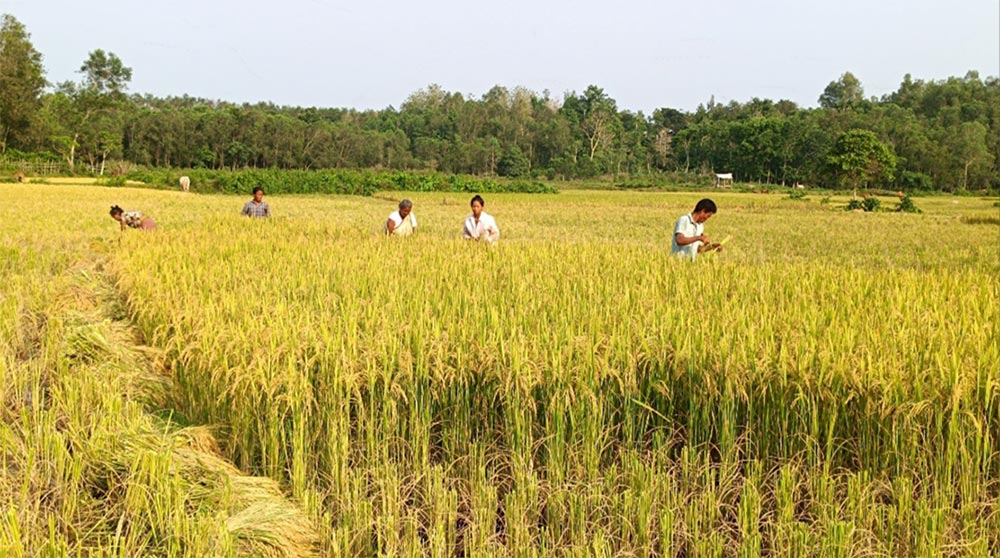 NALITABARI, SHERPUR, Apr 26: Farmers in the border areas of Garo Hills in Nalitabari Upazila are being forced to harvest semi-ripe paddy early due to increasing attacks by wild elephants as the Boro harvesting season approaches.
Extensive Boro cultivation has been carried out in Ramchandrakura, Nayabil and Poragaon unions. While crops in many areas are now ripening, elephants from nearby forests are regularly entering farmlands in search of food, damaging standing crops by eating and trampling them.
Farmers say the human-elephant conflict has continued for nearly two decades without a lasting solution. In many cases, people have been killed after being trampled by elephants, while elephants have also died due to electric traps set by farmers to protect their crops.
With the harvesting season nearing, elephant attacks have reportedly doubled. Farmers say herds are entering crop fields almost daily in the late afternoon or evening, forcing them to guard their lands day and night by building makeshift watch towers in the fields.
Farmers use loud noises, shouting, beating tin sheets and sometimes burning torches to drive the elephants away. However, they say shortages and high prices of kerosene have made it harder to scare them off effectively.
As a result, many farmers have begun harvesting paddy prematurely to save at least part of their crop.
Agarupada Village farmer and Garo indigenous resident Mejes Sangma said elephants frequently raid their fields, forcing them to guard crops from temporary shelters built beside the fields. He said they try to drive elephants away with noise and fire, but it has become increasingly difficult.
Another farmer, Md Halim Uddin of Dawdhara village, said government compensation covers only a fraction of the damage caused by elephants. Even when received, it often comes after long delays. He demanded a simplified compensation process and installation of high-powered lighting in elephant-prone areas.
Madhutila Forest Range Officer Md Dewan Ali said the forest department is providing compensation to affected farmers, which is offering some financial relief. He added that awareness activities are being conducted to promote coexistence between humans and elephants.
Loading...
Loading...
Also read



Editor : Iqbal Sobhan Chowdhury
Published by the Editor on behalf of the Observer Ltd. from Globe Printers, 24/A, New Eskaton Road, Ramna, Dhaka.
Editorial, News and Commercial Offices : Aziz Bhaban (2nd floor), 93, Motijheel C/A, Dhaka-1000.
Phone: PABX- 41053001-06; Advertisement: 41053012; 01793317829, 01550707291, E-mail: [email protected], [email protected] Online: email: [email protected] 41053014; 01550707297 Advertisement: 01550707296
Published by the Editor on behalf of the Observer Ltd. from Globe Printers, 24/A, New Eskaton Road, Ramna, Dhaka.
Editorial, News and Commercial Offices : Aziz Bhaban (2nd floor), 93, Motijheel C/A, Dhaka-1000.
Phone: PABX- 41053001-06; Advertisement: 41053012; 01793317829, 01550707291, E-mail: [email protected], [email protected] Online: email: [email protected] 41053014; 01550707297 Advertisement: 01550707296


