



| HEADLINE |

|
PM vows BNP govt will launch Padma, Teesta Barrage projects


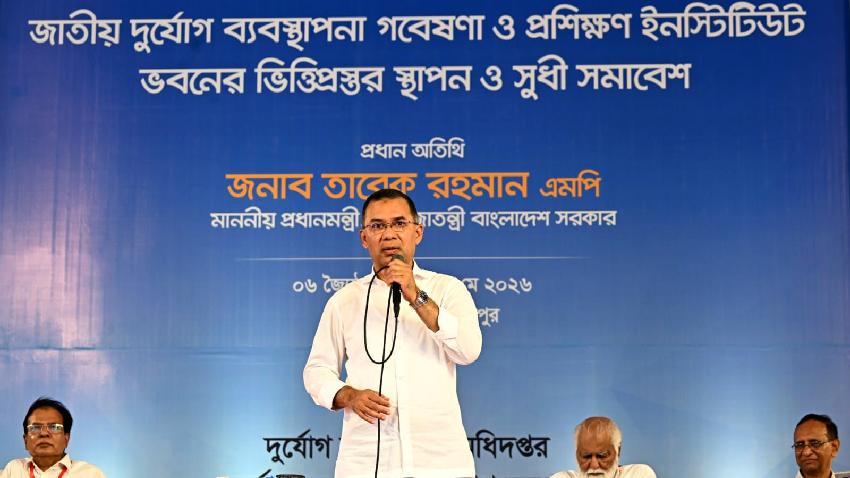
Prime Minister and BNP Chairman Tarique Rahman on Wednesday announced that his government will move ahead with long discussed plans to build the Padma Barrage and the Teesta Barrage, presenting the projects as key to securing water resources and protecting the environment.
Speaking at a civic reception after laying the foundation stone of the National Disaster Management Research and Training Institute, he said the administration has already taken a policy decision to construct a barrage on the Padma River, particularly in the Rajshahi region, to better manage water flow between the country’s northern and southern areas.
He said upstream water diversion structures across the border have reduced Bangladesh’s share of dry season water. The proposed Padma Barrage, he added, would allow the country to retain surplus monsoon water for use during lean months, ensuring timely irrigation for farmers and water supply for communities.
The prime minister also reaffirmed plans to implement the Teesta Barrage project. He said the BNP had long advocated for action on the Teesta and had undertaken various programmes on the issue under the leadership of the current Disaster Management and Relief Minister. According to him, the party had laid much of the groundwork for the initiative.
Tarique Rahman warned that the Farakka Barrage has created additional environmental challenges, including increased salinity in the southern region due to seawater intrusion.
Speaking at a civic reception after laying the foundation stone of the National Disaster Management Research and Training Institute, he said the administration has already taken a policy decision to construct a barrage on the Padma River, particularly in the Rajshahi region, to better manage water flow between the country’s northern and southern areas.
He said upstream water diversion structures across the border have reduced Bangladesh’s share of dry season water. The proposed Padma Barrage, he added, would allow the country to retain surplus monsoon water for use during lean months, ensuring timely irrigation for farmers and water supply for communities.
The prime minister also reaffirmed plans to implement the Teesta Barrage project. He said the BNP had long advocated for action on the Teesta and had undertaken various programmes on the issue under the leadership of the current Disaster Management and Relief Minister. According to him, the party had laid much of the groundwork for the initiative.
Tarique Rahman warned that the Farakka Barrage has created additional environmental challenges, including increased salinity in the southern region due to seawater intrusion.
He said the Sundarbans and surrounding ecosystems are under pressure, with plant species damaged and wildlife threatened. Storing excess rainwater, he argued, is essential to counter these impacts.
Turning to climate change, the prime minister noted visible shifts in seasonal patterns. Winters are no longer as cold as in previous decades, he said, recalling that students once needed sweaters even in late March during Independence Day rehearsals.
He also pointed to rapid urbanization and environmental degradation. Areas that were once water bodies or covered in trees have been replaced by buildings, he said, reducing natural resilience against disasters.
Referring to a documentary screened at the event, he highlighted the environmental cost of accommodating around 1.3 million Rohingya refugees in Cox’s Bazar.
Turning to climate change, the prime minister noted visible shifts in seasonal patterns. Winters are no longer as cold as in previous decades, he said, recalling that students once needed sweaters even in late March during Independence Day rehearsals.
He also pointed to rapid urbanization and environmental degradation. Areas that were once water bodies or covered in trees have been replaced by buildings, he said, reducing natural resilience against disasters.
Referring to a documentary screened at the event, he highlighted the environmental cost of accommodating around 1.3 million Rohingya refugees in Cox’s Bazar.
He said large numbers of trees were cleared to build shelters in areas that were previously forested.
The prime minister mentioned a proposed road project from Cox’s Bazar beach to Ukhiya that reportedly requires cutting about 3,000 trees. After reading about the plan, he said he contacted the relevant minister and instructed that engineers revise the design to avoid tree felling.
Groundwater depletion was another concern raised in his speech. In parts of Dhaka such as Gulshan and the Cantonment area, water that was once accessible at depths of 20 to 25 feet now requires drilling 600 to 700 feet, he said. Intensive use of deep tube wells for agriculture to feed a population of 200 million is gradually exhausting underground reserves, increasing long term risks.
He said the government has already begun implementing its election pledge to excavate canals, describing the initiative as closely linked to agriculture, public welfare and even earthquake related safety.
Bangladesh remains highly vulnerable to natural disasters, he said, with even minor events causing extensive crop and livestock losses. The newly launched National Disaster Management Research and Training Institute will focus on studying changing weather patterns and strengthening preparedness through training and public awareness.
While natural disasters cannot be prevented, he said, their impact can be reduced through research, education and responsible resource management. Protecting and properly utilizing the country’s limited resources is essential for sustainable development, he added.
Disaster Management and Relief Minister Asadul Habib Dulu, State Minister M Iqbal Hossain and Director General of the Department of Disaster Management Razwanur Rahman also addressed the gathering.
The prime minister mentioned a proposed road project from Cox’s Bazar beach to Ukhiya that reportedly requires cutting about 3,000 trees. After reading about the plan, he said he contacted the relevant minister and instructed that engineers revise the design to avoid tree felling.
Groundwater depletion was another concern raised in his speech. In parts of Dhaka such as Gulshan and the Cantonment area, water that was once accessible at depths of 20 to 25 feet now requires drilling 600 to 700 feet, he said. Intensive use of deep tube wells for agriculture to feed a population of 200 million is gradually exhausting underground reserves, increasing long term risks.
He said the government has already begun implementing its election pledge to excavate canals, describing the initiative as closely linked to agriculture, public welfare and even earthquake related safety.
Bangladesh remains highly vulnerable to natural disasters, he said, with even minor events causing extensive crop and livestock losses. The newly launched National Disaster Management Research and Training Institute will focus on studying changing weather patterns and strengthening preparedness through training and public awareness.
While natural disasters cannot be prevented, he said, their impact can be reduced through research, education and responsible resource management. Protecting and properly utilizing the country’s limited resources is essential for sustainable development, he added.
Disaster Management and Relief Minister Asadul Habib Dulu, State Minister M Iqbal Hossain and Director General of the Department of Disaster Management Razwanur Rahman also addressed the gathering.
A documentary produced by the department was screened, and the prime minister received a commemorative crest.
Senior government officials, lawmakers and the prime minister’s Defence Adviser, Brigadier General Retd Dr AKM Shamsul Islam, were present at the event.
Senior government officials, lawmakers and the prime minister’s Defence Adviser, Brigadier General Retd Dr AKM Shamsul Islam, were present at the event.
Loading...
Loading...
Also read






Editor : Iqbal Sobhan Chowdhury
Published by the Editor on behalf of the Observer Ltd. from Globe Printers, 24/A, New Eskaton Road, Ramna, Dhaka.
Editorial, News and Commercial Offices : Aziz Bhaban (2nd floor), 93, Motijheel C/A, Dhaka-1000.
Phone: PABX- 41053001-06; Advertisement: 41053012; 01793317829, 01550707291, E-mail: [email protected], [email protected] Online: email: [email protected] 41053014; 01550707297 Advertisement: 01550707296
Published by the Editor on behalf of the Observer Ltd. from Globe Printers, 24/A, New Eskaton Road, Ramna, Dhaka.
Editorial, News and Commercial Offices : Aziz Bhaban (2nd floor), 93, Motijheel C/A, Dhaka-1000.
Phone: PABX- 41053001-06; Advertisement: 41053012; 01793317829, 01550707291, E-mail: [email protected], [email protected] Online: email: [email protected] 41053014; 01550707297 Advertisement: 01550707296


