



| HEADLINE |

|

Sundarbans Under Siege (Part - I)
Pollution, salinity, industrial expansion put forest at risk
Industrial waste disposal, vessel traffic and climate-driven salinity are degrading the forest's soil and water, threatening its biodiversity and ecological balance
Published : Wednesday, 3 June, 2026 at 12:00 AM
Mizanur Rahman


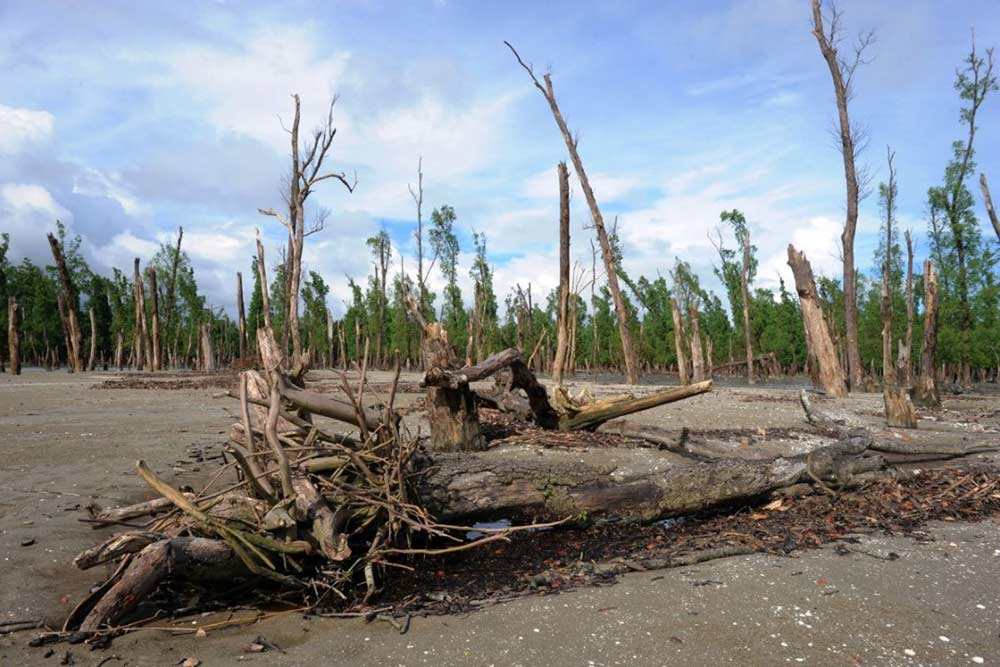 The Sundarbans, Bangladesh's largest natural shield against coastal disasters and a globally recognised heritage site, is facing mounting environmental pressure from both climate change and human activities. Rising salinity, industrial expansion, river pollution, vessel movement and increasing tourism are altering the forest's fragile ecosystem, affecting its plants, wildlife and aquatic species. Despite legal protections around the forest, pollution continues to intensify, raising concerns over the long-term survival of one of the country's most valuable natural resources.
The impact of climate change has increased the salinity of water and soil in the Sundarbans, while pollution from multiple sources is placing additional strain on the forest's ecosystem. Experts and environmentalists warn that industrial activities, shipping, tourism and other human interventions are contributing to environmental degradation in the world's largest mangrove forest.
Recognising the ecological importance of the area, the government in 1999 declared a 10-kilometre zone around the Sundarbans an Ecologically Critical Area (ECA) to control pollution and ensure sustainable environmental management. A notification issued on January 13, 2015, identified the mouzas included within the protected zone.
However, according to relevant sources, more than a hundred industrial and commercial establishments have been built within the ECA over the past decade. Waste from several industries is reportedly being discharged into the Pashur River, from where it spreads into the rivers and soil of the forest.
In Shyamnagar upazila alone, more than a hundred establishments have been set up within 10 kilometres of the Sundarbans in the Padmapakur, Athulia, Burigoalini, Munshiganj, Ramjannagar and Ishwaripur areas. These include crab processing units, shrimp fry hatcheries, rice mills, vending factories, brick kilns, petrol pumps, hotels and motels.
Environmental concerns have also grown over the movement of domestic and foreign vessels through waterways inside the forest.
For years, ships travelling from Mongla Port have passed through the Sundarbans to the Angtihara area of Koyra.
According to environmental experts, engine noise, hydraulic horns and bright lights from vessels disturb wildlife. Oil and other waste discharged from ships are also polluting the forest's rivers and soil. The situation has been compounded by a series of shipping accidents in and around the Sundarbans.
Sources from the Inland Water Transport Authority (IWTA) said that 36 vessels sank over the past 10 years. Of them, 21 sank in the Pashur, Shela and Bhola rivers within the Sundarbans, while 15 others sank in rivers across Khulna and Jessore.
A recent study conducted by the Environmental Science Discipline of Khulna University found a sharp rise in oil contamination in the Pashur River. According to the study, the maximum amount of oil per litre of river water was 10.8 milligrams in 2010. It has now increased to 68 milligrams, although the acceptable level is 10 milligrams.
Dr Abdullah Harun Chowdhury, a professor of the Environmental Science Discipline at Khulna University, said pollution levels in the rivers and forest soil have increased significantly. He noted that tree seedlings are no longer growing in many areas as they once did and that aquatic species are being affected by the rising concentration of oil in river water.
He also said deer, monkeys and other wild animals are now rarely seen in forests adjacent to waterways frequently used by vessels.
Dr ASM Helal Uddin Ahmed Siddiqui, a divisional officer of the Bangladesh Forest Research Institute, said findings from multiple studies show that about 40 per cent of Sundari trees are affected by top-dying disease, while around 50 per cent are suffering from heart rot.
According to him, older Sundari trees in highly saline areas are particularly vulnerable. Heart rot affects trees in both highly saline and less saline areas, causing internal decay and weakening the species that gives the Sundarbans its name.
Wildlife is also facing pressure from illegal hunting. Forest department and police sources said at least 40 poachers were arrested with deer meat and skins during the past year. In separate drives in areas adjacent to the Sundarbans in Koyra upazila, authorities recovered 512 kilograms of deer meat, one slaughtered deer, five skins and several deer heads.
Mahfuzur Rahman Mukul, Khulna divisional coordinator of the Bangladesh Environmental Lawyers Association (BELA), said the Sundarbans is the lifeline of people living across the southern region. He alleged that regulations governing the ECA are not being properly enforced.
He said industrial establishments are not allowed within a 25-kilometre ECA zone around the Sundarbans in India, while Bangladesh has designated a 10-kilometre ECA around the forest. "But the rules are not being followed. They must be enforced.
Otherwise, the biodiversity of the Sundarbans will be destroyed," he said.
Environmentalists warn that the combined effects of pollution, habitat degradation and rising salinity are placing increasing pressure on the Sundarbans ecosystem. They fear that unless effective measures are taken to protect the forest and enforce environmental regulations, the ecological balance of this unique mangrove forest could face even greater risks in the years ahead.

Loading...
Loading...
Also read



Editor : Iqbal Sobhan Chowdhury
Published by the Editor on behalf of the Observer Ltd. from Globe Printers, 24/A, New Eskaton Road, Ramna, Dhaka.
Editorial, News and Commercial Offices : Aziz Bhaban (2nd floor), 93, Motijheel C/A, Dhaka-1000.
Phone: PABX- 41053001-06; Advertisement: 41053012; 01793317829, 01550707291, E-mail: [email protected], [email protected] Online: email: [email protected] 41053014; 01550707297 Advertisement: 01550707296
Published by the Editor on behalf of the Observer Ltd. from Globe Printers, 24/A, New Eskaton Road, Ramna, Dhaka.
Editorial, News and Commercial Offices : Aziz Bhaban (2nd floor), 93, Motijheel C/A, Dhaka-1000.
Phone: PABX- 41053001-06; Advertisement: 41053012; 01793317829, 01550707291, E-mail: [email protected], [email protected] Online: email: [email protected] 41053014; 01550707297 Advertisement: 01550707296


