



| HEADLINE |

|

Rohingya response plan: UN cuts local host community share to 5pc
Cox’s Bazar CSO-NGO Forum alleges reduced allocation and calls for repatriation roadmap and fair funding distribution
Published : Friday, 12 June, 2026 at 12:00 AM
Our Correspondent


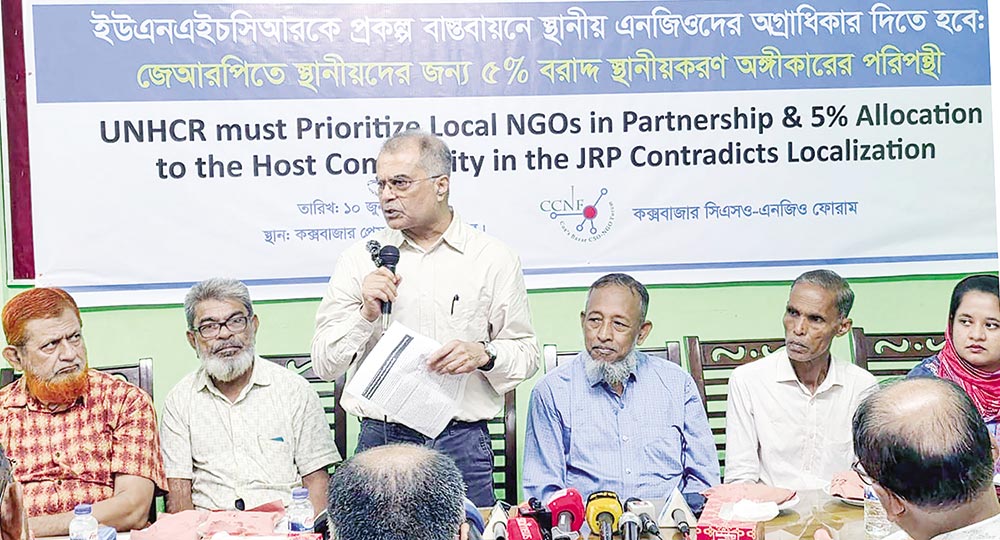 COX’S BAZAR, June 11: The United Nations has reportedly reduced the allocation for local communities in Cox’s Bazar from 25 per cent to 5 per cent under the Joint Response Plan (JRP) 2026, according to claims made by a local NGO network.
The allegation was made at a press conference organised by the Cox’s Bazar CSO-NGO Forum (CCNF) at the Cox’s Bazar Press Club on Wednesday.
The forum said the decision affects the Bangladeshi host communities that have been hosting more than 1.2 million forcibly displaced Rohingyas for years.
They also claimed that local NGOs have been excluded from the implementation framework of the JRP 2026, which they said contradicts commitments under the Grand Bargain localisation agenda signed by UNHCR.
Speakers at the press conference alleged that no clear roadmap has yet been developed for the safe and dignified repatriation of Rohingyas to Myanmar, even as multiple agencies continue to focus on aid allocation.
They demanded an immediate and clear repatriation plan, stressing that the Rohingya crisis has now entered its ninth year since 2017.
The forum said Bangladesh government agencies, local communities, national and international NGOs, and UN bodies have been jointly providing humanitarian assistance to the Rohingya population through annual joint response plans.
However, they expressed concern that local NGOs were not included in the opening ceremony of the JRP 2026 implementation process, while international organisations were given representation.
They also criticised what they described as unequal participation opportunities for local actors in policy-level discussions.
The CCNF proposed a revised “JRP 2.0” framework, calling for a clear roadmap for the safe, voluntary and dignified repatriation of Rohingyas to Myanmar, along with stronger inclusion of local organisations in aid management.
Speakers also raised concerns over funding distribution, alleging that of a $150 million allocation from the United States for the Rohingya response, 92 per cent went to UN agencies while only 8 per cent was allocated to international NGOs.
They said local organisations should be given direct access to funding and included as implementing partners in future JRP allocations.
The press conference also claimed that one local NGO had received more than 30 projects while others had received none, calling for an end to what they described as a centralised funding system.
Speakers reiterated their call for safe, voluntary and dignified repatriation of Rohingyas and urged stronger cooperation to ensure safety, peace and welfare inside the camps.
They also suggested exploring treated water from the Naf River to reduce pressure on groundwater in the region.

Loading...
Loading...
Also read



Editor : Iqbal Sobhan Chowdhury
Published by the Editor on behalf of the Observer Ltd. from Globe Printers, 24/A, New Eskaton Road, Ramna, Dhaka.
Editorial, News and Commercial Offices : Aziz Bhaban (2nd floor), 93, Motijheel C/A, Dhaka-1000.
Phone: PABX- 41053001-06; Advertisement: 41053012; 01793317829, 01550707291, 01550707296
E-mail: [email protected], [email protected]. [email protected], [email protected], [email protected], [email protected], Online-email: [email protected]
Published by the Editor on behalf of the Observer Ltd. from Globe Printers, 24/A, New Eskaton Road, Ramna, Dhaka.
Editorial, News and Commercial Offices : Aziz Bhaban (2nd floor), 93, Motijheel C/A, Dhaka-1000.
Phone: PABX- 41053001-06; Advertisement: 41053012; 01793317829, 01550707291, 01550707296
E-mail: [email protected], [email protected]. [email protected], [email protected], [email protected], [email protected], Online-email: [email protected]


