



| HEADLINE |

|
CPD questions feasibility of FY27 budget targets
Published : Sunday, 21 June, 2026 at 12:46 PM
Observer Online Desk


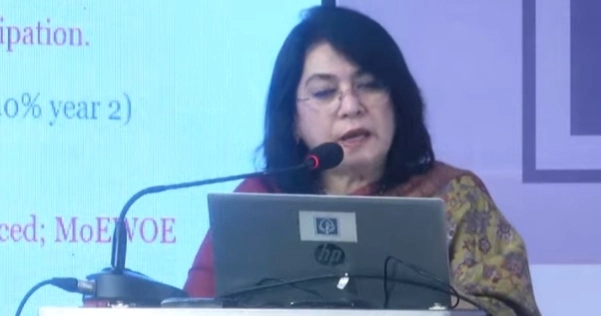
CPD Executive Director Dr Fahmida Khatun presented the think tank’s Independent Review of Bangladesh’s Development analysis at its Budget Dialogue 2026 at a hotel in the capital’s Gulshan on Sunday.
The Centre for Policy Dialogue (CPD) has described the proposed FY2026-27 national budget as a recovery-oriented plan that prioritises human development, while cautioning that its ambitious economic targets may be difficult to achieve.
The think tank said the budget’s macroeconomic assumptions appear fragile and the proposed fiscal framework is unlikely to be sustained in its current form.
CPD Executive Director Dr Fahmida Khatun presented the think tank’s Independent Review of Bangladesh’s Development (IRBD) analysis at its Budget Dialogue 2026 at a hotel in the capital’s Gulshan on Sunday.
The think tank put forward eight key observations on the FY27 budget, which Finance Minister Amir Khosru Mahmud Chowdhury presented to Parliament on 11 June.
CPD noted that the government’s GDP growth target of 6.5 per cent represents a recovery claim from an estimated 5.0 per cent in the revised FY26 budget, but Bangladesh Bureau of Statistics (BBS) provisional data puts actual FY26 growth at only 4.14 per cent.
On revenue mobilisation, CPD flagged that the government targets an 18.2 per cent growth in revenue collection, reaching Tk6,95,000 crore, but its own projection based on data through March 2026 suggests actual FY26 collection may be only around Tk4,50,000 crore, implying the real growth target required is closer to 54.4 per cent.
The think tank welcomed the budget’s reprioritisation of public expenditure towards human capital sectors, noting that health allocation surged 124 per cent and education rose 42.7 per cent compared to the revised FY26 budget.
However, it cautioned that both sectors suffer from persistently weak budget utilisation, with health development spending utilisation collapsing from 80 per cent in FY15 to just 30 per cent in FY25.
On the Annual Development Programme (ADP), CPD said the Tk3 lakh crore ADP allocation, a 50 per cent jump over the revised FY26 figure, reflects an ambitious fiscal stance, but only 35.4 per cent of last year’s ADP was spent in the first ten months, signalling low absorptive capacity.
It also noted that none of the eight mega projects due for completion in FY27, including the Rooppur Nuclear Power Plant, are expected to finish on time.
CPD raised equity concerns over personal income tax structure, pointing out that lower-income groups face a proportionally higher tax burden increase than those earning above Tk30 lakh annually.
On social protection, the Social Safety Net Programme(SSNP) allocation rose 13.9 per cent to Tk1,44,000 crore in FY27, but CPD observed that pension management and agriculture subsidy together absorb 43.2 per cent of the total SSNP budget, programmes not strictly targeted at the poor.
Regarding the government’s pledge to create one crore new jobs within 18 months, CPD found budget allocations across four key employment ministries either declining or stagnant as a share of total expenditure.
The Ministry of Commerce saw the sharpest cut, with allocation slashed from Tk909 crore to Tk329 crore.
CPD also flagged the absence of a medium-term roadmap to address preference erosion ahead of Bangladesh’s LDC graduation, despite the government formally requesting a three-year deferral in February 2026.
“This budget is the first major opportunity for the new government to demonstrate its ability to drive economic recovery through sustained structural reforms,” Fahmida Khatun said, adding that its success will ultimately depend on the quality of execution and the strength of institutional capacity to deliver.
Loading...
Loading...
Also read






Editor : Iqbal Sobhan Chowdhury
Published by the Editor on behalf of the Observer Ltd. from Globe Printers, 24/A, New Eskaton Road, Ramna, Dhaka.
Editorial, News and Commercial Offices : Aziz Bhaban (2nd floor), 93, Motijheel C/A, Dhaka-1000.
Phone: PABX- 41053001-06; Advertisement: 41053012; 01793317829, 01550707291, E-mail: [email protected], [email protected] Online: email: [email protected] 41053014; 01550707297 Advertisement: 01550707296
Published by the Editor on behalf of the Observer Ltd. from Globe Printers, 24/A, New Eskaton Road, Ramna, Dhaka.
Editorial, News and Commercial Offices : Aziz Bhaban (2nd floor), 93, Motijheel C/A, Dhaka-1000.
Phone: PABX- 41053001-06; Advertisement: 41053012; 01793317829, 01550707291, E-mail: [email protected], [email protected] Online: email: [email protected] 41053014; 01550707297 Advertisement: 01550707296


