



| HEADLINE |

|
13 July 1930: The day the World Cup story began


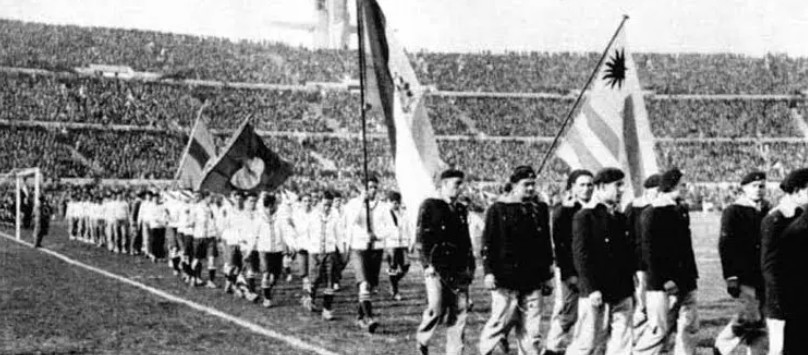
What started as a 13-team tournament in Uruguay has grown into football's premier international competition, captivating billions and shaping generations of players and supporters.
Ninety-six years ago on 13 July 1930, international football entered a new era as the inaugural FIFA World Cup kicked off in Montevideo, Uruguay. What began as a modest 13-team tournament has since evolved into the sport's most prestigious international competition.
Ninety-six years ago on 13 July 1930, international football entered a new era as the inaugural FIFA World Cup kicked off in Montevideo, Uruguay. What began as a modest 13-team tournament with no qualification process has evolved into football's premier international competition, watched by billions across the globe.

A tournament born from ambition
Before 1930, the Olympic Games represented the highest level of international football. However, FIFA believed the rapidly growing sport needed its own global championship. The vision belonged largely to FIFA president Jules Rimet, whose proposal was approved at the FIFA Congress in Amsterdam in 1928.
The vision belonged largely to FIFA president Jules Rimet, whose proposal for a standalone international tournament was approved at the FIFA Congress in Amsterdam in 1928. The decision marked the beginning of what has become football's most enduring competition.
Uruguay's Olympic success in 1924 and 1928 made it the dominant force in international football at the time. The country also offered to cover travel and accommodation costs for participating teams, a significant incentive during the economic difficulties of the Great Depression.
Why only 13 teams?
Unlike today's World Cup, there were no qualifying matches.
National associations received direct invitations from FIFA, but the long sea voyage to South America discouraged many European countries from participating.
Ultimately, only 13 nations travelled to Uruguay"seven from South America, four from Europe and two from North America. France, Belgium, Romania and Yugoslavia became the only European representatives willing to undertake the journey across the Atlantic.
The entire tournament was staged in Montevideo across Estadio Centenario, Gran Parque Central and Estadio Pocitos, with a total of 18 matches played over 18 days.

History made on opening day
The tournament began with a rare occurrence: two matches kicking off simultaneously on the same day.
At Estadio Pocitos, France defeated Mexico 4-1, while at Gran Parque Central the United States recorded a 3-0 victory over Belgium.
The most enduring moment came in the 19th minute of France's victory when Lucien Laurent converted Ernest Libérati's cross to score the first goal in FIFA World Cup history.
Decades later, Laurent remained modest about his place in history, recalling the goal as a simple finish rather than a historic achievement.
Uruguay crowns itself the first champion
The tournament concluded on 30 July with hosts Uruguay facing neighbours Argentina before a crowd of more than 68,000 at Estadio Centenario.
Trailing 2-1 at half-time, Uruguay rallied to secure a 4-2 victory and become the first FIFA World Cup champions.
Captain José Nasazzi became the first footballer to lift what was later renamed the Jules Rimet Trophy in honour of the FIFA president who spearheaded the competition.

From a modest tournament to a global spectacle
The inaugural championship bore little resemblance to the competition known today. What began with 13 invited teams in 1930 expanded to 16 teams in 1934, 24 in 1982 and 32 in 1998. The 2026 edition, to be hosted jointly by Canada, Mexico and the United States, will feature a record 48 nations, reflecting football's growing global reach.
The tournament's influence has grown far beyond the pitch. Television broadcasts from the 1950s introduced the World Cup to millions of households, while satellite television, commercial sponsorship and, more recently, digital streaming have transformed it into one of the world's most widely watched sporting events.

Its history has also been defined by generations of exceptional players. Pelé announced himself as a 17-year-old champion in 1958, Diego Maradona produced one of the tournament's greatest individual performances in 1986, and stars including Ronaldo Nazário, Zinedine Zidane, Andrés Iniesta, Lionel Messi and Kylian Mbappé have each left an enduring mark on football's biggest stage.
Today, the FIFA World Cup is more than a championship "it is a global event that transcends sport, bringing together nations, cultures and billions of supporters every four years.
More than a championship
The World Cup has become a stage where sporting achievement intersects with national identity, culture and collective memory.
Every edition has produced moments that transcend the game itself "from unexpected upsets and dramatic finals to performances that have inspired generations of footballers.
Winning the World Cup remains the highest achievement in international football.
A legacy that endures
What began in Montevideo on 13 July 1930 with just 13 invited teams has grown into football's premier international competition, enduring global conflicts, political change and the sport's own evolution over nearly a century.
More than a championship, the World Cup has become a stage for national pride, cultural expression and some of sport's most memorable moments. Every edition has produced iconic goals, dramatic finals and performances that have shaped football history.
Yet every chapter can be traced back to that winter's day in Uruguay. The opening whistle on 13 July 1930 did more than begin a tournament "it marked the start of a global tradition that continues to unite players and supporters around the world.
History made on opening day• No qualification tournament: The inaugural FIFA World Cup in 1930 featured invited teams only. Qualification rounds were introduced in later editions.• A weeks-long sea voyage: The four European participants "France, Belgium, Romania and Yugoslavia "travelled to Uruguay by ship, as commercial air travel was not yet a practical option for such long-distance journeys.• An 18-day tournament: The first World Cup ran from 13 to 30 July 1930, with all 18 matches played in Montevideo.• Two opening matches: Contrary to popular belief, the tournament began with two simultaneous fixtures "France vs Mexico and the United States vs Belgium"on 13 July 1930.• The first goal in World Cup history: France's Lucien Laurent scored the tournament's and World Cup history's "first goal in the 19th minute of the opening match against Mexico.
Loading...
Loading...
Also read






Editor : Iqbal Sobhan Chowdhury
Published by the Editor on behalf of the Observer Ltd. from Globe Printers, 24/A, New Eskaton Road, Ramna, Dhaka.
Editorial, News and Commercial Offices : Aziz Bhaban (2nd floor), 93, Motijheel C/A, Dhaka-1000.
Phone: PABX- 41053001-06; Advertisement: 41053012; 01793317829, 01550707291, E-mail: [email protected], [email protected] Online: email: [email protected] 41053014; 01550707297 Advertisement: 01550707296
Published by the Editor on behalf of the Observer Ltd. from Globe Printers, 24/A, New Eskaton Road, Ramna, Dhaka.
Editorial, News and Commercial Offices : Aziz Bhaban (2nd floor), 93, Motijheel C/A, Dhaka-1000.
Phone: PABX- 41053001-06; Advertisement: 41053012; 01793317829, 01550707291, E-mail: [email protected], [email protected] Online: email: [email protected] 41053014; 01550707297 Advertisement: 01550707296


