



| HEADLINE |

|

The Weight of One Match
How the WC final defines a legacy!
Published : Saturday, 18 July, 2026 at 12:00 AM
Sports Desk


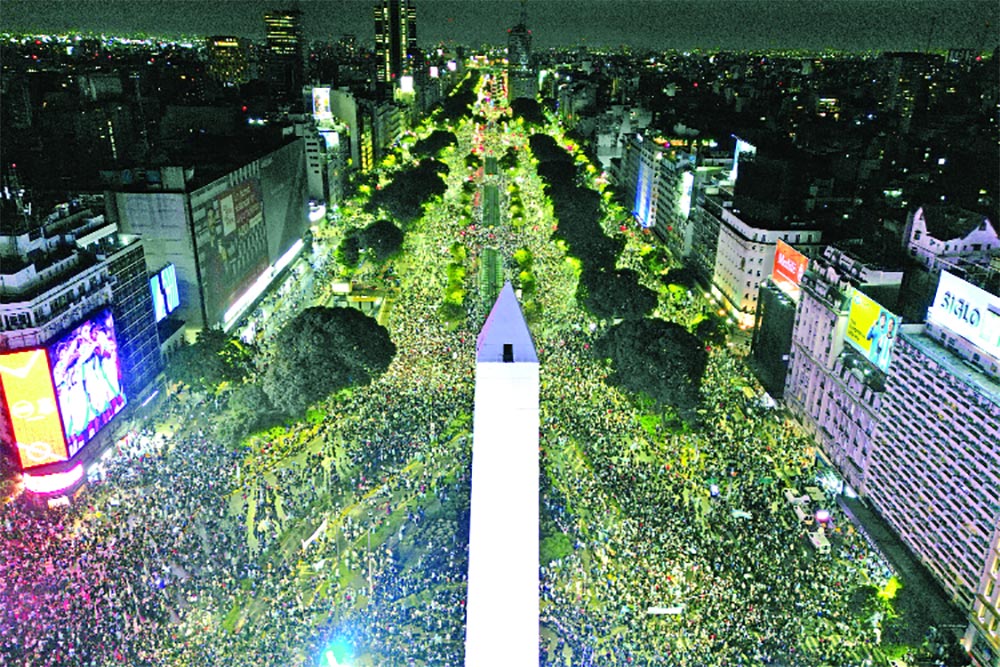 Every footballer dreams of playing in a World Cup.
Only a handful ever play in a World Cup final.
And even fewer leave it as champions.
That is why, for all the statistics, trophies and individual awards accumulated throughout a career, football history often remembers one match above all others-the World Cup final.
On Sunday, Spain and Argentina will meet in the FIFA World Cup 2026 final, with the greatest prize in football at stake. For the players, the trophy represents more than a medal or a celebration.
It represents legacy.
History has repeatedly shown that the World Cup final has the power to redefine careers.
Lionel Messi spent more than a decade answering questions about what was missing from his extraordinary résumé. Despite winning almost everything at club level, critics continued to point towards the World Cup. One unforgettable night in Qatar in 2022 changed that conversation forever.
Mario Götze needed only one goal in the 2014 final to secure his place in football history.
Andrés Iniesta's extra-time winner in 2010 transformed him from one of Spain's finest midfielders into a national icon.
By contrast, some of football's greatest names experienced the opposite emotion.
Johan Cruyff revolutionised football, yet never lifted the World Cup.
Roberto Baggio's unforgettable penalty miss in 1994 became one of the sport's defining images.
Michel Platini, Ferenc Puskás and countless other legends finished extraordinary careers without football's ultimate prize.
Greatness alone is not enough.
The World Cup final asks one final question.
Can you deliver when the entire world is watching?
That is what makes Sunday's final so compelling.
For Spain, victory would confirm the emergence of a new football dynasty.
This young generation has already impressed with technical excellence, tactical maturity and fearless attacking football. Winning the World Cup would transform promising stars into global icons almost overnight.
For Argentina, the stakes feel even greater.
Lionel Messi stands only one victory away from ending what could be his final World Cup campaign with a second winners' medal. It would strengthen an already remarkable legacy and place an extraordinary final chapter on one of football's greatest careers.
Yet football has never been decided by reputation.
Every World Cup final writes its own story.
Sometimes heroes emerge unexpectedly.
Sometimes established stars disappear under pressure.
Sometimes one save, one tackle or one substitution becomes the moment remembered for generations.
That uncertainty is precisely why the World Cup final remains the sport's greatest occasion.
There are league titles every year.
There is a Champions League every season.
A World Cup final comes only once every four years.
For many players, it comes only once in a lifetime.
On Sunday, ninety minutes-or perhaps one hundred and twenty-will separate triumph from heartbreak.
One team will celebrate beneath the confetti.
The other will leave wondering what might have been.
Because in football, careers are measured by consistency.
Legacies are often measured by one match.
And there is no match bigger than the FIFA World Cup final.
Loading...
Loading...
Also read



Editor : Iqbal Sobhan Chowdhury
Published by the Editor on behalf of the Observer Ltd. from Globe Printers, 24/A, New Eskaton Road, Ramna, Dhaka.
Editorial, News and Commercial Offices : Aziz Bhaban (2nd floor), 93, Motijheel C/A, Dhaka-1000.
Phone: PABX- 41053001-06; Advertisement: 41053012; 01793317829, 01550707291, E-mail: [email protected], [email protected] Online: email: [email protected] 41053014; 01550707297 Advertisement: 01550707296
Published by the Editor on behalf of the Observer Ltd. from Globe Printers, 24/A, New Eskaton Road, Ramna, Dhaka.
Editorial, News and Commercial Offices : Aziz Bhaban (2nd floor), 93, Motijheel C/A, Dhaka-1000.
Phone: PABX- 41053001-06; Advertisement: 41053012; 01793317829, 01550707291, E-mail: [email protected], [email protected] Online: email: [email protected] 41053014; 01550707297 Advertisement: 01550707296


