



| HEADLINE |

|
Balochistan today, East Pakistan before 1971?


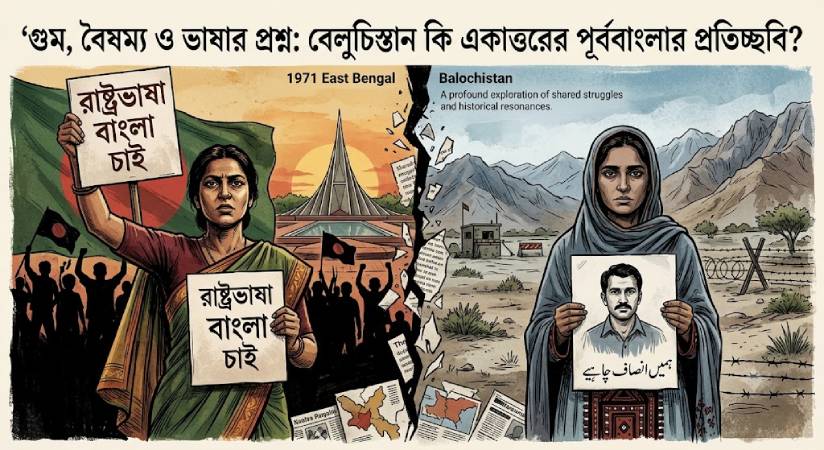
Pakistan’s southwestern province Balochistan has once again drawn international attention over allegations of enforced disappearances, rights violations, political exclusion and economic inequality. Amid the ongoing crisis, some South Asian analysts are comparing certain aspects of Balochistan’s situation with conditions in erstwhile East Pakistan before 1971, while experts caution against making a direct comparison between two different historical contexts.
For decades, Balochistan has remained at the centre of political unrest, separatist movements and allegations of human rights abuses. Recent reports of military operations, disappearances and alleged extrajudicial killings have renewed debates over whether the province reflects some historical similarities with the experience of East Pakistan before Bangladesh’s independence.
Analysts point to four major areas of comparison between the two regions, language rights, economic disparities, political representation and human rights concerns. However, they also stress that the constitutional, political and international contexts of Balochistan and pre-1971 East Pakistan are fundamentally different.
Various human rights groups have repeatedly accused Pakistani security forces of enforced disappearances, arbitrary arrests and extrajudicial killings in Balochistan. The Human Rights Council of Balochistan (HRCB) has published reports highlighting alleged cases of disappearances and deaths in the region. The Pakistani government, however, rejects such allegations, saying security operations are being carried out against armed separatist groups and militants.
The issue of state power and alleged rights violations has been one of the key reasons behind comparisons with East Pakistan before 1971, when political tensions between the central government and the eastern wing of Pakistan continued to escalate.
Language and cultural identity remain another major point of discussion. Baloch political and cultural groups have long alleged that the dominance of Urdu in administration and education has weakened the Balochi language and cultural identity.
Historians note that the declaration of Urdu as the sole state language of Pakistan after 1948 triggered the Language Movement in East Pakistan, which later became a crucial foundation of Bengali nationalism. However, they also emphasise that the present language debate in Balochistan and the 1952 Language Movement in East Pakistan emerged from different historical circumstances.
Economic inequality is also a major concern in Balochistan. Despite being rich in natural resources, including gas, copper and gold, the province remains one of Pakistan’s least developed regions. Local leaders have long alleged that the benefits of resource extraction are controlled largely by the central government, while local communities receive limited advantages.
Researchers studying Pakistan’s economic history say similar grievances existed in East Pakistan, where despite making significant contributions to foreign exchange earnings, revenue generation and production, the region received comparatively less development investment during Pakistan’s early years.
Political analysts argue that Balochistan’s crisis is not only a security issue but also a reflection of long-standing political exclusion, centralisation of power and a lack of public trust.
At the same time, experts warn against drawing a direct equation between Balochistan and Bangladesh’s independence struggle. They say differences in political structures, international circumstances and constitutional frameworks must be taken into account while analysing the two cases.
Recently, claims regarding a declaration of independence for Balochistan have circulated on social media and some regional platforms. However, no formal recognition or confirmation of such a declaration has been made by any internationally recognised state or the United Nations.
Analysts believe the ongoing developments in Balochistan raise broader questions about how unresolved issues of identity, economic justice, political participation and human rights can create long-term challenges for states.
While history offers important lessons, experts emphasise that each region must be examined through its own political and historical context, with fact-based analysis rather than simple comparisons.
-HIS
Loading...
Loading...
Also read








Editor : Iqbal Sobhan Chowdhury
Published by the Editor on behalf of the Observer Ltd. from Globe Printers, 24/A, New Eskaton Road, Ramna, Dhaka.
Editorial, News and Commercial Offices : Aziz Bhaban (2nd floor), 93, Motijheel C/A, Dhaka-1000.
Phone: PABX- 41053001-06; Advertisement: 41053012; 01793317829, 01550707291, E-mail: [email protected], [email protected] Online: email: [email protected] 41053014; 01550707297 Advertisement: 01550707296
Published by the Editor on behalf of the Observer Ltd. from Globe Printers, 24/A, New Eskaton Road, Ramna, Dhaka.
Editorial, News and Commercial Offices : Aziz Bhaban (2nd floor), 93, Motijheel C/A, Dhaka-1000.
Phone: PABX- 41053001-06; Advertisement: 41053012; 01793317829, 01550707291, E-mail: [email protected], [email protected] Online: email: [email protected] 41053014; 01550707297 Advertisement: 01550707296


