



| HEADLINE |

|
Teesta erosion leaves Rajarhat families fearing homelessness
Published : Monday, 20 July, 2026 at 12:00 AM
Our Correspondent


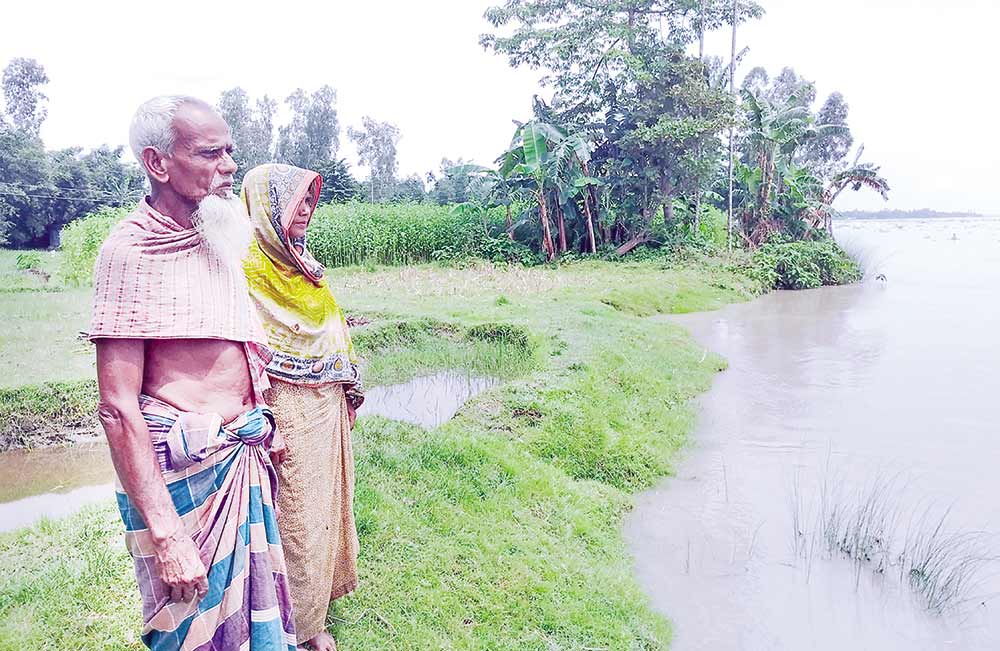 RAJARHAT, KURIGRAM, July 19: As erosion along the Teesta River intensifies in Kurigram's Rajarhat Upazila, many riverside families are living in fear of losing their last remaining homes.
"My house is surrounded by embankments everywhere except in front of my home. If this house is washed away, where will I go? Where will I live?" said Abdul Jalil, 65, a resident of Rati Mouza in Bidyananda union, standing beside the eroding riverbank with his wife Umme Kulsum Begum.
According to local residents, severe erosion has resumed in parts of Bidyananda and Gharialdanga unions as the Teesta's water level continues to rise and fall following upstream flows and recent rainfall.
Homes, cropland and riverbank areas are being swallowed by the river, while mosques, madrasas, schools and graveyards remain under threat.
Residents alleged that although geo-bags have been placed at some erosion-prone points, many have already been washed away, leaving vulnerable communities without effective protection.
Umme Kulsum said the family had already lost all their farmland to the river more than two decades ago.
"We came here after losing everything. Now only this homestead remains. If the river takes this too, we will have nowhere to go," she said.
Abdul Jalil said his son works at a garment factory and sends money home every month, which barely covers household expenses.
"We have no work here. I borrowed money to marry off my daughter. At night I can't sleep, fearing the river may take away our house at any moment," he said, urging the government to construct erosion protection in front of their home.
Another resident, Alam Mia, said only a small number of geo-bags had been dumped in the area, but those too were disappearing into the river.
"The mosque and the school are now under threat. We don't know when they will collapse into the river," he said.
Rajarhat Upazila Nirbahi Officer Tanzila Tasnim said the administration had inspected the affected areas and arranged for geo-bags to be placed at vulnerable points.
She said assistance from different government agencies was continuing and that applications were being accepted from displaced families without land so they could be considered for settlement on government khas land.
Loading...
Loading...
Also read



Editor : Iqbal Sobhan Chowdhury
Published by the Editor on behalf of the Observer Ltd. from Globe Printers, 24/A, New Eskaton Road, Ramna, Dhaka.
Editorial, News and Commercial Offices : Aziz Bhaban (2nd floor), 93, Motijheel C/A, Dhaka-1000.
Phone: PABX- 41053001-06; Advertisement: 41053012; 01793317829, 01550707291, E-mail: [email protected], [email protected] Online: email: [email protected] 41053014; 01550707297 Advertisement: 01550707296
Published by the Editor on behalf of the Observer Ltd. from Globe Printers, 24/A, New Eskaton Road, Ramna, Dhaka.
Editorial, News and Commercial Offices : Aziz Bhaban (2nd floor), 93, Motijheel C/A, Dhaka-1000.
Phone: PABX- 41053001-06; Advertisement: 41053012; 01793317829, 01550707291, E-mail: [email protected], [email protected] Online: email: [email protected] 41053014; 01550707297 Advertisement: 01550707296


