



| HEADLINE |

|
Bangladesh Wins Duty-Free Access for 8,428 Products to South Korea
Published : Wednesday, 5 August, 2026 at 12:00 AM
Business Correspondent


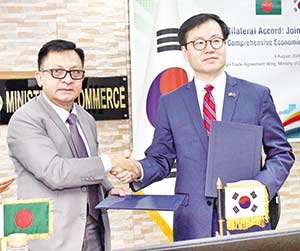 Bangladesh has secured immediate duty-free access for 8,428 products to the South Korean market under a landmark Comprehensive Economic Partnership Agreement (CEPA), marking one of the country's most significant trade breakthroughs as it prepares for the post-LDC era.
The agreement was signed at the Ministry of Commerce in Dhaka on Tuesday by Commerce Minister Khondkar Abdul Muktadir and South Korean Trade Minister Yeo Han-koo, paving the way for deeper trade, investment and technology cooperation between the two countries.
According to the Ministry of Commerce, the CEPA will grant Bangladesh duty-free market access for 8,428 products from the very first day it comes into force. In return, South Korea will enjoy immediate duty-free access for 1,054 products in the Bangladeshi market.
The agreement delivers a major boost to Bangladesh's export sector, with its flagship products�"including readymade garments, leather and leather goods, footwear, jute products and other manufactured items�"set to enter South Korea duty-free, significantly enhancing their competitiveness in one of Asia's largest high-income consumer markets.
Beyond trade in goods, the CEPA establishes a broad framework for economic cooperation. Bangladesh has committed to opening 95 service sub-sectors to South Korea, while Seoul will provide market access across 111 service sub-sectors under four modes of supply, creating new opportunities for businesses, professionals and service providers in both countries.
Officials believe the agreement will encourage a new wave of South Korean investment in Bangladesh, strengthen industrial cooperation, accelerate technology transfer and help integrate the country more deeply into regional and global supply chains.
Addressing a press briefing after the signing ceremony, Commerce Minister Khondkar Abdul Muktadir described the agreement as a milestone achieved in record time.
"Within the shortest possible time, we have been able to conclude a trade agreement with one of the world's major economies. Our government has accomplished this within five months," he said.
The minister noted that 97 per cent of Bangladeshi products would receive preferential tariff treatment under the CEPA, while 87 per cent of South Korean products would enjoy similar benefits in Bangladesh.
Describing South Korea's US$2 trillion economy as a vital trading partner, he said the agreement would create substantial opportunities for Bangladesh's export industries while ensuring smoother imports of essential industrial inputs, agricultural products, plastics, machinery and spare parts from South Korea.
"We want to transform Bangladesh into a US$1 trillion economy by 2034. To achieve that, we need sustained economic growth of around 8 per cent and significantly higher foreign investment. Agreements like this are crucial to attracting that investment," he said.
South Korean Trade Minister Yeo Han-koo said economic relations between the two nations began with textile trade 56 years ago and had steadily expanded over the decades.
"The global economy is now moving beyond traditional trade towards diversified products, advanced technologies and resilient supply chains. Our two countries must also broaden the scope of our trade and investment partnership," he said.
He expressed confidence that Bangladesh's new government would further strengthen the country's economic prospects and said South Korea was keen to deepen cooperation in advanced technology, manufacturing and supply-chain development.
Yeo also said the CEPA would make Bangladesh a more attractive destination for South Korean businesses by providing greater certainty and improved market conditions for long-term investment.
Although bilateral trade has expanded steadily in recent years, it remains well below its potential.
Total trade between the two countries currently stands at approximately US$1.39 billion, with Bangladesh exporting goods worth US$491.73 million and importing US$902.90 million, resulting in a trade deficit of about US$411 million.
Bangladesh's principal exports to South Korea include knitwear, woven garments, home textiles, leather and leather products, footwear, pharmaceuticals, jute and jute goods, frozen food and ceramics. Imports from South Korea mainly comprise iron and steel, industrial machinery, electrical equipment, plastics, chemicals, paper and paper products.
Trade officials believe the CEPA will help narrow the trade imbalance over time by expanding Bangladesh's export basket, attracting high-value investment and strengthening industrial competitiveness, while positioning the country more favourably in global value chains ahead of its graduation from least-developed country status.
Loading...
Loading...
Also read



Editor : Iqbal Sobhan Chowdhury
Published by the Editor on behalf of the Observer Ltd. from Globe Printers, 24/A, New Eskaton Road, Ramna, Dhaka.
Editorial, News and Commercial Offices : Aziz Bhaban (2nd floor), 93, Motijheel C/A, Dhaka-1000.
Phone: PABX- 41053001-06; Advertisement: 41053012; 01793317829, 01550707291, E-mail: [email protected], [email protected] Online: email: [email protected] 41053014; 01550707297 Advertisement: 01550707296
Published by the Editor on behalf of the Observer Ltd. from Globe Printers, 24/A, New Eskaton Road, Ramna, Dhaka.
Editorial, News and Commercial Offices : Aziz Bhaban (2nd floor), 93, Motijheel C/A, Dhaka-1000.
Phone: PABX- 41053001-06; Advertisement: 41053012; 01793317829, 01550707291, E-mail: [email protected], [email protected] Online: email: [email protected] 41053014; 01550707297 Advertisement: 01550707296


