



| HEADLINE |

|
Questions raised as Jamaat photo event excludes Zia's declaration and party's 1971 role
Published : Saturday, 8 August, 2026 at 7:24 PM
Observer Special Correspondent


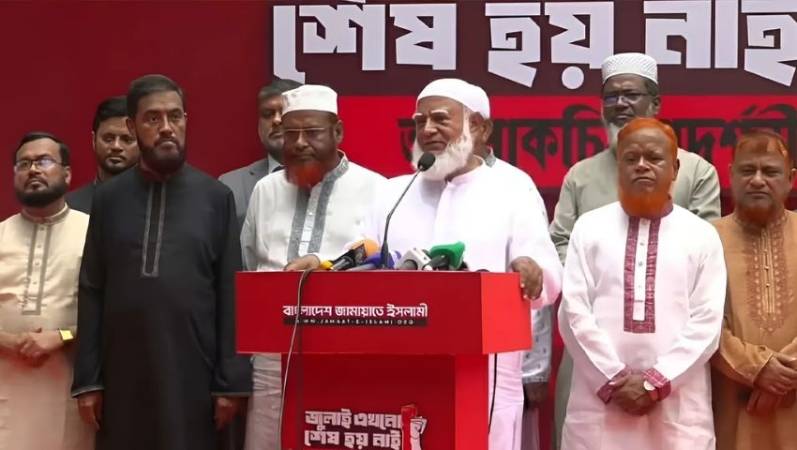
A new political controversy has erupted over a photo exhibition titled "July is not over yet," organized at the official residence of Jamaat-e-Islami Ameer Dr. Shafiqur Rahman.
Although the exhibition displayed photographs of the March 7 speech, the 1971 Liberation War, and various historical political movements, it omitted any photo, speech, or mention of the declaration of independence by Shaheed President Ziaur Rahman.
Similarly, the exhibition contained no discussion regarding Jamaat-e-Islami's own role during the 1971 Liberation War.
Major Ziaur Rahman contributed significantly in the liberation war of Bangladesh. However, his contribution was neglected and hidden during the previous Awami League regime.
Jamaat’s photo exhibition continues the ousted government’s legacy as it features Sheikh Mujibur Rahman yet Ziaur Rahman is missing. This has sparked widespread discussion and criticism across political circles and social media platforms.
Analysts argue that after August 5, Jamaat-e-Islami had managed to build a relatively positive political image among a section of the general public. However, presenting sensitive historical matters in such a controversial manner has negatively impacted that image.
Raising questions over the issue on Saturday (August 8), BNP Senior Joint Secretary General Ruhul Kabir Rizvi said excluding an important chapter of Liberation War history is not a mere coincidence; it carries political significance. He added that the incident has raised questions among the public regarding new political equations.
However, Jamaat Ameer Dr. Shafiqur Rahman claimed that the exhibition was not organized to present the complete history of Bangladesh. Instead, it aimed to highlight the continuity of public movements against authoritarian and fascist rule.
According to him, Ziaur Rahman was not included in the exhibition's content because he is not considered an authoritarian ruler.
This explanation by the Jamaat chief has raised fresh questions.
Questions are being raised from various quarters as to why Ziaur Rahman's heroic role and declaration of independence were entirely excluded despite featuring various historical events and personalities of the 1971 Liberation War.
Simultaneously, questions are being asked why there was no discussion on Jamaat-e-Islami's own political role during 1971 when references to Liberation War history were included.
Questions have also been raised among leaders of the National Citizen Party (NCP) regarding the exhibition.
Newly elected Member of Parliament for the Kurigram-2 constituency and NCP Central Joint Convener Dr. Atiq Mujahid said the exhibition was not created as a comprehensive history of Bangladesh's Liberation War. Rather, it primarily highlighted how the Awami League turned into an autocratic and authoritarian political force.
However, he admitted that if the complete history of Bangladesh were presented, Ziaur Rahman's declaration of independence should have definitely been included.
NCP Joint Convener Sarwar Tushar also made a brief comment, stating, "We want the undistorted history of the Liberation War."
Meanwhile, previous statements by the Jamaat Ameer regarding Ziaur Rahman's declaration of independence have resurfaced in discussions.
On December 16, 2024, during a Victory Day rally organized by Jamaat-e-Islami Dhaka Metropolitan South in Paltan, Shafiqur Rahman had questioned why Ziaur Rahman, who declared independence, was not given recognition. He also questioned when and where Sheikh Mujibur Rahman declared independence.
Comparing that previous statement with the complete absence of Ziaur Rahman's role in the current exhibition, many on social media are asking whether Jamaat-e-Islami's stance has changed.
Jamaat, however, claims there is no contradiction between the two statements. They maintain that the current exhibition's theme was authoritarian rule and the continuity of public resistance against it, rather than a comprehensive document of all Bangladeshi political history.
Overall, the "July is not over yet" exhibition is no longer confined to a debate over a photo display. It has brought Bangladesh's Liberation War history, the declaration of independence, historical narratives of the Awami League and BNP, and Jamaat-e-Islami's current political stance into a single debate.
Critics question how a political party presents sensitive historical chapters when it seeks to be part of new political equations, noting that historical presentation serves as a key benchmark for public acceptability.
In particular, political circles are emphasizing why such silence exists regarding Ziaur Rahman's role just a year and a half after questioning the lack of recognition for his declaration of independence in December 2024.
Although Jamaat claims there is no fundamental conflict between the exhibition's content and its past statements, questions remain about the consistency of its political stance.
On the other hand, the absence of Jamaat-e-Islami's own 1971 role in the exhibition has also become a key point of criticism. When Liberation War history is presented alongside political movements, transparency is expected regarding how controversial and uncomfortable chapters of that history are explained. Questions like "Is Jamaat-e-Islami still unwilling to accept itself as a pro-Liberation War force?" are gaining traction.
It remains difficult to predict how much this controversy will affect the newly formed positive image Jamaat-e-Islami built among a section of the public after August 5.
However, a section of political analysts believes that ambiguity on sensitive historical matters could create a new crisis of trust.
Ultimately, the debate is not limited to whose photo is included or excluded from a photo display. Rather, questions are being raised about whether Jamaat-e-Islami is redefining its position on the Liberation War and independence history in the new political reality, or if selective portions of history are being highlighted due to political strategy.
The answer will largely depend on how clear, consistent, and transparent Jamaat-e-Islami's position remains regarding the Liberation War, the declaration of independence, and its own role in 1971 in the future.
In Bangladeshi politics, history is not merely a matter of the past; it serves as a crucial foundation for present political legitimacy, public trust, and future political support.
Regardless of the Jamaat chief's explanation, public reactions suggest that the general public has not taken lightly the arrangement of an exhibition that ignores the declaration of independence and heroic contributions of Shaheed President Ziaur Rahman.
-TS/SA
Loading...
Loading...
Also read



Editor : Iqbal Sobhan Chowdhury
Published by the Editor on behalf of the Observer Ltd. from Globe Printers, 24/A, New Eskaton Road, Ramna, Dhaka.
Editorial, News and Commercial Offices : Aziz Bhaban (2nd floor), 93, Motijheel C/A, Dhaka-1000.
Phone: PABX- 41053001-06; Advertisement: 41053012; 01793317829, 01550707291, E-mail: [email protected], [email protected] Online: email: [email protected] 41053014; 01550707297 Advertisement: 01550707296
Published by the Editor on behalf of the Observer Ltd. from Globe Printers, 24/A, New Eskaton Road, Ramna, Dhaka.
Editorial, News and Commercial Offices : Aziz Bhaban (2nd floor), 93, Motijheel C/A, Dhaka-1000.
Phone: PABX- 41053001-06; Advertisement: 41053012; 01793317829, 01550707291, E-mail: [email protected], [email protected] Online: email: [email protected] 41053014; 01550707297 Advertisement: 01550707296


