



| HEADLINE |

|

The Missed Train
Will Bangladesh be able to board now?


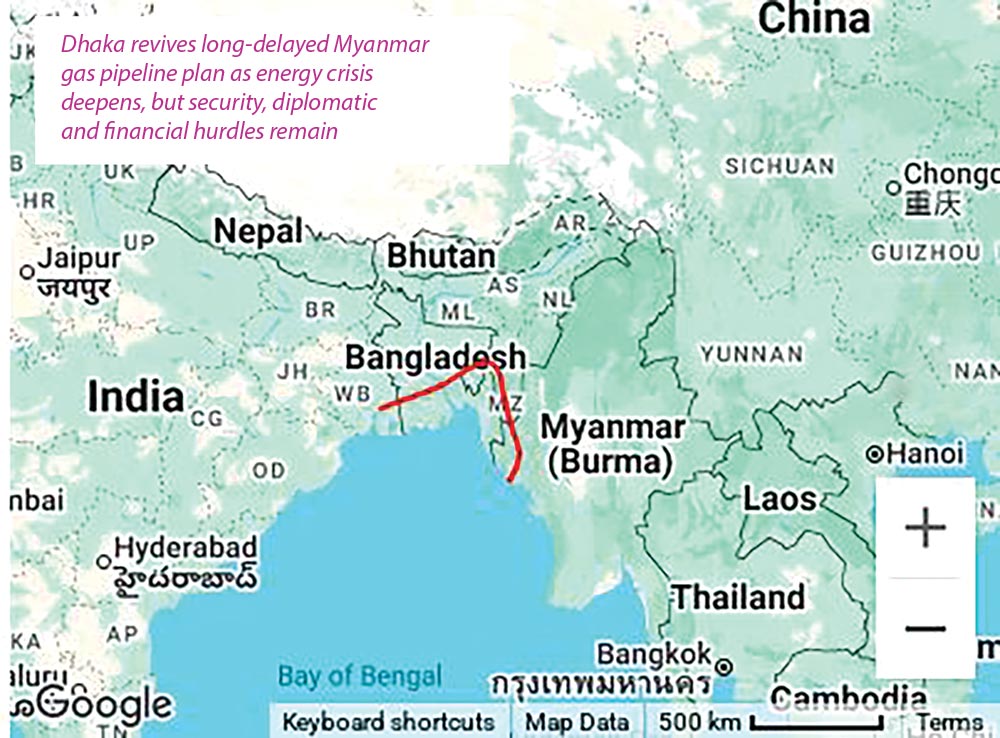 Bangladesh is once again looking to Myanmar for natural gas, reviving a nearly three-decade-old idea of importing the fuel through a cross-border pipeline as a deepening energy crisis cripples industries and strains power generation. But the renewed initiative also brings back memories of a missed opportunity-one that eventually saw Myanmar turn to China for the development of its gas resources.
Power, Energy and Mineral Resources Minister Iqbal Hassan Mahmood formally raised the proposal during a meeting with Myanmar Ambassador to Bangladesh U Kyaw Soe Moe at the Secretariat on August 2, 2026.
The initiative revives discussions that began in 1997, when Bangladeshi private firm Mohona Holdings first proposed a pipeline linking Myanmar’s gas fields to Bangladesh and potentially onward to India. Formal trilateral talks among Bangladesh, Myanmar and India began in 2004 but stalled the following year after Bangladesh attached conditions on transit access that India found unacceptable.
A DEEPENING ENERGY CRUNCH
Bangladesh’s urgency is unmistakable. Domestic gas production has fallen to around 1.65 billion cubic feet per day-1.05 billion cubic feet below the 2017 level-while demand continues to rise.
The crisis worsened on July 21, 2026, when a fire forced the closure of one of the country’s LNG import terminals.
“We have substantial demand for natural gas and are particularly interested in securing supplies from Myanmar through a pipeline,” Minister Mahmood said during the meeting.
Both sides agreed to pursue further discussions through the Bangladesh-Myanmar Joint Technical Committee, with ministerial-level meetings also being considered. Mahmood said he would formally invite Myanmar’s energy minister to visit Bangladesh and expressed his willingness to travel to Myanmar if necessary.
The proposal, however, remains at a preliminary stage. Gas availability, pricing, pipeline routes, security arrangements and financing mechanisms have yet to be determined.
 THE MISSED OPPORTUNITY
The idea of bringing Myanmar gas to Bangladesh and India dates back to 1997, when Mohona Holdings proposed a pipeline from Myanmar’s offshore fields through Bangladesh to India. At the time, the Bangladeshi government showed limited enthusiasm, believing domestic gas reserves would be sufficient for decades.
The proposal gained momentum in the early 2000s as Indian oil and gas companies, including GAIL, ONGC Videsh and Essar, invested heavily in Myanmar’s hydrocarbon sector. India, facing growing energy demand, pursued the pipeline to secure gas from Myanmar’s newly discovered offshore fields.
In January 2005, Bangladesh, India and Myanmar reached an agreement in principle on the trilateral project.
The project was estimated to cost $1 billion, with India bearing most of the expense and around $350 million invested in Bangladesh. Bangladesh was expected to receive nearly $100 million annually in carrier fees, a one-time $100 million right-of-way charge and $25 million a year for management participation. It would also have had the option to withdraw gas for domestic use.
But the agreement broke down after Bangladesh attached additional conditions.
Dhaka demanded a corridor through Indian territory to import hydroelectricity from Nepal and Bhutan, unhindered access for merchandise moving between Bangladesh, Nepal and Bhutan through India, and measures to reduce the bilateral trade deficit. At the time, Bangladesh imported around $1.8 billion worth of Indian products while exporting only about $144 million.
India declined to negotiate these issues within the trilateral gas pipeline forum, and Bangladesh withdrew from the project in 2006.
CHINA STEPS IN
Following Bangladesh’s withdrawal, India explored an alternative route bypassing Bangladesh through Mizoram, Tripura, Assam, Siliguri and Kolkata. The route would have been 500 kilometres longer and increased construction costs by around Tk 2,500 crore, or roughly $250 million at the time. Security concerns over militant activities in Assam and Garo rebel areas added to the complications.
Myanmar, meanwhile, did not wait indefinitely.
In late 2008, it signed an agreement with China. Daewoo International, the Korean company that discovered the Shwe, Shwephu and Mia gas fields, signed a deal with China National Petroleum Corporation (CNPC) to develop them with $5.6 billion in investment.
A SECOND CHANCE
The 2026 proposal would connect Myanmar’s gas fields to Chattogram. But the circumstances are very different from those surrounding the original project.
The most significant obstacle is the security situation in Myanmar’s Rakhine State. The Arakan Army, an ethnic armed organisation, now controls almost the entire Bangladesh-Myanmar border region, raising fundamental questions over pipeline security.
The Rohingya crisis is another major complication. Diplomatic tensions between Bangladesh and Myanmar remain strained, while Myanmar has yet to agree to repatriate Rohingya refugees who fled to Bangladesh following military operations in Rakhine State. A genocide case against Myanmar is also pending before international courts.
Some analysts have warned that an energy cooperation agreement with Myanmar could weaken Bangladesh’s position on the Rohingya issue, while others argue that economic engagement could provide leverage for diplomatic progress.
Against this backdrop, the August 2 meeting provided a framework for further discussion. The Joint Technical Committee is expected to examine technical feasibility, routes and financial logistics, while ministerial-level talks could address broader political and diplomatic obstacles.
Comprehensive feasibility studies will also be needed to assess gas availability, pricing, transportation routes and the project’s economic costs and benefits.
ENERGY AND REGIONAL CONNECTIVITY
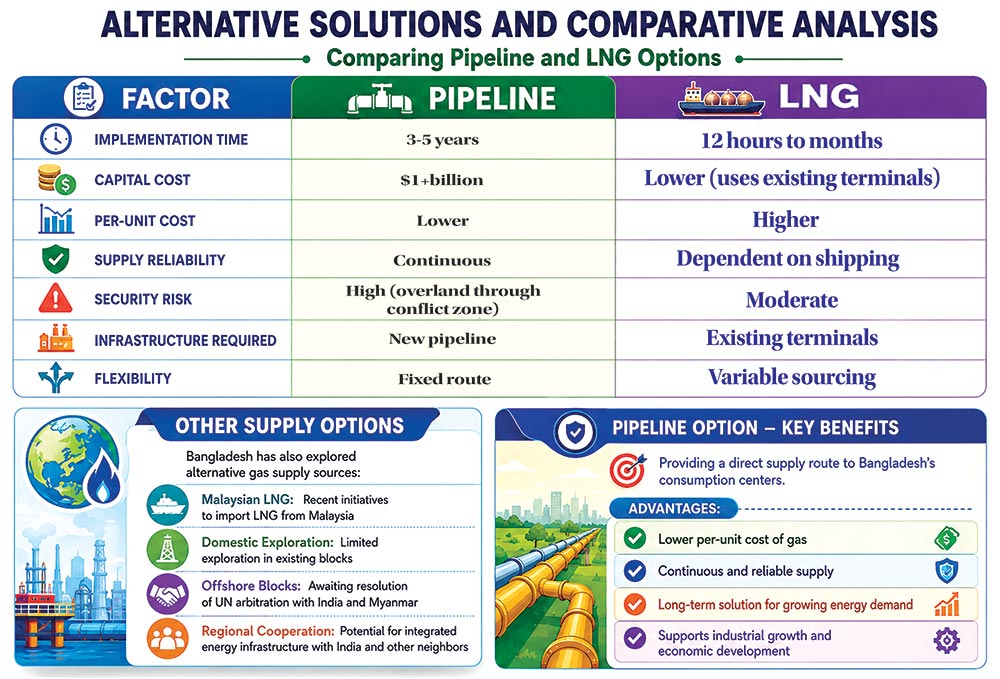
Energy experts caution that Myanmar gas cannot provide an immediate answer to Bangladesh’s current shortage, even under favourable conditions. A cross-border pipeline would take years to build, while Myanmar’s political and security situation would need to stabilise significantly before construction could safely begin.
The proposal also sits within a wider regional infrastructure picture. India’s Hydrocarbon Vision 2030 envisions up to 6,900 kilometres of gas pipelines connecting northeastern states, West Bengal, Chittagong and Sittwe in Myanmar, with 13 routes proposed under the broader vision.
Bangladesh already has energy infrastructure cooperation with India. Indian Oil Corporation and Bangladesh Petroleum Corporation agreed in April 2016 to jointly develop an LPG terminal in Chittagong. Numaligarh Refinery Ltd also signed an agreement with Bangladesh Petroleum Corporation to build a pipeline from Siliguri to Parbatipur to supply High Speed Diesel to Bangladesh.
During the August 2 meeting, Mahmood also referred to a proposed China-Myanmar-Bangladesh economic corridor discussed during Prime Minister Tarique Rahman’s recent visit to China. He suggested that a Bangladesh-Myanmar pipeline could support wider regional connectivity.
This makes the proposal about more than gas alone. Energy infrastructure could become part of broader efforts to expand trade, investment and connectivity across South and Southeast Asia.
CAN BANGLADESH BOARD THIS TIME?
The revival of the Myanmar-Bangladesh-India gas pipeline idea offers Bangladesh another opportunity to pursue an alternative source of energy amid a mounting crisis. But the obstacles are formidable, ranging from security and diplomatic tensions to gas availability, financing and the long construction timeline.
Energy experts agree that Bangladesh should proceed cautiously but actively. Data from Myanmar’s Ministry of Energy, the World Bank and the International Energy Agency show that Myanmar possesses proven natural gas reserves of approximately 22 trillion cubic feet.
For Bangladesh, the lesson from the past is clear: a second chance requires more than reviving an old proposal. Detailed feasibility studies will be essential before any commitment is made, with the project assessed on its technical, economic and political merits and with its risks fully considered.

Loading...
Loading...
Also read




Editor : Iqbal Sobhan Chowdhury
Published by the Editor on behalf of the Observer Ltd. from Globe Printers, 24/A, New Eskaton Road, Ramna, Dhaka.
Editorial, News and Commercial Offices : Aziz Bhaban (2nd floor), 93, Motijheel C/A, Dhaka-1000.
Phone: PABX- 41053001-06; Advertisement: 41053012; 01793317829, 01550707291, E-mail: [email protected], [email protected] Online: email: [email protected] 41053014; 01550707297 Advertisement: 01550707296
Published by the Editor on behalf of the Observer Ltd. from Globe Printers, 24/A, New Eskaton Road, Ramna, Dhaka.
Editorial, News and Commercial Offices : Aziz Bhaban (2nd floor), 93, Motijheel C/A, Dhaka-1000.
Phone: PABX- 41053001-06; Advertisement: 41053012; 01793317829, 01550707291, E-mail: [email protected], [email protected] Online: email: [email protected] 41053014; 01550707297 Advertisement: 01550707296


