



| HEADLINE |

|

City dwellers struggle to make ends meet
Published : Saturday, 15 August, 2026 at 12:00 AM
Simanta Bardhan


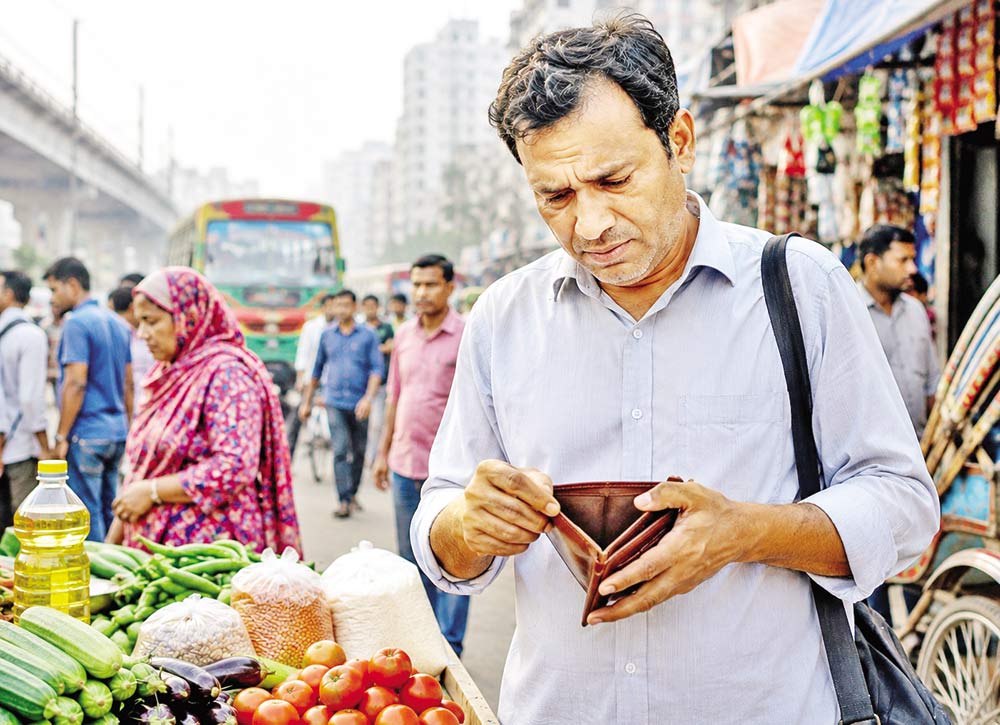 Uzzal Hossain Rahat works as a sales manager at a private firm in Dhaka. For many years, he supported his family comfortably with his monthly salary. But today, he finds this almost impossible. Despite having a steady job, the rising cost of living has pushed him into a very difficult corner. While his salary stays the same, the prices in the market keep growing every day. This pressure is not just about money; it is a constant worry about the future of his children. His story is like many others in the city who carry a heavy and silent burden.
In August 2026, the battle to afford basic food has become a daily reality for residents in cities like Dhaka. The prices of essential items that provide protein are rising every week. For example, a kilogramme of broiler chicken now costs between 190 and 200 Taka. Only seven days ago, it was much cheaper. A dozen eggs now cost up to 150 Taka, and a litre of milk is 110 Taka. For people like Sohel Ahmed, a resident of Jatrabari, every trip to the market is a shock. He says that he can no longer manage the costs of his household. Mothers like Ruma Akter are now forced to calculate every single egg they buy for their children.
When food becomes this expensive, it is not just an economic issue; it is a humanitarian crisis.
The pressure on city dwellers increased significantly in June 2026. This was when electricity prices were raised by an average of 16.7%. This change hit the poorest people very hard. Even those who use very little electricity, known as lifeline customers, saw their bills rise by nearly 15%. This hike in power costs makes everything else more expensive too. When factories and shops have to pay more for electricity, they pass those costs on to the customers by raising the prices of their goods. Experts say this was a very fast decision that has put a massive burden on people who were already struggling with high costs for fuel and gas.
If we look back to March 2026, we can see that the problem was already growing. The general inflation rate at that time was 8.71%.
The situation is particularly painful for the middle class. In the city, housing is the most expense. Many families spend between 40% and 50% of their total income just to pay their house rent. Data from the Consumers Association of Bangladesh (CAB) indicates that house rents in Dhaka have risen by 400 percent over the past 25 years.
After paying for their home, they spend about 55% of what is left on food. This leaves almost no money for the education of their children or for visits to the doctor. Many of these people belong to families that were once self-sufficient. Now, they are forced to borrow money to survive. Statistics show that about 80% of families cannot earn enough to meet their needs and one-third of them are now living on loans. Because they want to maintain their social status, they do not tell their neighbours about their struggles. This "silent agony" is a heavy weight that many carry every day.
Asked how the current rise in food and electricity prices could further affect inflation, Professor Dr. Mohammad Safiqul Islam of Jahangirnagar University said the country's inflation rate is currently between 10% and 11%. He said the country is currently facing shortages of fuel oil and gas for various reasons. Although the government is trying in different ways to manage the pressure, the shortages of fuel and gas have increased production, transportation and other related costs. As a result, he warned that inflation could rise further in the coming days.
Asked what steps the government could take to reduce the pressure on low and middle-income people, he said the government has already introduced programmes such as the Family Card and Farmer Card. These initiatives are expected to provide temporary relief to some people. However, he stressed that in the long run, the economy needs to be strengthened to tackle the pressure of inflation. Alongside infrastructure development, the government should prioritise productive industries so that new employment opportunities can be created.
Loading...
Loading...
Also read



Editor : Iqbal Sobhan Chowdhury
Published by the Editor on behalf of the Observer Ltd. from Globe Printers, 24/A, New Eskaton Road, Ramna, Dhaka.
Editorial, News and Commercial Offices : Aziz Bhaban (2nd floor), 93, Motijheel C/A, Dhaka-1000.
Phone: PABX- 41053001-06; Advertisement: 41053012; 01793317829, 01550707291, E-mail: [email protected], [email protected] Online: email: [email protected] 41053014; 01550707297 Advertisement: 01550707296
Published by the Editor on behalf of the Observer Ltd. from Globe Printers, 24/A, New Eskaton Road, Ramna, Dhaka.
Editorial, News and Commercial Offices : Aziz Bhaban (2nd floor), 93, Motijheel C/A, Dhaka-1000.
Phone: PABX- 41053001-06; Advertisement: 41053012; 01793317829, 01550707291, E-mail: [email protected], [email protected] Online: email: [email protected] 41053014; 01550707297 Advertisement: 01550707296


