



| HEADLINE |

|

James Webb detects water near Milky Way
Published : Wednesday, 19 August, 2026 at 4:50 PM
Observer Online Report


Collected Photo
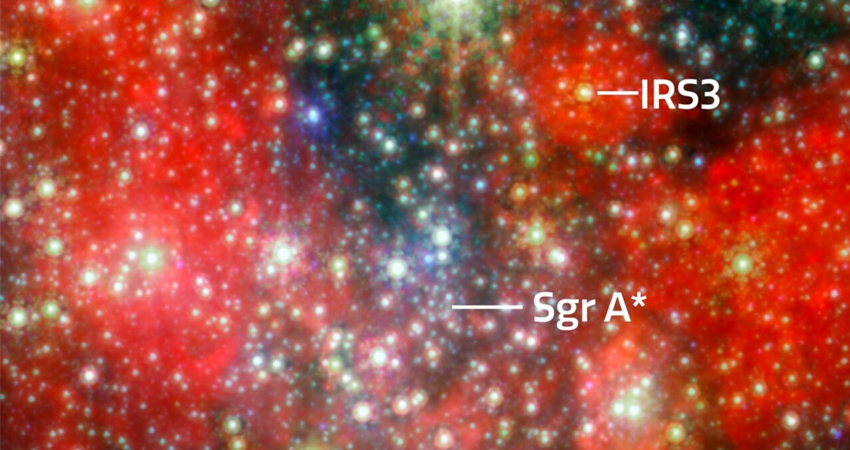
Astronomers using the James Webb Space Telescope have discovered water and cosmic dust around a dying giant star near the Milky Way's central super-massive black hole.
The star, designated IRS 3, is currently transitioning into a white dwarf and shedding its outer layers into space. Despite the extreme radiation surrounding the galactic core, scientists detected molecular water and rich silicates within the star's expanding envelope.
IRS 3 is located near the galactic center after forming roughly 16 light-years away and migrating inward. It is six times more massive than the Sun, estimated to be 72 million years old, and maintains a surface temperature of 2,800 Kelvin.
The star's powerful stellar winds propel its outer layers outward at 15 kilometers per second. This activity has generated a massive dust cloud spanning 10,000 astronomical units around the star.
Macarena Garcia Marin, a European Space Agency scientist for JWST's MIRI instrument, noted that this marks the first continuous mid-infrared spectrum collected from the star.
She explained that detecting water proves molecular matter can withstand intense radiation environments. The findings confirm that stars close to super-massive black holes can continuously cycle material back into their surrounding interstellar medium.
-SA/NS
Loading...
Loading...
Also read








Editor : Iqbal Sobhan Chowdhury
Published by the Editor on behalf of the Observer Ltd. from Globe Printers, 24/A, New Eskaton Road, Ramna, Dhaka.
Editorial, News and Commercial Offices : Aziz Bhaban (2nd floor), 93, Motijheel C/A, Dhaka-1000.
Phone: PABX- 41053001-06; Advertisement: 41053012; 01793317829, 01550707291, E-mail: [email protected], [email protected] Online: email: [email protected] 41053014; 01550707297 Advertisement: 01550707296
Published by the Editor on behalf of the Observer Ltd. from Globe Printers, 24/A, New Eskaton Road, Ramna, Dhaka.
Editorial, News and Commercial Offices : Aziz Bhaban (2nd floor), 93, Motijheel C/A, Dhaka-1000.
Phone: PABX- 41053001-06; Advertisement: 41053012; 01793317829, 01550707291, E-mail: [email protected], [email protected] Online: email: [email protected] 41053014; 01550707297 Advertisement: 01550707296


