



| HEADLINE |

|

Gaza’s healthcare system in deep crisis
Published : Tuesday, 25 August, 2026 at 1:30 PM
Observer Online Report


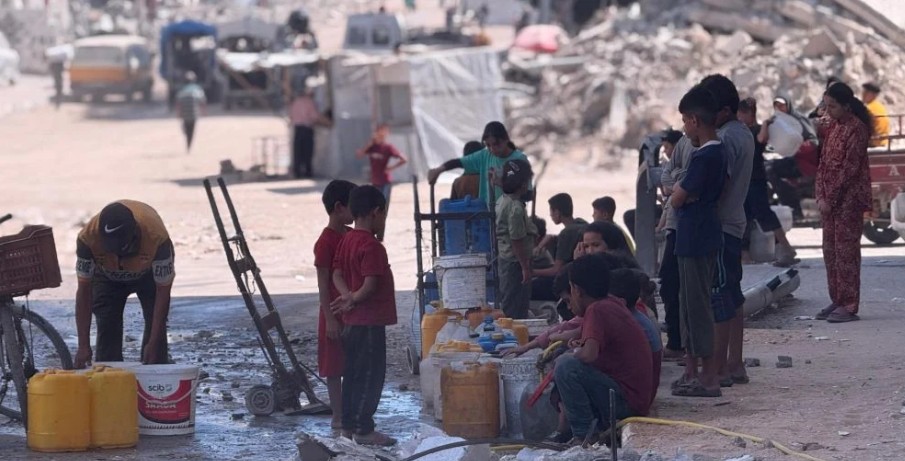
Gaza’s healthcare system is struggling to provide even basic medical services as hospitals remain damaged and essential facilities, medicines and healthcare workers are in short supply.
The crisis is deepening despite receiving less international attention than before. Hospitals are operating with limited capacity, while many displaced people struggle to reach medical facilities.
The crisis is particularly severe in displacement camps, where poor sanitation, lack of safe drinking water and extreme weather are worsening health conditions.
A recent visit to an informal camp built around the ruins of Hasan Salama School in Gaza City’s Nasr area found hundreds of displaced people living in tents on the school grounds and in the remaining buildings. No organisation runs the camp, leaving residents without regular access to essential services, including healthcare.
The school was bombed in August 2024 along with the nearby Nasr School, killing at least 30 people.
Healthcare workers from a local private clinic recently provided free medical consultations at the camp, treating at least 150 patients in one day. They found chronic conditions such as high blood pressure, diabetes and kidney disease, as well as hepatitis and scabies. Children were also suffering from chickenpox, gastroenteritis, diarrhoea and respiratory infections.
For many displaced people, reaching a doctor has become extremely difficult because of transport costs, long distances, exhaustion and extreme heat. As a result, many delay seeking treatment even when they urgently need it.
One 46-year-old man, whose leg was severely injured by shrapnel and who needs crutches to walk, was also suffering from high blood pressure. Although nearby Al-Rantisi Hospital is partially operational, it mainly treats children and cancer patients. Travelling to another hospital would cost him at least $8, which is unaffordable for many displaced families struggling to secure daily meals.
Before the war, the UN agency for Palestinian refugees, UNRWA, operated 22 clinics across Gaza. Only six are currently functioning.
Of Gaza’s 34 hospitals, just 19 are partially operational. Most wards remain closed because of the destruction. There are now only about 2,200 hospital beds for nearly two million people. Al-Shifa Hospital alone had 700 beds before the war.
Laboratory services, surgery and other medical facilities are also severely limited. Hospitals face shortages of essential equipment and medicines, as well as a lack of healthcare workers.
Restoring healthcare in Gaza will require more than rebuilding hospitals. Primary healthcare centres also need to be reopened, while urgent medical services must be taken directly to vulnerable people living in displacement camps.
Source: Al Jazeera
SKS
Loading...
Loading...
Also read



Editor : Iqbal Sobhan Chowdhury
Published by the Editor on behalf of the Observer Ltd. from Globe Printers, 24/A, New Eskaton Road, Ramna, Dhaka.
Editorial, News and Commercial Offices : Aziz Bhaban (2nd floor), 93, Motijheel C/A, Dhaka-1000.
Phone: PABX- 41053001-06; Advertisement: 41053012; 01793317829, 01550707291, E-mail: [email protected], [email protected] Online: email: [email protected] 41053014; 01550707297 Advertisement: 01550707296
Published by the Editor on behalf of the Observer Ltd. from Globe Printers, 24/A, New Eskaton Road, Ramna, Dhaka.
Editorial, News and Commercial Offices : Aziz Bhaban (2nd floor), 93, Motijheel C/A, Dhaka-1000.
Phone: PABX- 41053001-06; Advertisement: 41053012; 01793317829, 01550707291, E-mail: [email protected], [email protected] Online: email: [email protected] 41053014; 01550707297 Advertisement: 01550707296


