



| HEADLINE |

|
Circus fades, performers switch professions
Permit hassles, shrinking audiences and shortage of performers push the once-popular entertainment to the brink
Published : Saturday, 19 September, 2026 at 12:00 AM
Our Correspondent


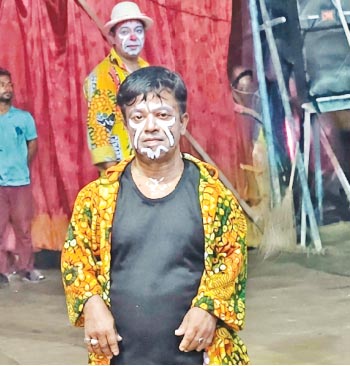 SHERPUR, BOGURA, Sept 18: Once, a fair in Bangladesh was almost synonymous with the circus.
Huge tents, colourful lights, microphone announcements and drumbeats would fill fairgrounds. As evening fell, families would rush to the circus tent to watch rope-walking, motorcycle stunts and other daring acts.
But times have changed, and so have people's entertainment choices. The circus has lost much of its former appeal, with permit complications, cancelled fairs, declining audiences, a shortage of performers and growing demand for dance and music pushing the industry towards extinction.
The Lion Circus of Nawabganj, Dhaka, is one example. The troupe has been performing across the country for more than 120 years. It is currently staging shows at a fair in Kalyani area of Sughata Union in Sherpur Upazila of Bogura.
Suman, who has worked with the circus for years, said the industry was now on the verge of extinction.
“There used to be around 40 to 42 circuses in the country. Now the number has fallen to 17 or 18. Only five or six operate regularly,” he said.
Many circuses shut down during the Covid-19 pandemic and have yet to recover, he added.
According to Suman, obtaining permission has become the biggest obstacle. In some places, authorities approve fairs but do not permit entertainment activities, making it impossible for circuses to operate. Fairs are also sometimes cancelled following political disputes or clashes, leaving performers without work.
He urged authorities to allow circuses to operate whenever fairs are approved.
“If a fair is allowed, the circus should also be allowed to operate. That is the only way this art can survive,” he said.
Circus performers once worked for nearly 11 months a year, travelling to different parts of the country. Now, due to permit problems, they cannot perform regularly even for six months.
Shuklal, a circus performer from Madhukhali in Faridpur, said the situation was very different 10 to 12 years ago.
“We could perform for up to 11 months a year. Now it is difficult to work even for six months. As fairs do not take place for much of the year, performers are being forced to switch professions,” he said.
A general circus worker once earned around Tk 12,000 a month, while skilled performers earned Tk 20,000 to Tk 30,000. With shows now irregular, however, many performers have uncertain incomes.
Changing audience preferences have added to the crisis.
Shuklal said audiences were now more interested in dance and music than circus acts.
“The demand for vulgar dance performances has increased, pushing the actual circus acts into the background,” he said.
To attract audiences, circus owners often have to arrange dance performances, reducing the prominence of traditional acts.
Rima Akter Eti, another performer, has been involved in the circus since childhood. Her parents were also circus performers. After their deaths, she continued in the profession, and her family depends on her income.
She said audiences often start demanding dance performances after watching only a few circus acts.
“If there is no audience, there is no income. So owners are often forced to cater to the audience's demands,” she said.
With circuses closed for much of the year, performers are increasingly taking up other jobs. Some work in garments factories, some drive auto-rickshaws and others have found different occupations.
Singer Liza Sarker, who has been associated with the circus for around 15 years, said she would not encourage her children to join the profession.
“My children are studying. I will not bring them into this profession,” she said.
Wild animals such as tigers and bears were once major circus attractions. But legal restrictions have made it difficult for circuses to feature them. Many traditional acts have also disappeared, reducing the variety of performances.
The Lion Circus, with a history of more than 120 years, has entertained generations across the country. Preserving that legacy, however, has now become a major challenge.
The performers say they mainly need permission to operate legally, better coordination between fairs and entertainment activities, and government support.
“If circus owners contact the upazila administration directly, we will look into the matter and try to provide assistance,” said Saifuzzaman Himu, Upazila Nirbahi Officer.
Loading...
Loading...
Also read



Editor : Iqbal Sobhan Chowdhury
Published by the Editor on behalf of the Observer Ltd. from Globe Printers, 24/A, New Eskaton Road, Ramna, Dhaka.
Editorial, News and Commercial Offices : Aziz Bhaban (2nd floor), 93, Motijheel C/A, Dhaka-1000.
Phone: PABX- 41053001-06; Advertisement: 41053012; 01793317829, 01550707291, E-mail: [email protected], [email protected] Online: email: [email protected] 41053014; 01550707297 Advertisement: 01550707296
Published by the Editor on behalf of the Observer Ltd. from Globe Printers, 24/A, New Eskaton Road, Ramna, Dhaka.
Editorial, News and Commercial Offices : Aziz Bhaban (2nd floor), 93, Motijheel C/A, Dhaka-1000.
Phone: PABX- 41053001-06; Advertisement: 41053012; 01793317829, 01550707291, E-mail: [email protected], [email protected] Online: email: [email protected] 41053014; 01550707297 Advertisement: 01550707296


