



| HEADLINE |

|
55pc of Bangladesh’s knitwear factories see orders cut; Four A bucks trend
Published : Tuesday, 22 September, 2026 at 1:14 PM
Tanjeem


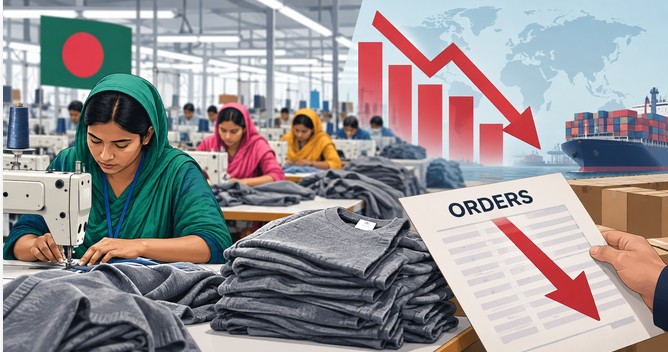
Bangladesh’s worsening gas and power shortages are disrupting production across the garment industry, with 55 per cent of knitwear factories reporting cancelled or reduced orders from buyers.
But one supplier to global brands such as Walmart, Gap and Next is bucking the trend by keeping production largely uninterrupted.
Four A Yarn Dyeing, located on the outskirts of Dhaka, continues to operate without major disruption despite the country’s intensifying energy crisis. Workers at the factory are regularly producing hoodies and attaching international brand logos to garments.
The company’s ability to maintain production is largely attributed to its diversified power sources. Four A Yarn Dyeing has generated its own electricity since 2019, including through solar power-- a setup that remains relatively uncommon in Bangladesh’s garment industry.
Bangladesh, the world’s second-largest readymade garment exporter after China, is currently facing an acute energy crunch, with the ongoing crisis in the Middle East adding further pressure. the order of per cent said that
Factories surveyed also reported delays in shipments and receiving lower-priced orders from buyers.
Four A Yarn Dyeing, however, has so far avoided those difficulties. The factory employs around 7,500 workers and meets about 40 per cent of its electricity needs through solar power. Most of the remainder comes from its own gas- and diesel-powered generation facilities.
“We have never depended on a single source of energy. We always had alternatives for everything,” said Abdullahil Naqib, one of the company’s owners.
“We need some certainty. However, the cost of running the business has increased. First there was an oil shortage, and then came the gas shortage,” he said.
Higher fuel prices have increased Four A Yarn Dyeing’s production costs by 2-3 per cent, with its monthly energy bill rising by as much as Tk 5 million, according to Naqib.
Pressure on garment manufacturers intensified on Monday after Bangladesh raised fuel prices by up to 17.4 per cent. The government said the increase was necessary because of higher global fuel prices and rising transportation costs linked to the conflict in the Middle East.
To reduce the impact of future power and fuel disruptions, Four A Yarn Dyeing is planning to install large-scale battery storage at its factory. The batteries would allow production to continue for several hours when problems arise with other power sources.
“We have been able to absorb the additional costs, but that is not possible for every factory,” Naqib said.
Almost the entire roof of the factory is covered with solar panels.
The energy crisis is also putting pressure on Bangladesh’s broader power and energy sector. The power minister said last week that rising costs of imported gas were slowing industrial development, disrupting electricity supplies and forcing cuts in development spending because of increased subsidies for gas.
Bangladesh’s ready-made garment sector accounts for more than 80 per cent of the country’s total export earnings. The industry employs around four million people and contributes roughly 10 per cent to gross domestic product.
Energy shortages are also forcing some garment manufacturers to bear additional costs to meet shipment deadlines, including sending goods by air. Others are offering discounts to buyers to ensure timely delivery.
“We already operate on very thin margins. Higher energy prices will put those margins under even greater pressure,” said garment exporter Shahidullah Azim.
“Even as production and transportation costs rise, it is becoming increasingly difficult for us to remain competitive,” he said.
But one supplier to global brands such as Walmart, Gap and Next is bucking the trend by keeping production largely uninterrupted.
Four A Yarn Dyeing, located on the outskirts of Dhaka, continues to operate without major disruption despite the country’s intensifying energy crisis. Workers at the factory are regularly producing hoodies and attaching international brand logos to garments.
The company’s ability to maintain production is largely attributed to its diversified power sources. Four A Yarn Dyeing has generated its own electricity since 2019, including through solar power-- a setup that remains relatively uncommon in Bangladesh’s garment industry.
Bangladesh, the world’s second-largest readymade garment exporter after China, is currently facing an acute energy crunch, with the ongoing crisis in the Middle East adding further pressure. the order of per cent said that
A significant portion of the country’s electricity generation depends on natural gas, furnace oil and diesel, leaving industrial production vulnerable to disruptions in fuel supplies.
According to a recent survey of 134 knitwear factories, 55 per cent said they had experienced order cancellations or reductions by buyers because of gas and power shortages since late August. Some 78 per cent said they had been forced to partially suspend production.
Factories surveyed also reported delays in shipments and receiving lower-priced orders from buyers.
Four A Yarn Dyeing, however, has so far avoided those difficulties. The factory employs around 7,500 workers and meets about 40 per cent of its electricity needs through solar power. Most of the remainder comes from its own gas- and diesel-powered generation facilities.
“We have never depended on a single source of energy. We always had alternatives for everything,” said Abdullahil Naqib, one of the company’s owners.
“We need some certainty. However, the cost of running the business has increased. First there was an oil shortage, and then came the gas shortage,” he said.
Higher fuel prices have increased Four A Yarn Dyeing’s production costs by 2-3 per cent, with its monthly energy bill rising by as much as Tk 5 million, according to Naqib.
Pressure on garment manufacturers intensified on Monday after Bangladesh raised fuel prices by up to 17.4 per cent. The government said the increase was necessary because of higher global fuel prices and rising transportation costs linked to the conflict in the Middle East.
To reduce the impact of future power and fuel disruptions, Four A Yarn Dyeing is planning to install large-scale battery storage at its factory. The batteries would allow production to continue for several hours when problems arise with other power sources.
“We have been able to absorb the additional costs, but that is not possible for every factory,” Naqib said.
Almost the entire roof of the factory is covered with solar panels.
The energy crisis is also putting pressure on Bangladesh’s broader power and energy sector. The power minister said last week that rising costs of imported gas were slowing industrial development, disrupting electricity supplies and forcing cuts in development spending because of increased subsidies for gas.
Bangladesh’s ready-made garment sector accounts for more than 80 per cent of the country’s total export earnings. The industry employs around four million people and contributes roughly 10 per cent to gross domestic product.
Energy shortages are also forcing some garment manufacturers to bear additional costs to meet shipment deadlines, including sending goods by air. Others are offering discounts to buyers to ensure timely delivery.
“We already operate on very thin margins. Higher energy prices will put those margins under even greater pressure,” said garment exporter Shahidullah Azim.
“Even as production and transportation costs rise, it is becoming increasingly difficult for us to remain competitive,” he said.
Azim said a Canadian buyer that had initially planned to place an order for 25,000 pieces ultimately ordered only 8,000, citing declining buyer confidence in Bangladesh’s operating environment as one of the reasons.
For many manufacturers, however, the biggest concern is not the higher fuel price itself but the continuing gas shortages and power disruptions.
Mohiuddin Rubel, additional managing director of Denim Expert Ltd, said such problems were relatively less severe in competing garment-producing countries such as Vietnam and India.
“Whether we can maintain our position against other sourcing countries or fall behind them will depend on how effectively we can manage this situation,” Rubel added.
Loading...
Loading...
Also read







Editor : Iqbal Sobhan Chowdhury
Published by the Editor on behalf of the Observer Ltd. from Globe Printers, 24/A, New Eskaton Road, Ramna, Dhaka.
Editorial, News and Commercial Offices : Aziz Bhaban (2nd floor), 93, Motijheel C/A, Dhaka-1000.
Phone: PABX- 41053001-06; Advertisement: 41053012; 01793317829, 01550707291, E-mail: [email protected], [email protected] Online: email: [email protected] 41053014; 01550707297 Advertisement: 01550707296
Published by the Editor on behalf of the Observer Ltd. from Globe Printers, 24/A, New Eskaton Road, Ramna, Dhaka.
Editorial, News and Commercial Offices : Aziz Bhaban (2nd floor), 93, Motijheel C/A, Dhaka-1000.
Phone: PABX- 41053001-06; Advertisement: 41053012; 01793317829, 01550707291, E-mail: [email protected], [email protected] Online: email: [email protected] 41053014; 01550707297 Advertisement: 01550707296


