



| HEADLINE |

|
Viral online claims misrepresent real history of 'Sammi Meri Waar'
Published : Thursday, 24 September, 2026 at 1:23 PM
Observer Online Report


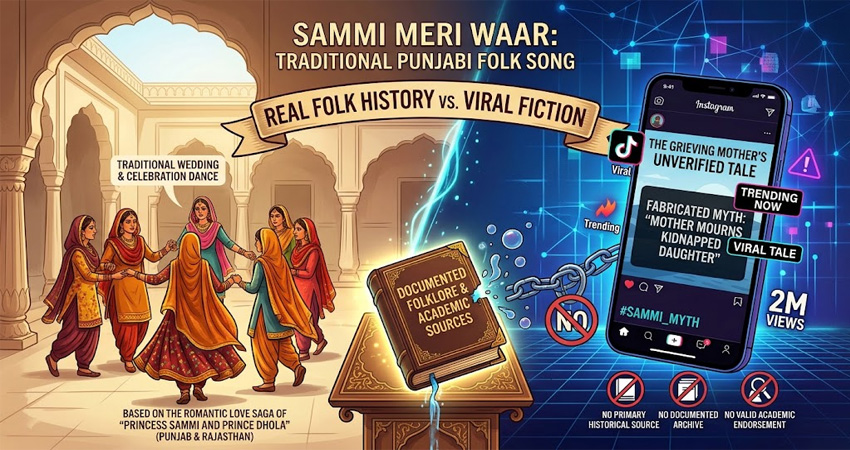
AI Illustration
A viral social media trend has falsely attributed an emotional story of child abduction to the iconic Punjabi folk song "Sammi Meri Waar," contradicting established cultural and academic records.
Short-video platforms including Instagram and TikTok have recently been flooded with posts claiming that the traditional song depicts a grieving mother mourning her daughter kidnapped by "a cruel person." These viral posts, often accompanied by short vocal covers, provide no citation from historical texts, folklorists, or archived records.
Historians and regional archives confirm that the tradition of Sammi originates from a celebrated romantic legend. According to Encyclopedia Britannica, the slow and rhythmic folk dance is rooted in the tragic love saga of Princess Sammi and Prince Dhola, placing it within the broader Dhola-Maru romantic ballad tradition across Punjab and Rajasthan.
The song gained widespread international popularity following its performance on Coke Studio Pakistan in August 2015 by vocalists Quratulain Balouch and Umair Jaswal. At the time of its release, the track was described as a traditional celebration song performed during weddings in the Sandal Bar and Pothohar regions of Punjab.
Academic research highlights how folk traditions undergo revival and transformation over time. In a 2012 research paper published in the journal Sikh Formations, ethnomusicologist Gibb Schreffler examined the modern reconstruction of Sammi performances, emphasizing that scholars analyze cultural art forms through documented history rather than unverified oral revisions.
Social media analysts note that content creators frequently invent dramatic backstories for traditional songs to increase viewer engagement on short-video algorithms. Experts confirm there is no primary source supporting the abduction narrative, rendering the viral claim a modern invention rather than historical fact.
-SA
Loading...
Loading...
Also read








Editor : Iqbal Sobhan Chowdhury
Published by the Editor on behalf of the Observer Ltd. from Globe Printers, 24/A, New Eskaton Road, Ramna, Dhaka.
Editorial, News and Commercial Offices : Aziz Bhaban (2nd floor), 93, Motijheel C/A, Dhaka-1000.
Phone: PABX- 41053001-06; Advertisement: 41053012; 01793317829, 01550707291, E-mail: [email protected], [email protected] Online: email: [email protected] 41053014; 01550707297 Advertisement: 01550707296
Published by the Editor on behalf of the Observer Ltd. from Globe Printers, 24/A, New Eskaton Road, Ramna, Dhaka.
Editorial, News and Commercial Offices : Aziz Bhaban (2nd floor), 93, Motijheel C/A, Dhaka-1000.
Phone: PABX- 41053001-06; Advertisement: 41053012; 01793317829, 01550707291, E-mail: [email protected], [email protected] Online: email: [email protected] 41053014; 01550707297 Advertisement: 01550707296


