



| HEADLINE |

|
Domestic workers gain legal recognition, but social barriers remain
Published : Thursday, 24 September, 2026 at 1:42 PM
Staff Correspondent


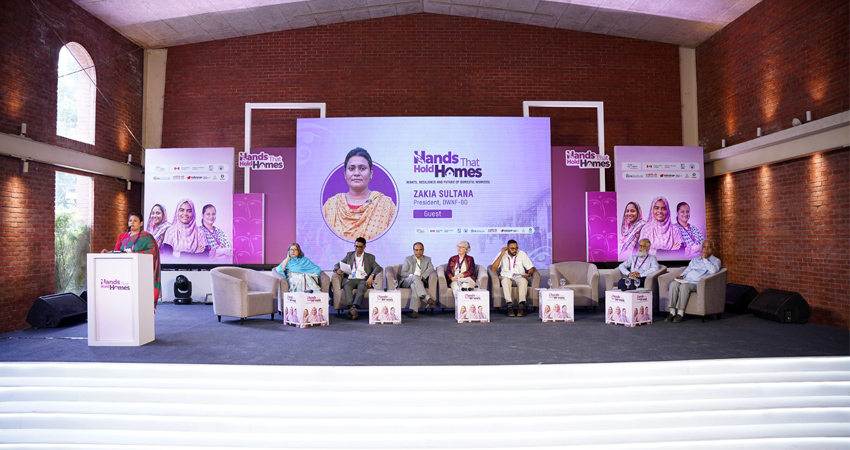
Bangladesh has made progress in giving domestic workers legal recognition, but changing social attitudes remains a major challenge, speakers said at a event in Dhaka on Wednesday.
They said laws and policies alone cannot ensure the rights of domestic workers. Families, employers and society also need to change the way they view and treat domestic workers.
The event, titled “Hands That Hold Homes: Rights, Resilience and the Future of Domestic Workers,” was organised by Oxfam in Bangladesh. It marked seven years of the Securing Rights for Women Domestic Workers in Bangladesh (SUNITI) project.
Speaking as the chief guest, Md Humayun Kabir, Additional Secretary at the Ministry of Labour and Employment, said the government alone could not ensure the rights of domestic workers.
“It is not possible for the government alone to go from house to house and monitor whether the rights of child workers are being ensured,” he said. “Everyone in society needs to come forward in this regard.”
He said low wages, long working hours, limited social protection, workplace harassment and a lack of awareness about rights remain major problems for domestic workers.
Kabir said the government has prepared short, medium and long-term plans based on recommendations from the Labour Reform Commission. He also said work to update the Labour Rules in line with the amended labour law had made significant progress.
Rasheda K Chowdhury, former adviser to the caretaker government, said legal reform would have little impact without a change in people's attitudes.
“We may change many things, but unless we change our mindset, meaningful change will not happen,” she said.
She also called for better childcare facilities for working mothers and greater access to social protection for domestic workers.
Syed Sultan Uddin Ahmed, former chairman of the Labour Reform Commission and executive director of the Bangladesh Institute of Labour Studies, said the recognition of domestic workers in the amended Labour Act was an important step, but it was still partial.
He said stronger organisations and leadership among domestic workers were important achievements of the SUNITI project and should be strengthened further.
“We have not yet fully secured any of the rights of women domestic workers,” he said. “Even the law we obtained in 2026 provides only partial recognition.”
Other speakers also stressed the need for better protection and greater respect for domestic workers.
The event also saw the launch of a publication covering seven years of evidence, policy analysis and learning from the SUNITI project. It also includes 10 stories from the lives of women domestic workers.
The project's final evaluation found that awareness of domestic workers' rights rose from 12 per cent to 74 per cent. Wage-negotiation capacity increased from 23 per cent to 61 per cent, while written employment arrangements increased from 8 per cent to 28 per cent.
An afternoon discussion focused on implementation of the amended labour law, social protection, complaint and remedy systems, skills recognition, employer accountability and stronger worker leadership.
The event ended with personal stories, cultural activities, lessons from the project and commitments for the future.
-SA
Loading...
Loading...
Also read





Editor : Iqbal Sobhan Chowdhury
Published by the Editor on behalf of the Observer Ltd. from Globe Printers, 24/A, New Eskaton Road, Ramna, Dhaka.
Editorial, News and Commercial Offices : Aziz Bhaban (2nd floor), 93, Motijheel C/A, Dhaka-1000.
Phone: PABX- 41053001-06; Advertisement: 41053012; 01793317829, 01550707291, E-mail: [email protected], [email protected] Online: email: [email protected] 41053014; 01550707297 Advertisement: 01550707296
Published by the Editor on behalf of the Observer Ltd. from Globe Printers, 24/A, New Eskaton Road, Ramna, Dhaka.
Editorial, News and Commercial Offices : Aziz Bhaban (2nd floor), 93, Motijheel C/A, Dhaka-1000.
Phone: PABX- 41053001-06; Advertisement: 41053012; 01793317829, 01550707291, E-mail: [email protected], [email protected] Online: email: [email protected] 41053014; 01550707297 Advertisement: 01550707296


