



| HEADLINE |

|

BIP beeps alarm on public health challenges in city planning
Published : Saturday, 3 October, 2026 at 12:00 AM
Staff Correspondent


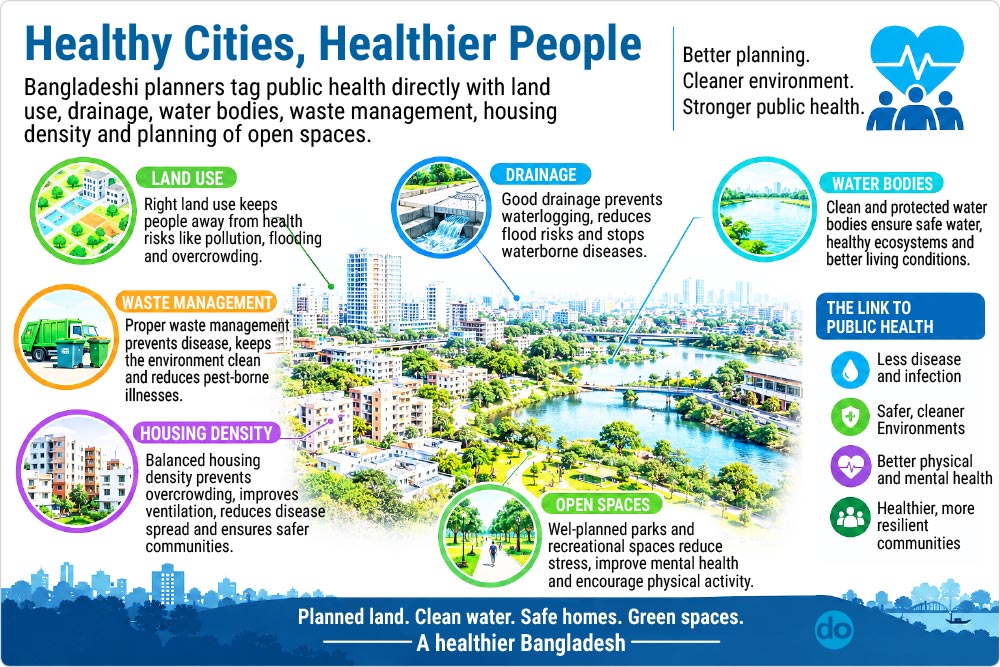 The Bangladesh Institute of Planners (BIP) has called for greater emphasis on urban planning to address public health challenges such as dengue, measles, water logging, air pollution, urban heat and unsafe water.
The organisation said public health is not only a matter of medical care but is also directly linked to land use, drainage, water bodies, waste management, housing density and the planning of open spaces.
BIP President and planner Dr Muhammad Ariful Islam made the call at a press conference titled “Role of Urban Planning in Protecting Public Health from Measles and Dengue” at the Juhur Hossain Chowdhury Hall of the National Press Club on Friday.
He said that large amounts of money are spent on emergency treatment after disease outbreaks, while underlying factors such as unplanned land use, poor drainage, inadequate waste management and gaps in vaccination often remain unaddressed. Preventive measures should therefore be taken before outbreaks occur, alongside treatment.
He further said a pre-monsoon survey conducted by Dhaka South City Corporation (DSCC) in May identified 63 wards as dengue-prone, including 27 at the highest risk. A total of 2,238 houses were inspected, and Aedes larvae or pupae were found in 281 of them. Of these positive houses, 35.23 percent were multi-storey buildings and 17.44 percent were under construction.
Water accumulating in construction sites, basements, lift pits and rooftops can create breeding grounds for mosquitoes. BIP recommended including measures to prevent water accumulation and ensure basement management as conditions for construction approval, along with regular larval inspections at construction sites.
Identifying low vaccination coverage as the main risk for measles, BIP said vaccination centres should be established in densely populated areas, with locations designated for mobile vaccination when necessary.
The press conference also stressed protecting water bodies and flood-flow zones, integrated planning of drainage, water supply and sanitation infrastructure, and increasing green-blue infrastructure, public transport and open spaces.
BIP also called for health impact assessments for major projects, GIS-based mapping of high-risk areas, and the inclusion of low-income and informal settlements in urban planning.
BIP Vice-President Sheikh Mohammad Mehedi Ahsan and General Secretary Planner Professor Dr Md Mosleh Uddin Hasan among others were present at the press conference.
Loading...
Loading...
Also read



Editor : Iqbal Sobhan Chowdhury
Published by the Editor on behalf of the Observer Ltd. from Globe Printers, 24/A, New Eskaton Road, Ramna, Dhaka.
Editorial, News and Commercial Offices : Aziz Bhaban (2nd floor), 93, Motijheel C/A, Dhaka-1000.
Phone: PABX- 41053001-06; Advertisement: 41053012; 01793317829, 01550707291, E-mail: [email protected], [email protected] Online: email: [email protected] 41053014; 01550707297 Advertisement: 01550707296
Published by the Editor on behalf of the Observer Ltd. from Globe Printers, 24/A, New Eskaton Road, Ramna, Dhaka.
Editorial, News and Commercial Offices : Aziz Bhaban (2nd floor), 93, Motijheel C/A, Dhaka-1000.
Phone: PABX- 41053001-06; Advertisement: 41053012; 01793317829, 01550707291, E-mail: [email protected], [email protected] Online: email: [email protected] 41053014; 01550707297 Advertisement: 01550707296


