



| HEADLINE |

|

Gopalganj ponds produce pearls alongside fish
Published : Sunday, 11 October, 2026 at 12:00 AM
Our Correspondent


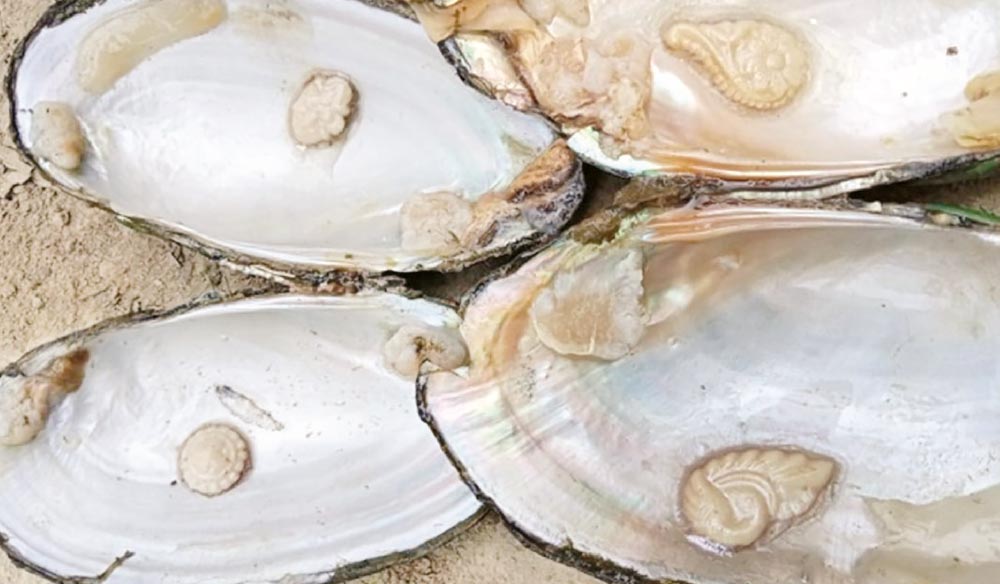 GOPALGANJ, Oct 10: Farming mussels for pearl production alongside fish in the same ponds has shown promise in Gopalganj, creating a potential new source of income for fish farmers.
However, the emerging sector has yet to reach its full potential due to limited government support and inadequate market facilities, officials and entrepreneurs said.
According to the Fisheries Department, a pilot pearl farming initiative was launched in six ponds in Kotalipara Upazila under a project titled “Conservation and Development of Indigenous Fish Species and Snails”.
A total of 7,800 mussels were implanted with image nuclei to begin pearl production. After the trial, around 17,400 image pearls were collected from the mussels.
Officials said around 20,000 mussels could be kept in a one-acre pond if suitable conditions are maintained. Each mussel could produce pearls worth between Tk 600 and Tk 1,000, offering farmers an additional source of income alongside fish farming.
S M Shahjahan Siraj, Senior Upazila Fisheries Officer in Kotalipara, said mussels could be raised alongside fish without requiring separate feed.
“Phytoplankton that naturally develops in the water is their main food. So, pearl farming is possible in ponds where there is sufficient phytoplankton,” he said.
The Fisheries Department had formed groups of 25 entrepreneurs, with five selected from each of the district’s five upazilas, and provided them with training in pearl farming.
However, the project ended in June, and pearl farming is now continuing in only two ponds in Kotalipara. Officials said many entrepreneurs were losing interest due to the lack of continued government support.
The Fisheries Department said image pearls could be produced relatively quickly in the same ponds used for fish farming. Although producing round pearls takes longer, image pearls allow farmers to produce both fish and pearls from the same water body.
District Fisheries Officer Md Kamrul Islam said Gopalganj has 19,482 ponds across its five upazilas, creating significant scope for pearl farming.
“We are encouraging farmers to make use of these water bodies for pearl cultivation,” he said.
But a lack of a reliable market remains a major obstacle. Only a handful of businesses in the country currently buy pearls, making entrepreneurs reluctant to invest because there is no assurance of selling their produce after harvest.
Those involved in the sector said establishing a stable market and marketing network alongside production could help expand pearl farming in Gopalganj.
They said the sector could become a promising part of the local economy if quality pearl production and export opportunities are developed in the future.

Loading...
Loading...
Also read



Editor : Iqbal Sobhan Chowdhury
Published by the Editor on behalf of the Observer Ltd. from Globe Printers, 24/A, New Eskaton Road, Ramna, Dhaka.
Editorial, News and Commercial Offices : Aziz Bhaban (2nd floor), 93, Motijheel C/A, Dhaka-1000.
Phone: PABX- 41053001-06; Advertisement: 41053012; 01793317829, 01550707291, E-mail: [email protected], [email protected] Online: email: [email protected] 41053014; 01550707297 Advertisement: 01550707296
Published by the Editor on behalf of the Observer Ltd. from Globe Printers, 24/A, New Eskaton Road, Ramna, Dhaka.
Editorial, News and Commercial Offices : Aziz Bhaban (2nd floor), 93, Motijheel C/A, Dhaka-1000.
Phone: PABX- 41053001-06; Advertisement: 41053012; 01793317829, 01550707291, E-mail: [email protected], [email protected] Online: email: [email protected] 41053014; 01550707297 Advertisement: 01550707296


