



| HEADLINE |

|

Vietnam’s Maritime Lessons for Bangladesh
Published : Sunday, 11 October, 2026 at 12:00 AM
Muhammad Irfan Sadik


 Two Asian states inherited long, difficult coastlines as their least-used national asset. One has spent nearly four decades converting that coastline into the world’s third largest seafood exporter, a part of the state's economic power projection and national treasure.
 The other still treats its sea as an afterthought beyond the delta. Vietnam and Bangladesh are close enough in size, both economies sit in the $450-500 billion range, but Vietnam’s economy is more diversified than Bangladesh’s over reliance on Readymade garments (RMG).
Vietnam’s sea is the South China Sea, arguably the world’s most contested and heavily armed waterway, where Chinese coast guard cutters, militarised reefs and an unresolved nine-dash line press against Hanoi's exclusive economic zone. Vietnam cannot match Beijing militarily, so it has built resilience through calibrated statecraft instead. The 2019 defence white paper’s “Four No’s,” no alliances, no siding with one power against another, no foreign bases, no use of force, gives Hanoi diplomatic leverages to hedge between Washington, Tokyo and Beijing at once, a posture which political analysts call ‘bamboo diplomacy’. Diplomatically, Vietnam runs two tracks in parallel; (I) Track One through ASEAN’s slow-moving Code of Conduct talks and formal protests grounded in the 1982 UN Convention on the Law of the Sea, and (II) Track Two through the Diplomatic Academy of Vietnam's long-running International Workshop on the South China Sea, which has internationalized the dispute in legal and academic ways for over a decade without ever committing Hanoi to formal arbitration. The doctrine Vietnamese officials have long called "cooperation and struggle" is not outright victory. It is endurance and resilience which Bangladesh gaps in its own territorial waters. Even though Bangladesh doesn’t have this much confrontations compared to Vietnam, still Bangladesh suffers from Myanmar’s Arakan Army, and several non-state actors in the open Bay of Bengal.
Back to Vietnam, the 2018 Coast Guard Law elevated the Vietnam Coast Guard to a ‘core force,’ paired with a dedicated Fisheries Surveillance Force and, since 2019, standing maritime militia squadrons, six raised at first, fourteen planned, drawn from coastal provinces as an uneven answer to China’s own fishing militia. None of it has resolved the dispute. It has kept Vietnam's claims, and its fishermen, and national maritime economy and sovereignty in a heavily contested sea, where other states would have ignored it.
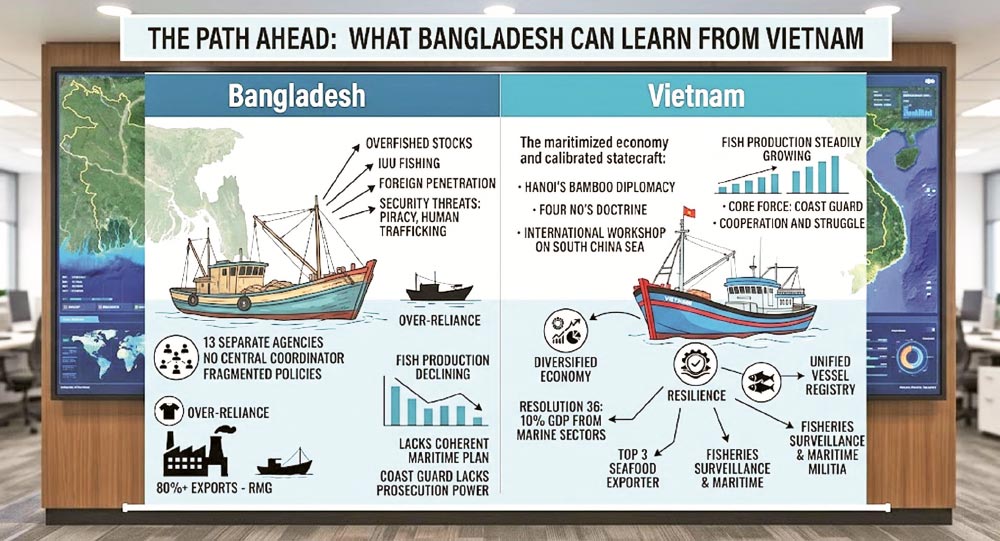 The same argument goes for Vietnam's maritimised economy. Resolution 36, adopted by the Communist Party in 2018, set a target of 10 per cent of GDP from pure marine sectors by 2030, with the country’s coastal provinces contributing up to 70 per cent of national output. Tourism, ports, aquaculture, offshore wind and oil all under one maritime policy. This is a pure shift of economy, while Bangladesh is yet to formalise a coherent maritime plan. As of now, Vietnam’s GDP is now growing past 8 per cent a year; while Bangladesh’s nearer 6 with focus mostly on RMGs and remittances.
Bangladesh has a lot to learn from Vietnam, as it has diversified its economy with maritimisation rather than fiercely competing with Bangladesh in the RMG sector. Bangladesh’s 1,19,000-square-kilometre exclusive economic zone still remains governed by thirteen separate agencies with no central coordinating authority, national maritime or ocean code, doctrine or policy. The Blue Economy Cell operates inside the energy ministry, not the Prime Minister’s office.
The Coast Guard can arrest smugglers or maritime pirates but still cannot prosecute them. Jurisdictional overlapping creates further inter-agency fragmentation rather than operational integrity. A 2019 research-vessel survey found clear evidence of depleted and overfished stocks, while another research shows that new dead zones have been identified due to illegal, unreported and unregulated (IUU) fishing, along with frequent foreign vessel penetration near Myanmar coast. The national fisheries data is still outdated, the true scale of fishing remains unknown. And the scale of maritime piracy, armed robbery, maritime terrorism, and human tracking are frequent headlines from the Eastern coast.
Vietnam has its own unresolved fishing crisis, an EU “yellow card” open since 2017, but Hanoi has registered all 79,000 of its fishing vessels on a single national digitalised database and can name every violation they make. Bangladesh cannot yet count its own fleet with that precision, let alone small-scale fishing boats, and foreign vessels at our own territorial waters. Which plagued our maritime economy for years. According to the Department of Fisheries, total fish production in 2021-2022 was 7,06,000 tonnes; which decreased to 6,79,000 tonnes next year. It further deteriorated, as 2023-24 fish production was 7.5 per cent lower than the previous. And lastly, it further declined to 52,55,000 tonnes. This is a dark reality for a maritime country like Bangladesh. Vietnam produced double the numbers of Bangladesh and steadily growing upwards. The lesson here is not about tonnage, it’s about policy and execution, from top to bottom outcome-based decision making. The non traditional threats, such as armed robbery, drug trafficking, and human trafficking particularly Rohingya people are addressable with a unified vessel registry, a Prime Minister-led maritime security council, maritimise and diversity the economy and local-led security infrastructure with rapid response can enhance security and radically change the economic fragility of Bangladesh. Internationalizing these threats through BIMSTEC, IORA and other regional forums can leverage Bangladesh legally, which is a perfect example Hanoi did to counter maritime security threats.
Above all, a garment sector supplying over 80 per cent of Bangladesh’s exports is a single point of economic fragility that Vietnam’s diversified. Untapped fisheries, open-ocean farming, long-line tuna fishing and offshore international shipping capacity are among the next big opportunities, if Dhaka can seize them. Bangladesh won its independence 54 years ago, but its maritime birthright remains largely untapped. Vietnam faced a far more hostile maritime environment and still built an economic future around the sea. How much longer will Bangladesh wait to build one of its own?
The writer is a researcher and Executive Director of Project Upokul

Loading...
Loading...
Also read



Editor : Iqbal Sobhan Chowdhury
Published by the Editor on behalf of the Observer Ltd. from Globe Printers, 24/A, New Eskaton Road, Ramna, Dhaka.
Editorial, News and Commercial Offices : Aziz Bhaban (2nd floor), 93, Motijheel C/A, Dhaka-1000.
Phone: PABX- 41053001-06; Advertisement: 41053012; 01793317829, 01550707291, E-mail: [email protected], [email protected] Online: email: [email protected] 41053014; 01550707297 Advertisement: 01550707296
Published by the Editor on behalf of the Observer Ltd. from Globe Printers, 24/A, New Eskaton Road, Ramna, Dhaka.
Editorial, News and Commercial Offices : Aziz Bhaban (2nd floor), 93, Motijheel C/A, Dhaka-1000.
Phone: PABX- 41053001-06; Advertisement: 41053012; 01793317829, 01550707291, E-mail: [email protected], [email protected] Online: email: [email protected] 41053014; 01550707297 Advertisement: 01550707296


