



| HEADLINE |

|

Bangladesh and the New Geopolitics of AI
Published : Sunday, 11 October, 2026 at 12:00 AM
Md Al-Amin


 Artificial Intelligence (AI) is no longer merely a technological innovation. It is rapidly becoming an instrument of economic competitiveness, military development and geopolitical influence. From enabling people to manage office activities remotely to transforming how governments, companies and militaries operate, AI is reshaping the global order. Countries are increasingly competing not only to develop AI capabilities but also to secure access to technology, semiconductors, data and critical supply chains. For Bangladesh, this emerging geopolitical landscape presents both an opportunity and a strategic challenge.
Bangladesh’s current position shows both progress and limitations. According to the WIPO Global Innovation Index (GII) 2025, Bangladesh ranks 106th out of 139 economies and eighth among 10 economies in Central and Southern Asia. Its innovation-input rank is 115th, while its innovation-output rank is 95th, reflecting a significant gap in research, infrastructure and institutional capacity despite relatively stronger innovation outputs. Meanwhile, the Oxford Insights Government AI Readiness Index 2025 places Bangladesh 75th among 195 countries. Bangladesh performs relatively well in Public Sector Adoption, scoring 82.78 out of 100, and Policy Capacity, with a score of 69. However, its scores are much weaker in AI Infrastructure (39.02), Development & Diffusion (26.97) and Resilience (29.64). These figures indicate that Bangladesh has made meaningful progress in government-led AI adoption and digital public services but remains a middle-to-lower-tier player in technological innovation and AI ecosystem development. Limited computing infrastructure, research capacity, skilled talent, private-sector innovation and AI governance remain major constraints.
The geopolitical dimension of AI is becoming increasingly visible. As a developing country, Bangladesh has an opportunity to use technological cooperation to strengthen its economic and strategic position. The country has recently joined the World Artificial Intelligence Cooperation Organisation (WAICO), led by China and comprising 29 countries. At the same time, the United States formed another AI alliance, Pax Silica, last July with the European Union and 23 other countries. During a recent visit, US Special Envoy for South and Central Asia Sergio Gor proposed that Bangladesh join the US-led Pax Silica initiative, saying that Bangladesh has significant potential to become a partner in the global economic security alliance focused on AI, semiconductors and critical mineral supply chains.
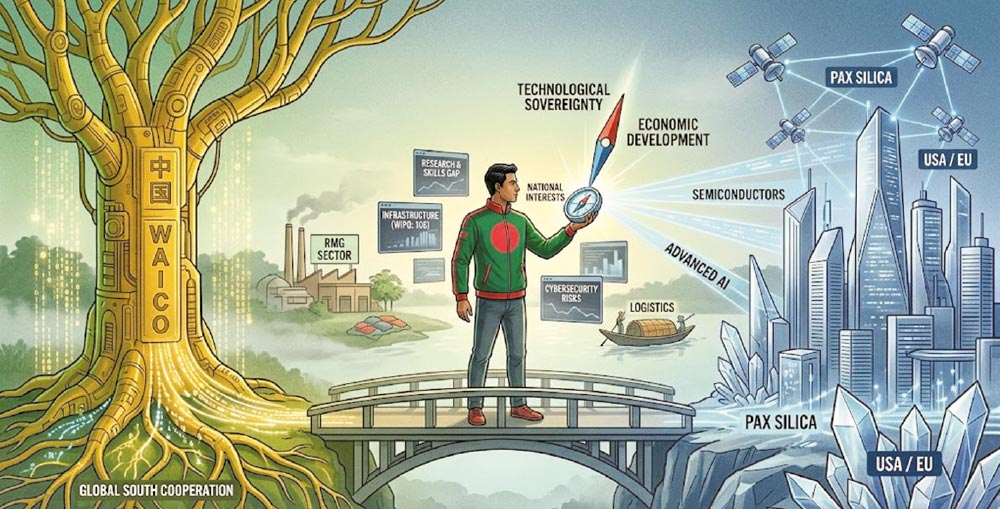 This development puts Bangladesh before an important strategic choice. WAICO offers an avenue for engagement with a China-led platform and greater representation of the Global South, while Pax Silica could provide access to leading technology economies and advanced AI and semiconductor ecosystems. Bangladesh should therefore avoid viewing these platforms simply through the lens of geopolitical rivalry. Its technological diplomacy should instead be guided by national interests, economic priorities and the goal of building long-term technological capacity.
The economic opportunities are considerable. AI can enhance productivity, reduce production costs, boost export competitiveness and foster innovation. In the RMG sector, for instance, AI can improve demand forecasting, quality control, inventory management, production planning and supply-chain efficiency. By analysing global fashion trends and consumer preferences, AI can help manufacturers respond more quickly to international demand while reducing waste and lead times. Combining AI with skilled labour could help Bangladesh move from a low-cost export model towards a more technology-driven, high-value and globally competitive RMG industry. It could also strengthen export earnings and create new opportunities for skilled Bangladeshi professionals at home and abroad.
Bangladesh can also use AI to capitalise on its strategic geographical position between South and Southeast Asia. AI-enabled smart logistics, ports, transportation, border management and maritime surveillance could strengthen the country’s role as a regional trade, transit and digital connectivity hub. Integrating AI into connectivity and infrastructure could enhance economic and strategic resilience while allowing Bangladesh to benefit from its proximity to major markets such as India, China and ASEAN.
The strategic implications extend to defence and national security. AI can strengthen Bangladesh’s capabilities in intelligent surveillance, border monitoring, maritime security, threat detection and data-driven decision-making. AI-enabled systems can improve situational awareness, strengthen disaster and crisis response, and support more efficient use of defence resources. These capabilities could help Bangladesh build a smarter, more agile and technologically advanced defence system while maintaining strategic autonomy.
At the same time, technological development must not leave Bangladesh dependent on foreign systems. AI can accelerate local research, automation, smart manufacturing, digital services and the development of home-grown solutions. Building domestic technological capabilities can reduce reliance on foreign technology, expertise and imported solutions. In this sense, AI is not only an economic opportunity but also a matter of technological sovereignty.
This is where WAICO could become strategically significant for Bangladesh. Participation in the organisation could strengthen Bangladesh’s position in global AI governance and provide a platform to represent the interests and priorities of the Global South. It could facilitate technology and knowledge sharing, capacity building, research collaboration and international partnerships. WAICO membership could also create opportunities for investment and technological cooperation while allowing Bangladesh to contribute to emerging global norms and standards on AI. Such engagement could strengthen Bangladesh’s position as an emerging voice of the Global South in global AI governance.
Pax Silica could offer a different set of opportunities. Engagement with the US-led initiative could strengthen Bangladesh’s links with the Global North and leading technology economies. It could provide opportunities for technology transfer, investment, innovation partnerships and access to advanced semiconductor and AI ecosystems. Such cooperation could enhance Bangladesh’s technological and strategic relevance, diversify its international partnerships and support the development of domestic capabilities in AI, semiconductors and other critical digital technologies.
However, Bangladesh cannot benefit fully from either platform without addressing its domestic weaknesses. The country faces a shortage of skilled professionals, data protection and privacy concerns, cybersecurity risks, infrastructure limitations and challenges surrounding the ethical use of AI. Its relatively low scores in AI infrastructure and development and diffusion underline the scale of the challenge. International partnerships alone cannot solve these problems. Bangladesh must simultaneously strengthen its own research institutions, digital infrastructure, human capital and regulatory capacity.
Therefore, Dhaka should approach WAICO and Pax Silica through a pragmatic and interest-based technology diplomacy. The objective should not be to choose sides in a broader geopolitical contest but to secure the knowledge, investment, technology and partnerships necessary for national development. Where interests converge, Bangladesh should remain open to cooperation with both the Global South and the Global North.
The new geopolitics of AI is ultimately about much more than algorithms. It concerns economic power, national security, technological sovereignty and influence over the rules that will shape the digital future. Bangladesh has already moved beyond being merely an AI consumer, but it still has a long way to go before becoming a significant regional innovator. If it invests in skills, infrastructure, research, governance and domestic innovation while pursuing balanced technological diplomacy, Bangladesh can turn the geopolitical competition around AI into an opportunity. The challenge now is to ensure that the country does not merely participate in the new AI order, but develops the capacity to shape it.
The writer is an educator

Loading...
Loading...
Also read



Editor : Iqbal Sobhan Chowdhury
Published by the Editor on behalf of the Observer Ltd. from Globe Printers, 24/A, New Eskaton Road, Ramna, Dhaka.
Editorial, News and Commercial Offices : Aziz Bhaban (2nd floor), 93, Motijheel C/A, Dhaka-1000.
Phone: PABX- 41053001-06; Advertisement: 41053012; 01793317829, 01550707291, E-mail: [email protected], [email protected] Online: email: [email protected] 41053014; 01550707297 Advertisement: 01550707296
Published by the Editor on behalf of the Observer Ltd. from Globe Printers, 24/A, New Eskaton Road, Ramna, Dhaka.
Editorial, News and Commercial Offices : Aziz Bhaban (2nd floor), 93, Motijheel C/A, Dhaka-1000.
Phone: PABX- 41053001-06; Advertisement: 41053012; 01793317829, 01550707291, E-mail: [email protected], [email protected] Online: email: [email protected] 41053014; 01550707297 Advertisement: 01550707296


