



| HEADLINE |

|

Dhaka conference marks 72 years of Algeria's liberation struggle
Published : Saturday, 31 October, 2026 at 10:00 PM
Press Release


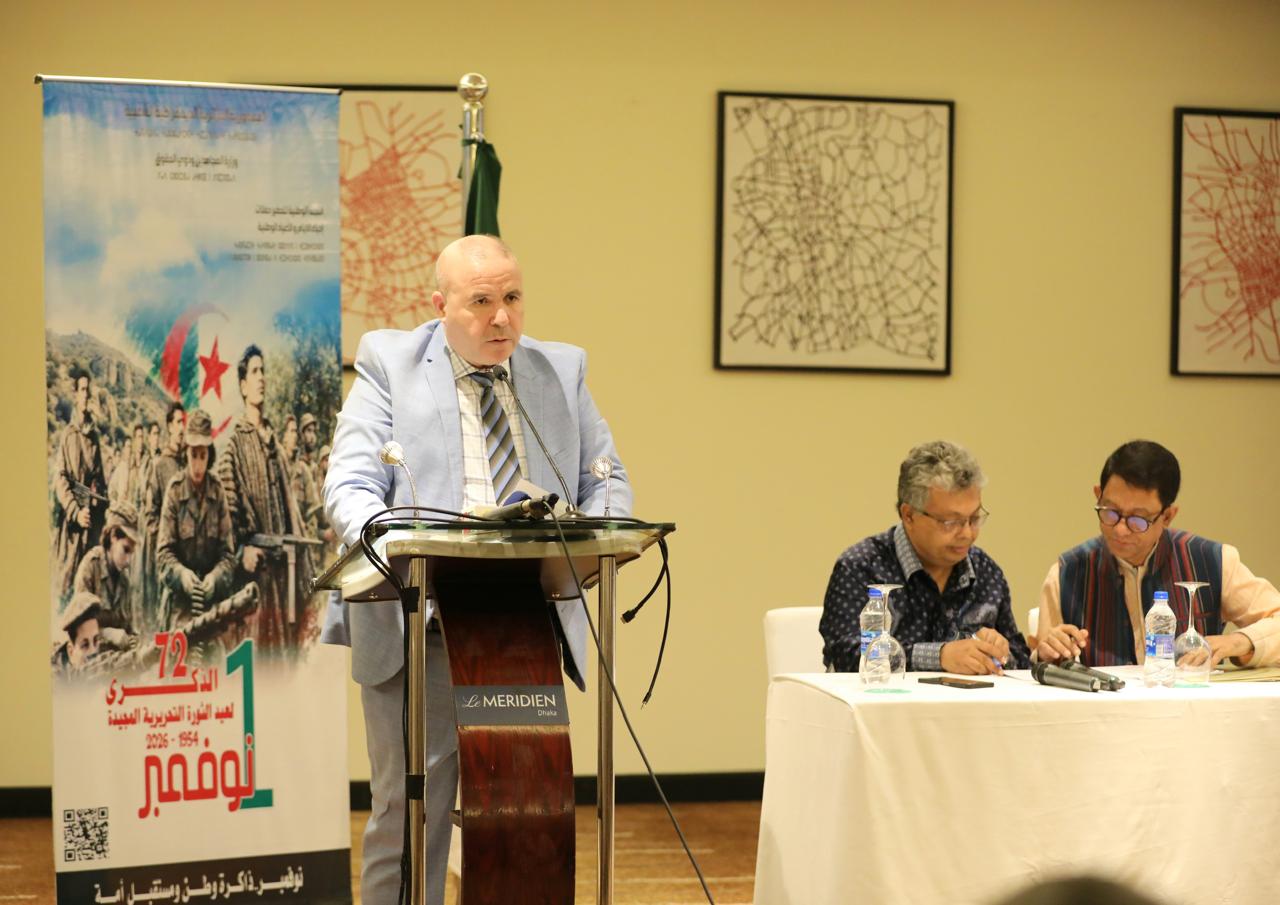
The role of Algeria’s 1954 revolution in shaping global decolonisation, international relations and the right to self-determination was highlighted at a conference in Dhaka on Saturday.
Titled “The Algerian Revolution of November 1, 1954 and Its Impact on International Relations”, the conference was held at Le Méridien Dhaka ahead of the 72nd anniversary of the revolution.
Algerian Ambassador to Bangladesh Dr Abdelouahab Saidani said the revolution was not just a struggle for national independence but also a turning point in international diplomacy that inspired liberation movements across Africa, Asia and Latin America.
He recalled the sacrifices made by Algerians during 132 years of French colonial rule, which ended with the country's independence in July 1962.
The ambassador also highlighted the revolution's contribution to international discussions on human rights, self-determination and humanitarian law. He noted that Algeria later became a major centre of support for liberation movements, earning the reputation of the “Mecca of Revolutionaries”.
Referring to the historical ties between Algeria and Bangladesh, Saidani stressed the importance of sovereignty, national dignity, social justice and solidarity among countries of the Global South. He also called for stronger relations between the two countries.
In the keynote address, S. M. Shameem Reza, professor of the Department of Mass Communication and Journalism, discussed how the revolution influenced international politics and contributed to the emergence of a postcolonial world order.
In his paper, titled “The Algerian Revolution of 1954: Its Impact on International Relations and World Politics”, Reza said the National Liberation Front (FLN), which launched the uprising on November 1, 1954, transformed Algeria's independence struggle into an international diplomatic issue.
He highlighted the role of international organisations, diplomatic networks and Afro-Asian solidarity in advancing the Algerian cause, particularly following the 1955 Bandung Conference.
Reza also discussed the revolution's impact on France's relations with the United States, NATO and the United Nations, as well as the significance of the Évian Accords signed in March 1962, which paved the way for Algeria's independence.
The conference brought together diplomats, academics, researchers and other guests to discuss the revolution's historical significance and its relevance to contemporary international affairs.
- MaT

Loading...
Loading...
Also read









Editor : Iqbal Sobhan Chowdhury
Published by the Editor on behalf of the Observer Ltd. from Globe Printers, 24/A, New Eskaton Road, Ramna, Dhaka.
Editorial, News and Commercial Offices : Aziz Bhaban (2nd floor), 93, Motijheel C/A, Dhaka-1000.
Phone: PABX- 41053001-06; Advertisement: 41053012; 01793317829, 01550707291, 01550707296
E-mail: [email protected], [email protected]. [email protected], [email protected], [email protected], [email protected], Online-email: [email protected]


