



| HEADLINE |

|

National Revolution and Solidarity Day
A Unique Chapter in Safeguarding Bangladesh’s Independence, Sovereignty
Published : Saturday, 7 November, 2026 at 12:00 AM
Emran Amiy


 The month of November is intrinsically intertwined with the history of Bangladesh. November 7, 1975, is a momentous day in the political history of Bangladesh-a day that provided the people of Bangladesh with the opportunity to be recognised with a new identity. Had this day not arrived, the democracy, independence, and sovereignty of Bangladesh would have vanished. On that day, a decisive step by courageous members of the armed forces altered the nation’s future. This day is known to the people of Bangladesh as “National Revolution and Solidarity Day.” It was a day that marked the end of the post-independence political chaos in newly independent Bangladesh, while simultaneously signalling the resurgence of Bangladeshi nationalist consciousness.
Following the glorious Liberation War of 1971, the people of Bangladesh had anticipated a synthesis of independence and democracy. However, the period from 1972 to 1975 was plagued by deep political instability, economic disaster, and administrative corruption. In January 1975, a one-party rule was introduced through the establishment of “BAKSAL,” leaving freedom-loving Bangladeshis politically deprived and dissatisfied. Following the assassination of Sheikh Mujibur Rahman and his family on August 15, 1975, the country's politics took a completely different direction, initiating a power struggle between military factions and administrative forces. On November 3, 1975, Brigadier Khaled Mosharraf seized power in a coup and placed the Declaration of Independence exponent and Sector Commander, Major General Ziaur Rahman, under house arrest. This sparked anger and discontent among freedom fighters and ordinary soldiers within the army, leading to a fierce struggle for power and plunging the future of the newly born nation of Bangladesh into uncertainty.
To uphold the future of the country and the nation and to free the land from the shackles of subjugation, brave soldiers of the Bangladesh Army stepped forward. On the dawn of November 7, 1975, a spontaneous movement of ordinary soldiers and freedom fighters began in the Dhaka Cantonment, which swiftly transformed into widespread public participation. The capital and various cantonments and cities across the country echoed with the slogan: “Let the unity of soldiers and the public remain unbreakable.” During this volatile situation, revolutionary soldiers and citizens freed Major General Ziaur Rahman from the captivity of the power-grabbing, Mujib-aligned Khaled Mosharraf. Entrusted by courageous soldiers to steer the nation through turbulent times, the responsibility of a vanishing Bangladesh was placed upon the shoulders of Ziaur Rahman.
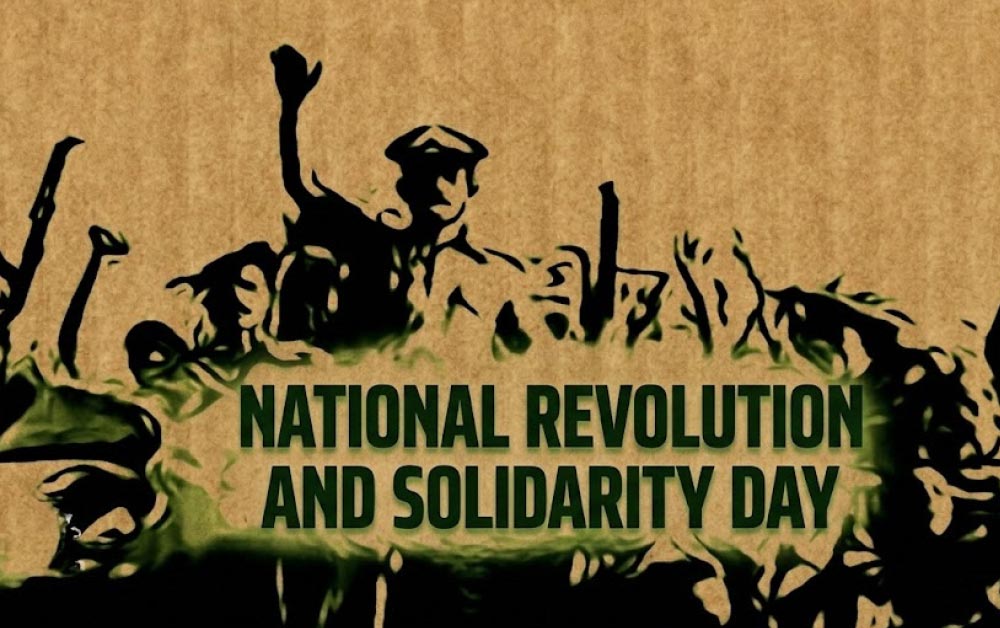 From this very day, the wheel of Bangladesh's destiny turned. A dream journey began to advance the country and the nation with a new identity. Embracing the principle that “Power is not the goal; the people are the source of all power,” a new path commenced. Under the leadership of Ziaur Rahman, the concept of “Bangladeshi Nationalism” was born. The core philosophy of Bangladeshi Nationalism was to build a distinct national consciousness rooted in Bangladesh’s independence, sovereignty, territorial integrity, culture, and religious heritage. Ziaur Rahman realised that independence is not merely geographical; rather, it is the combined manifestation of a nation's self-identity, culture, heritage, economy, and political freedom.
In the post-liberation era, the tendency to confine national identity solely to linguistic or ethnic terms was pushing Bangladesh towards narrow-mindedness. Breaking through the shackles of this narrowness, martyred President Zia proclaimed: “We are Bangladeshis.” This declaration united every citizen under a single flag. To institutionalise this vision, he established the Bangladesh Nationalist Party (BNP) on September 1, 1978. The core foundation of BNP’s political ideology rests upon four pillars: Bangladeshi Nationalism: Establishing national unity based on civic identity, geographical unity, and the spirit of the glorious Liberation War. Democracy: The people shall be the source of all power, and elections shall be the sole basis of a government’s legitimacy. Economic Emancipation and Development: Adopting rural development, agricultural revolution, self-reliance, and industrialisation as the primary driving forces of national progress. International Stance and Diplomacy:
Maintaining that Bangladesh shall remain neutral yet sovereign and dignified-never dependent on any external power.
Thus, the events of November 7 were not merely a military coup; they marked the beginning of re-establishing trust between the state and its citizens. This day forged a symbolic connection of unity between the army and the general public, proving the necessity of national solidarity to protect the country’s sovereignty and independence. It laid the foundation for a new national philosophy and political ideology in Bangladesh. As the saying goes, “A nation survives only when its people stand firm on the basis of their own consciousness and unity.”
While Bangladesh was moving forward under the leadership of Ziaur Rahman, President Ziaur Rahman was martyred at the Chittagong Circuit House on May 30, 1981, at the hands of a few misguided military personnel. Having governed the country in a remarkably short span, he had transformed into such a popular statesman that the massive public attendance at his funeral testified to the depth of love the people held for him. Following in the footsteps of Ziaur Rahman, his wife, Begum Khaleda Zia, carried forward the spirit of Bangladeshi nationalism to advance the nation. Walking the path of martyred President Ziaur Rahman and the late Begum Khaleda Zia, their eldest son, BNP Chairman and Prime Minister Tarique Rahman, is working day and night to propel Bangladesh forward upholding the slogan "Bangladesh First."
Tarique Rahman has repeatedly declared: “Bangladesh is not anyone’s gift; Bangladesh is the fruit of a bloody liberation struggle. In the interest of the Bangladeshi state, our relations with everyone shall remain intact.” Through these words, he has proven that Ziaur Rahman’s Bangladeshi nationalism remains relevant and indispensable in the contemporary context. The people of Bangladesh believe-and it has become increasingly evident-that the reflection of his father, martyred President Ziaur Rahman, is mirrored in Tarique Rahman. It is visible in his simple lifestyle, his ideology, and his call for a discrimination-free “Bangladesh First” society. Consequently, the people now dare to dream again-knowing that this red-and-green Bangladesh is secure in the hands of genuine pro-Bangladesh patriots, neither subservient to pro-Indian nor pro-Pakistani forces. The very nation whose War of Independence was heralded by Major Ziaur Rahman’s declaration: “We revolt...”
The writer is a journalist

Loading...
Loading...
Also read



Editor : Iqbal Sobhan Chowdhury
Published by the Editor on behalf of the Observer Ltd. from Globe Printers, 24/A, New Eskaton Road, Ramna, Dhaka.
Editorial, News and Commercial Offices : Aziz Bhaban (2nd floor), 93, Motijheel C/A, Dhaka-1000.
Phone: PABX- 41053001-06; Advertisement: 41053012; 01793317829, 01550707291, 01550707296
E-mail: [email protected], [email protected]. [email protected], [email protected], [email protected], [email protected], Online-email: [email protected]


