



| HEADLINE |

|

Election Landscape In Districts
Youths likely to decide Bagerhat-1 fate
Published : Wednesday, 21 January, 2026 at 12:00 AM
Abul Ahasan Titu


 FAKIRHAT, BAGERHAT, Jan 20: The outcome of the 13th parliamentary election in Bagerhat-1 constituency-comprising Fakirhat, Mollahat and Chitalmari upazilas-is set to hinge on the choices of more than 100,000 young voters, candidates and analysts say.
With youths accounting for over 27 per cent of the total electorate, observers believe traditional vote banks may fracture, giving rise to new political equations in the constituency.
According to Election Commission data, Bagerhat-1 has a total of 375,560 voters. Of them, 103,880 are aged between 18 and 29-representing 27.66 per cent of the electorate. The number of first-time voters aged between 18 and 25 is also significant, adding a new dimension to the electoral arithmetic.
Analysts say these young voters could emerge as a decisive force, particularly amid debates over democratic transition and political reform. As a result, youths are increasingly being seen not merely as passive participants but as an influential and pressure-building group beyond conventional vote-bank politics.
Veteran politician and former public representative Rabindranath Halder Batul said, the sheer size of the youth bloc would be the key factor in determining the result.
"In Bangladesh, whenever there is intense competition between two or more strong contenders, victory and defeat are often decided by a narrow margin," he said. "Whichever candidate the majority of young voters side with will see their chances of winning increase significantly."
Political analysts echo this view, noting that the stance of young voters eager to cast their ballots will not only shape the outcome in one constituency but may also signal broader trends in national politics.
Predicting where the youth vote will ultimately go remains difficult. However, political parties acknowledge that social media campaigning-along with misinformation-has a tangible impact on young voters. As a result, parties are being forced to adopt new strategies to appeal to this "digital generation".
On the ground, candidates and their supporters have intensified campaigns on platforms such as Facebook and Instagram. The contest to win over young voters is therefore unfolding both offline and online.
Across Fakirhat, Mollahat and Chitalmari, discussions about the election are common at tea stalls and informal gatherings. Many voters can be seen attentively watching campaign content on their mobile phones.
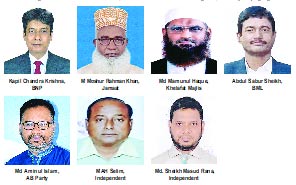
Election Commission records show that seven candidates are contesting the seat. They are BNP candidate Kapil Krishna Mondal; Bangladesh Jamaat-e-Islami candidate Md Mashiur Rahman Khan; Amar Bangladesh Party (AB Party) candidate Md Aminul Islam; Bangladesh Khelafat Majlis candidate Md Mamunul Haque; Bangladesh Muslim League (BML) candidate A Sabur Sheikh; and independent candidates Md Sheikh Masud Rana and MAH Selim.
However, voters and political observers believe the main contest will be among the BNP, Jamaat-e-Islami, and an independent candidate known as a former lawmaker.
Interviews with young voters across the three upazilas reveal a clear difference between the priorities of younger and older voters. For youths, employment opportunities and income security top the list.
They point out that the July mass uprising was sparked by demands to end discrimination in recruitment. Restrictions on freedom of expression, including internet shutdowns, had further angered young people at the time. Since August 5, 2024, youth demands have featured prominently in discussions on governance and political reform.
Rokeya Akter, a final-year English literature student at Fakirhat Kazi Azhar Ali College, said she was eager to vote to help shape the country's future.
"As a student, I care most about job opportunities, the quality and cost of education, and the rising cost of daily living," she said.
Candidates have openly acknowledged the importance of young voters. Jamaat-e-Islami candidate Md Mashiur Rahman Khan said, the party's youth wing was actively working to engage them.
"We are making commitments-not just promises-on employment, quality education and social harmony," he said.
A BNP leader at the upazila level, speaking on condition of anonymity, said Chhatra Dal and Jubo Dal activists were actively campaigning to attract young voters.
AB Party candidate Md Aminul Islam said his party planned to create 60,000 employment opportunities in agriculture, fisheries and poultry sectors in each upazila, alongside expanding access to higher education, cultural activities and overseas employment.
The Dhaka-Khulna and Barishal highways pass through Fakirhat and Mollahat, while the country's second-largest seaport is nearby. Despite these geographical advantages and the establishment of several industries, many jute mills, ceramic factories and fish-processing plants have shut down in recent years.
Monirul Islam Sheikh, a young voter from Fakirhat, said his vote would go to whoever could create jobs and drive socio-economic development. Analysts conclude that whichever side wins the confidence of young voters is likely to secure victory in Bagerhat-1.

Loading...
Loading...
Also read



Editor : Iqbal Sobhan Chowdhury
Published by the Editor on behalf of the Observer Ltd. from Globe Printers, 24/A, New Eskaton Road, Ramna, Dhaka.
Editorial, News and Commercial Offices : Aziz Bhaban (2nd floor), 93, Motijheel C/A, Dhaka-1000.
Phone: PABX- 41053001-06; Advertisement: 41053012; 01793317829, 01550707291, E-mail: [email protected], [email protected] Online: email: [email protected] 41053014; 01550707297 Advertisement: 01550707296
Published by the Editor on behalf of the Observer Ltd. from Globe Printers, 24/A, New Eskaton Road, Ramna, Dhaka.
Editorial, News and Commercial Offices : Aziz Bhaban (2nd floor), 93, Motijheel C/A, Dhaka-1000.
Phone: PABX- 41053001-06; Advertisement: 41053012; 01793317829, 01550707291, E-mail: [email protected], [email protected] Online: email: [email protected] 41053014; 01550707297 Advertisement: 01550707296


