



| HEADLINE |

|
Shaheed Harun Day observed at Gauripur
Published : Wednesday, 28 January, 2026 at 12:00 AM
Our Correspondent


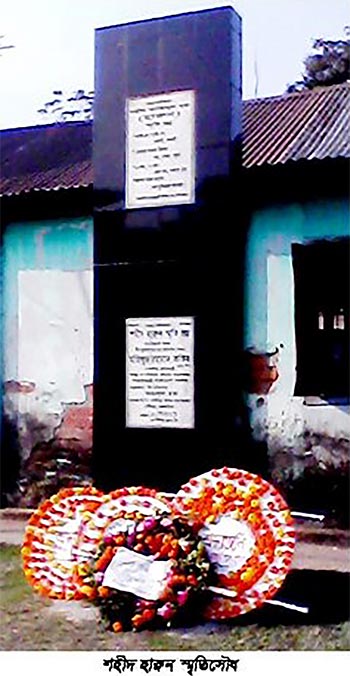 GAURIPUR, MYMENSINGH, Jan 27: Residents of Gauripur on Tuesday remembered Shaheed Azizul Haq Harun, who was killed during the 1969 Mass Uprising while leading student protests for the 11-point demands. The day, now observed as Shaheed Harun Day, marks the 57th anniversary of his death.
Harun, a bright student of Gauripur College, was shot dead by police on January 27, 1969, during a demonstration in the Gauripur town. The protest violated Section 144, and the firing followed orders from then sub-divisional administrator M.A. Samad. Harun's sacrifice came shortly after the January 24 killing of Motiur Rahman, a student of Dhaka's Nawkumar Institute, which had intensified student activism across the country.
Despite his pivotal role in the struggle, Harun has yet to receive official state recognition.
A memorial has been erected in his name in Gauripur, but his grave, located in his native village of Chondipasha in Nandail Upazila, remains largely unvisited. Harun was the son of Mia Box Sarkar and had six brothers and three sisters. Three of his brothers are still alive: Abdul Hamid, Abdur Rashid, and Shafikul Alam Chan Mia. His surviving sister is Anowara Khatun.
Family members recalled the tragic day vividly. Shafikul Alam Chan Mia, then a fifth grader, said he rushed to Gauripur on hearing the news but could not locate his brother. Harun's body was taken to an undisclosed location by police and returned three days later for burial under police supervision. His brother Abdur Rashid added that, unlike other national student martyrs, Harun's story did not receive widespread attention.
Former classmates remember Harun as a determined and courageous student. Retired Nandail headmaster Mohammad Ishak Akand said, Harun, along with fellow students, had been staying in a union council office room with the support of the then chairman Gunjur Ali. When the protest erupted, Harun called for unity among students and led the march despite the risk, ultimately losing his life within minutes of being shot.
Every year, local organisations and the Shaheed Harun Memorial Committee commemorate his sacrifice with a series of programmes including morning processions, floral tributes at the memorial, Milad ceremonies, and discussion meetings. The observances aim to honour his contribution to the 1969 student movement and to inspire future generations to uphold democratic values.
Shafikul Alam Chan Mia emphasised that remembering Shaheed Harun is essential to acknowledging the courage and aspirations of students who fought for people's rights. The day continues to be a poignant reminder of the cost of democracy and the resilience of student activism in Gauripur.
Loading...
Loading...
Also read



Editor : Iqbal Sobhan Chowdhury
Published by the Editor on behalf of the Observer Ltd. from Globe Printers, 24/A, New Eskaton Road, Ramna, Dhaka.
Editorial, News and Commercial Offices : Aziz Bhaban (2nd floor), 93, Motijheel C/A, Dhaka-1000.
Phone: PABX- 41053001-06; Advertisement: 41053012; 01793317829, 01550707291, E-mail: [email protected], [email protected] Online: email: [email protected] 41053014; 01550707297 Advertisement: 01550707296
Published by the Editor on behalf of the Observer Ltd. from Globe Printers, 24/A, New Eskaton Road, Ramna, Dhaka.
Editorial, News and Commercial Offices : Aziz Bhaban (2nd floor), 93, Motijheel C/A, Dhaka-1000.
Phone: PABX- 41053001-06; Advertisement: 41053012; 01793317829, 01550707291, E-mail: [email protected], [email protected] Online: email: [email protected] 41053014; 01550707297 Advertisement: 01550707296


