



| HEADLINE |

|

Rat invasion in Nageshwari Boro fields leaves farmers in despair
Published : Friday, 10 April, 2026 at 12:00 AM
Our Correspondent


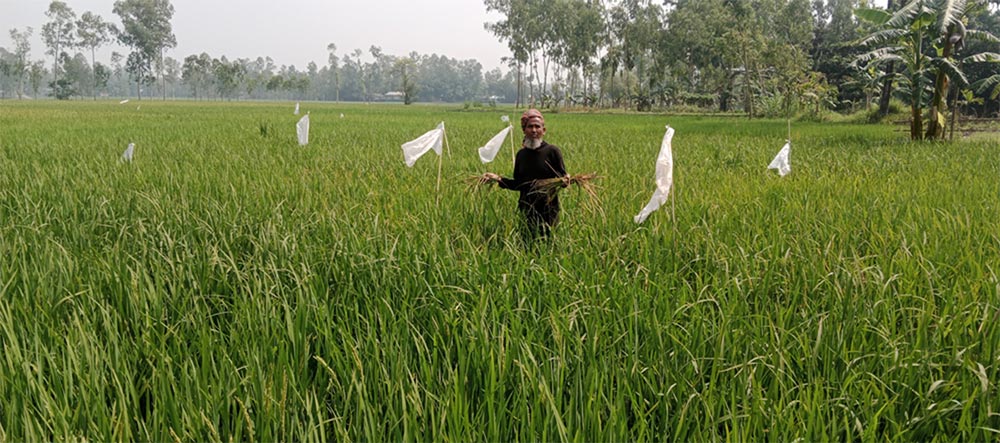 NAGESHWARI, KURIGRAM, Apr 9: A severe rat infestation has gripped the paddy fields of Nageshwari Upazila, leaving farmers in deep distress as rodents continue to destroy acre after acre of growing crops.
According to the Upazila Agriculture Office, a target was set to cultivate Boro paddy on 23,753 hectares of land this irrigation-dependent season. However, farmers exceeded expectations by cultivating 23,760 hectares.
Favourable weather conditions and diligent care led to a healthy growth of tillers, quickly covering the fields in lush green. Most of the plants have already reached the 'booting' stage (forming panicles), while some fields have already seen the emergence of grain heads. Recent rains in the month of Chaitra further refreshed the fields, with standing water raising hopes for a bumper harvest.
However, those dreams are quickly fading. Unusually large rats have launched a massive onslaught, gnawing through the base of the paddy plants. In many clusters, only one or two stalks remain while the rest lie severed on the ground. Farmers returning to their fields each morning are greeted by the sight of fallen stalks, a sight increasingly visible even from a distance.
Despite efforts to plug burrows along the ails, the rodents return as soon as the fields are quiet, digging new holes and continuing their destruction.
The scenario is consistent across the upazila. Binod Chandra, a farmer from East Sanjuarvhita in the municipality, shared that rats have attacked all six bighas of his land. Unable to stop the infestation by blocking holes, he has been forced to resort to chemical pesticides.
Similar accounts were shared by Osman Gani of Bamandanga Teliani, Md. Osman, Mahbubur Rahman, Faruk Hossain, and Masud Rana of Nunkhawa, as well as Subhash Chandra and Muzaffar Hossain of Baniyapara. Nurzaman Mia of Vitarband Daknirpath echoed their frustrations, stating that they are watching their hard work being cut down before their eyes, leaving them feeling helpless and panicked.
Upazila Agriculture Officer Shahriar Hossain emphasized that an integrated management approach is essential to curb the infestation.
"Rodent control can be achieved by flooding burrows, using smoke, setting bamboo traps or live traps, and applying poison baits. Furthermore, keeping the field embankments narrow and clean significantly reduces rat nesting," he said.
He added that the department is actively advising affected farmers to implement these measures immediately to safeguard their remaining crops.

Loading...
Loading...
Also read



Editor : Iqbal Sobhan Chowdhury
Published by the Editor on behalf of the Observer Ltd. from Globe Printers, 24/A, New Eskaton Road, Ramna, Dhaka.
Editorial, News and Commercial Offices : Aziz Bhaban (2nd floor), 93, Motijheel C/A, Dhaka-1000.
Phone: PABX- 41053001-06; Advertisement: 41053012; 01793317829, 01550707291, E-mail: [email protected], [email protected] Online: email: [email protected] 41053014; 01550707297 Advertisement: 01550707296
Published by the Editor on behalf of the Observer Ltd. from Globe Printers, 24/A, New Eskaton Road, Ramna, Dhaka.
Editorial, News and Commercial Offices : Aziz Bhaban (2nd floor), 93, Motijheel C/A, Dhaka-1000.
Phone: PABX- 41053001-06; Advertisement: 41053012; 01793317829, 01550707291, E-mail: [email protected], [email protected] Online: email: [email protected] 41053014; 01550707297 Advertisement: 01550707296


