



| HEADLINE |

|
KCC administrator highlights Mayur River revival to tackle city crisis


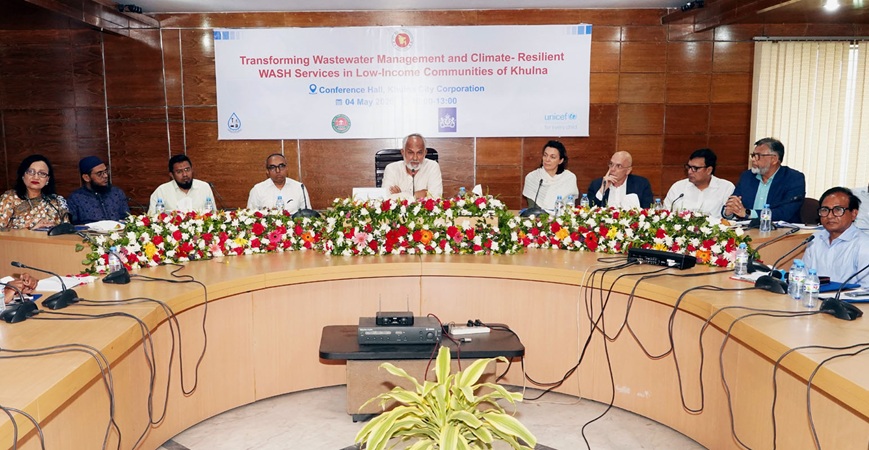
Khulna City Corporation (KCC) Administrator Nazrul Islam Manju on Monday said sufferings of city dwellers will persist unless the Mayur River is protected and restored.
He made the remarks while addressing an inception workshop on installation of wastewater treatment plants in low-income communities at Shaheed Altaf Auditorium of Nagar Bhaban in the city.
The programme was organised under the “Bangladesh Climate Resilient Sustainable Water Supply, Sanitation and Hygiene” project, implemented by the Department of Public Health Engineering with financial support from UNICEF.
Manju said although Khulna WASA is responsible for water supply, its services have yet to reach all areas, particularly in low-income settlements where scarcity of safe drinking water remains acute.
He stressed the need for establishing a water treatment plant centring the Mayur River and called upon a Netherlands-based donor agency to support its modernisation and transformation into a tourism area.
Highlighting sanitation challenges, he said nearly 47 per cent of human waste in project areas is discharged into drains or surface reservoirs due to dysfunctional shared toilets and lack of awareness among residents.
Under the project, climate-resilient sanitation facilities, effective waste treatment and timely disposal systems will be ensured to achieve 100 per cent safe sanitation, reduce environmental pollution and protect public health, officials said.
Initially, 10 additional water treatment plants will be installed in selected areas, while capacity of KCC will be enhanced for operation and maintenance of treatment facilities and medical waste management.
Two such plants have already been set up in Bastuhara area, where purified water is being supplied at Tk 0.60 per litre through prepaid cards or operators, sources added.
KCC Chief Executive Officer Rajib Ahmed presided over the workshop, while First Secretary of the Netherlands Embassy Igne Kassen and UNICEF Deputy Country Director Peter Maas spoke as special guests, among others.
SS/MS
He made the remarks while addressing an inception workshop on installation of wastewater treatment plants in low-income communities at Shaheed Altaf Auditorium of Nagar Bhaban in the city.
The programme was organised under the “Bangladesh Climate Resilient Sustainable Water Supply, Sanitation and Hygiene” project, implemented by the Department of Public Health Engineering with financial support from UNICEF.
Manju said although Khulna WASA is responsible for water supply, its services have yet to reach all areas, particularly in low-income settlements where scarcity of safe drinking water remains acute.
He stressed the need for establishing a water treatment plant centring the Mayur River and called upon a Netherlands-based donor agency to support its modernisation and transformation into a tourism area.
Highlighting sanitation challenges, he said nearly 47 per cent of human waste in project areas is discharged into drains or surface reservoirs due to dysfunctional shared toilets and lack of awareness among residents.
Under the project, climate-resilient sanitation facilities, effective waste treatment and timely disposal systems will be ensured to achieve 100 per cent safe sanitation, reduce environmental pollution and protect public health, officials said.
Initially, 10 additional water treatment plants will be installed in selected areas, while capacity of KCC will be enhanced for operation and maintenance of treatment facilities and medical waste management.
Two such plants have already been set up in Bastuhara area, where purified water is being supplied at Tk 0.60 per litre through prepaid cards or operators, sources added.
KCC Chief Executive Officer Rajib Ahmed presided over the workshop, while First Secretary of the Netherlands Embassy Igne Kassen and UNICEF Deputy Country Director Peter Maas spoke as special guests, among others.
SS/MS
Loading...
Loading...
Also read



Editor : Iqbal Sobhan Chowdhury
Published by the Editor on behalf of the Observer Ltd. from Globe Printers, 24/A, New Eskaton Road, Ramna, Dhaka.
Editorial, News and Commercial Offices : Aziz Bhaban (2nd floor), 93, Motijheel C/A, Dhaka-1000.
Phone: PABX- 41053001-06; Advertisement: 41053012; 01793317829, 01550707291, E-mail: [email protected], [email protected] Online: email: [email protected] 41053014; 01550707297 Advertisement: 01550707296
Published by the Editor on behalf of the Observer Ltd. from Globe Printers, 24/A, New Eskaton Road, Ramna, Dhaka.
Editorial, News and Commercial Offices : Aziz Bhaban (2nd floor), 93, Motijheel C/A, Dhaka-1000.
Phone: PABX- 41053001-06; Advertisement: 41053012; 01793317829, 01550707291, E-mail: [email protected], [email protected] Online: email: [email protected] 41053014; 01550707297 Advertisement: 01550707296


