



| HEADLINE |

|
Illegal fish traps threaten pangas breeding in Meghna-Tetulia rivers
Published : Sunday, 17 May, 2026 at 2:56 PM
Upazila Representative


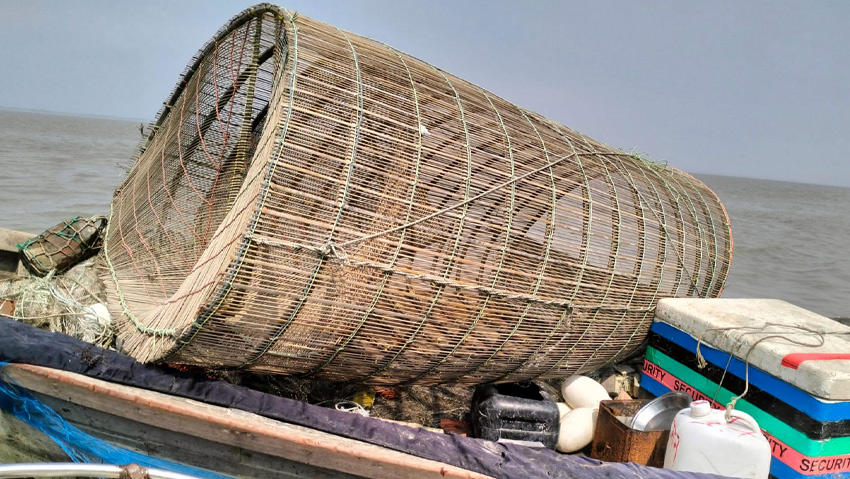
The widespread use of illegal giant fish traps known locally as “chai” in the Meghna and Tetulia rivers around Charfesson upazila in Bhola district is posing a serious threat to millions of juvenile pangas fish, raising concerns over the future of fish breeding and river biodiversity in the region.
Despite periodic drives by the fisheries department, local residents and experts allege that an organised syndicate continues to operate the banned traps with impunity, while weak monitoring and administrative inaction have allowed the destructive practice to flourish.
According to local sources, a network of fishermen has long been using large bamboo-made “chai” traps in the Meghna-Tetulia river system to indiscriminately catch juvenile pangas.
Fisheries officials occasionally seize some traps during raids, but the main operators remain beyond effective control.
Under Bangladesh’s fisheries regulations, catching pangas smaller than 12 inches (30 centimetres) is prohibited from November 1 to July 30 every year.
However, poor enforcement and lack of awareness among fishermen have rendered the restriction largely ineffective.
Fishermen said each giant trap costs between Tk 45,000 and Tk 50,000 to build and is mainly manufactured in Bhola’s Charfesson and Monpura areas, as well as parts of Bauphal upazila in Patuakhali district.
Before placing the traps 40 to 50 feet deep in the river, operators fill them with bait made from dried fish, oil cake, bran, sugar, flattened rice and fish oil. Within hours, tidal currents carry massive numbers of tiny pangas fry into the traps.
Locals estimate that around 40 juvenile fish make up just one kilogram, indicating the alarming scale of immature fish harvesting.
A single trap reportedly catches about 120 kilograms of fry daily, which are later sold in markets under the misleading label of “tengra” fish.
Fisheries experts, however, noted that real tengra is a separate species of catfish, typically much smaller in size and distinguishable by its dark back and silvery-white belly.
Residents alleged that around 50 fishermen, including several influential local figures from areas such as Betua New Sluz and Beribadh in Charfashion, are involved in the trade. Whenever enforcement drives begin, the operators reportedly shift locations to evade detection.
Officials said the fishermen also use technology to avoid capture. Many traps are placed in deep river channels and tracked using WhatsApp live-location features, making it difficult for authorities to locate them during operations.
Researchers previously identified the Tetulia River as a key breeding and migration zone for pangas. A 2017 study conducted under the EcoFish Bangladesh project, led by Sher-e-Bangla Agricultural University aquaculture researcher Mir Mohammad Ali, highlighted the ecological importance of protecting the area.
Mir Mohammad Ali warned that continued destruction of pangas fry in breeding grounds could severely reduce future fish production in Bangladesh’s rivers unless strict action is taken against the syndicates involved.
Charfesson Senior Fisheries Officer Joyonto Kumar Apu described the practice as a “serious threat” to pangas reproduction.
“We conduct regular drives, but it is difficult to identify the traps because they are set at night in deep waters,” he said, adding that larger-scale enforcement initiatives would be launched to stop the destructive fishing method.
SF/SH
Despite periodic drives by the fisheries department, local residents and experts allege that an organised syndicate continues to operate the banned traps with impunity, while weak monitoring and administrative inaction have allowed the destructive practice to flourish.
According to local sources, a network of fishermen has long been using large bamboo-made “chai” traps in the Meghna-Tetulia river system to indiscriminately catch juvenile pangas.
Fisheries officials occasionally seize some traps during raids, but the main operators remain beyond effective control.
Under Bangladesh’s fisheries regulations, catching pangas smaller than 12 inches (30 centimetres) is prohibited from November 1 to July 30 every year.
However, poor enforcement and lack of awareness among fishermen have rendered the restriction largely ineffective.
Fishermen said each giant trap costs between Tk 45,000 and Tk 50,000 to build and is mainly manufactured in Bhola’s Charfesson and Monpura areas, as well as parts of Bauphal upazila in Patuakhali district.
Before placing the traps 40 to 50 feet deep in the river, operators fill them with bait made from dried fish, oil cake, bran, sugar, flattened rice and fish oil. Within hours, tidal currents carry massive numbers of tiny pangas fry into the traps.
Locals estimate that around 40 juvenile fish make up just one kilogram, indicating the alarming scale of immature fish harvesting.
A single trap reportedly catches about 120 kilograms of fry daily, which are later sold in markets under the misleading label of “tengra” fish.
Fisheries experts, however, noted that real tengra is a separate species of catfish, typically much smaller in size and distinguishable by its dark back and silvery-white belly.
Residents alleged that around 50 fishermen, including several influential local figures from areas such as Betua New Sluz and Beribadh in Charfashion, are involved in the trade. Whenever enforcement drives begin, the operators reportedly shift locations to evade detection.
Officials said the fishermen also use technology to avoid capture. Many traps are placed in deep river channels and tracked using WhatsApp live-location features, making it difficult for authorities to locate them during operations.
Researchers previously identified the Tetulia River as a key breeding and migration zone for pangas. A 2017 study conducted under the EcoFish Bangladesh project, led by Sher-e-Bangla Agricultural University aquaculture researcher Mir Mohammad Ali, highlighted the ecological importance of protecting the area.
Mir Mohammad Ali warned that continued destruction of pangas fry in breeding grounds could severely reduce future fish production in Bangladesh’s rivers unless strict action is taken against the syndicates involved.
Charfesson Senior Fisheries Officer Joyonto Kumar Apu described the practice as a “serious threat” to pangas reproduction.
“We conduct regular drives, but it is difficult to identify the traps because they are set at night in deep waters,” he said, adding that larger-scale enforcement initiatives would be launched to stop the destructive fishing method.
SF/SH
Loading...
Loading...
Also read








Editor : Iqbal Sobhan Chowdhury
Published by the Editor on behalf of the Observer Ltd. from Globe Printers, 24/A, New Eskaton Road, Ramna, Dhaka.
Editorial, News and Commercial Offices : Aziz Bhaban (2nd floor), 93, Motijheel C/A, Dhaka-1000.
Phone: PABX- 41053001-06; Advertisement: 41053012; 01793317829, 01550707291, E-mail: [email protected], [email protected] Online: email: [email protected] 41053014; 01550707297 Advertisement: 01550707296
Published by the Editor on behalf of the Observer Ltd. from Globe Printers, 24/A, New Eskaton Road, Ramna, Dhaka.
Editorial, News and Commercial Offices : Aziz Bhaban (2nd floor), 93, Motijheel C/A, Dhaka-1000.
Phone: PABX- 41053001-06; Advertisement: 41053012; 01793317829, 01550707291, E-mail: [email protected], [email protected] Online: email: [email protected] 41053014; 01550707297 Advertisement: 01550707296


