



| HEADLINE |

|

The Ashes Are Warm
Published : Saturday, 4 July, 2026 at 12:00 AM
Mahesh Bhatt


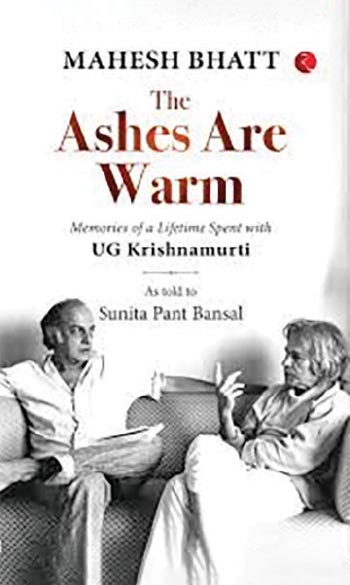 The filmmaker’s scorching memoir of his life with the anti-guru UG Krishnamurti as told to Sunita Pant Bansal also touches on his successes and failures, both romantic and professional…
“I came asking for light. /I was given fire. / And in the fire, I disappeared. / What remains is not me. / What remains is the smoke of a self, undone, curling through the empty chambers of the heart,” reads the Epilogue titled The Last Scripture in filmmaker Mahesh Bhatt’s The Ashes Are Warm: Memories of a Lifetime Spent with UG Krishnamurti. In the book, Bhatt looks back on a life in cinema and in the public eye, with its accoutrements of success and love, and adjuncts of scandal, grief and notoriety.
In reliving the moments and milestones of his life, Bhatt sounds like a man sitting amid the remains of his own certainties and ruins, touching each burnt object once to acknowledge that it existed, and not necessarily to restore it. The volume draws on Bhatt’s private jottings: diary-like entries written in hotel rooms, on film sets, and during moments of rage, tenderness, doubt and despair.Reviewed by Nawaid Anjum
Readers who pick up the book in search of a spiritual biography will be disappointed, perhaps usefully so, for, in this story of “two vagabonds with no destination.” UG is not presented as a guru, redeemer, philosopher or saint. In fact, the book’s deepest respect for him lies in its refusal to sanctify him. He is “the raging sage” in Bhatt’s life, the man who offered no balm, doctrine or Pethidine for the soul. The filmmaker says he went to UG scorched by life and did not receive consolation; instead, the anti-guru “rubbed salt” into his wounds. It is a brutal image, but also an honest one. UG, in a way, saved Bhatt not by comforting him, but by making comfort impossible.
Courtesy: Hindustan Times

Loading...
Loading...



Editor : Iqbal Sobhan Chowdhury
Published by the Editor on behalf of the Observer Ltd. from Globe Printers, 24/A, New Eskaton Road, Ramna, Dhaka.
Editorial, News and Commercial Offices : Aziz Bhaban (2nd floor), 93, Motijheel C/A, Dhaka-1000.
Phone: PABX- 41053001-06; Advertisement: 41053012; 01793317829, 01550707291, E-mail: [email protected], [email protected] Online: email: [email protected] 41053014; 01550707297 Advertisement: 01550707296
Published by the Editor on behalf of the Observer Ltd. from Globe Printers, 24/A, New Eskaton Road, Ramna, Dhaka.
Editorial, News and Commercial Offices : Aziz Bhaban (2nd floor), 93, Motijheel C/A, Dhaka-1000.
Phone: PABX- 41053001-06; Advertisement: 41053012; 01793317829, 01550707291, E-mail: [email protected], [email protected] Online: email: [email protected] 41053014; 01550707297 Advertisement: 01550707296


