



| HEADLINE |

|
Pry education reforms to draw on Japanese model: Bobby Hajjaj


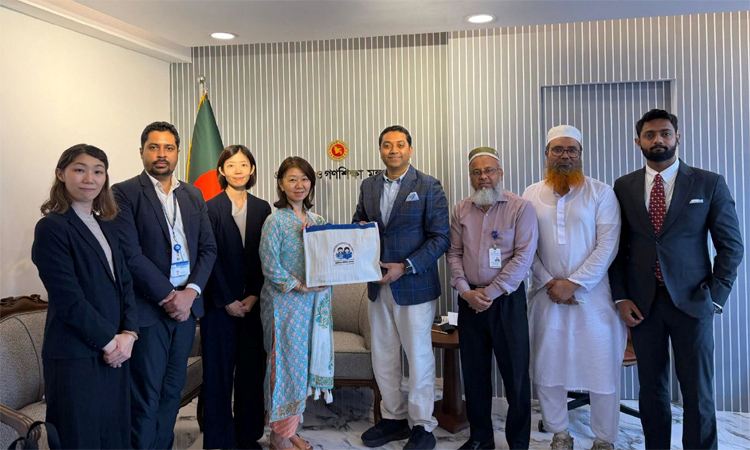
A high-level delegation led by Chief Representative of JICA Bangladesh Takahashi Junko met with State Minister for Primary and Mass Education Bobby Hajjaj in Dhaka on Wednesday. Photo: PID
State Minister for Primary and Mass Education Bobby Hajjaj on Wednesday said the government has undertaken extensive reforms to transform the country’s primary education system into one that is modern, skills-oriented and child-friendly.
He said, “In this regard, Japan’s successful experience in its education system has been sought, along with the country’s cooperation in curriculum development, teacher training and enhancing administrative efficiency.”
The state minister made the remarks during a courtesy meeting with a high-level delegation led by Takahashi Junko, chief representative of the Japan International Cooperation Agency (JICA) Bangladesh.
The meeting was held at the state minister’s office in the Secretariat in Dhaka, According to a press release.
Bobby Hajjaj said, “We are currently working on formulating a new curriculum for primary education. Special emphasis is being placed on improving the quality of civic education, sports education, cultural education, mathematics, and science education for Grade - 4 and 5, as well as ensuring a challenging and enjoyable learning environment for students.”
Stating that Japan’s civic education is widely admired, he said, “We want to learn from Japan’s experience to foster a sense of responsibility, discipline, ethics, and civic values among our students.”
He also outlined plans to establish “math labs” in primary schools in phases. Like science labs, the initiative is aimed at making mathematics education more attractive and technology-based, he said, adding that JICA’s technical support, training and advice would be important in this area.
He further said that as part of structural reforms in primary education, Bangladesh is reviewing the education administration systems of Thailand and Turkey.
“Initiatives have been taken to upgrade the responsibilities, accountability, Key Performance Indicators (KPIs), and monitoring systems of field-level offices to international standards,” he said.
Members of the JICA delegation expressed their interest in continuing ongoing cooperation in the development of primary education in Bangladesh. They discussed possible cooperation in areas such as curriculum development, teacher training, extracurricular activities, enhancing the efficiency of education administration, and creating a child-friendly learning environment.
Loading...
Loading...
Also read



Editor : Iqbal Sobhan Chowdhury
Published by the Editor on behalf of the Observer Ltd. from Globe Printers, 24/A, New Eskaton Road, Ramna, Dhaka.
Editorial, News and Commercial Offices : Aziz Bhaban (2nd floor), 93, Motijheel C/A, Dhaka-1000.
Phone: PABX- 41053001-06; Advertisement: 41053012; 01793317829, 01550707291, E-mail: [email protected], [email protected] Online: email: [email protected] 41053014; 01550707297 Advertisement: 01550707296
Published by the Editor on behalf of the Observer Ltd. from Globe Printers, 24/A, New Eskaton Road, Ramna, Dhaka.
Editorial, News and Commercial Offices : Aziz Bhaban (2nd floor), 93, Motijheel C/A, Dhaka-1000.
Phone: PABX- 41053001-06; Advertisement: 41053012; 01793317829, 01550707291, E-mail: [email protected], [email protected] Online: email: [email protected] 41053014; 01550707297 Advertisement: 01550707296


