



| HEADLINE |

|

New online scam, 5 mistakes that could empty bank account



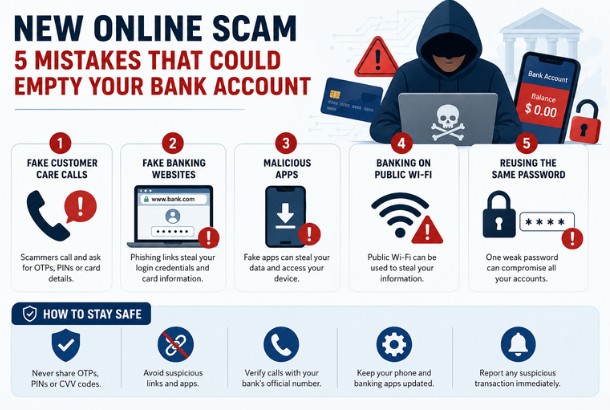
As online banking, mobile financial services (MFS) and digital payments become increasingly popular, cybercriminals are adopting more sophisticated tactics to steal users' financial information.
While one-time password (OTP) theft was once their primary method, fraudsters are now exploiting fake banking websites, bogus customer care services, remote access apps and social media to target unsuspecting customers. while one to one their passward the report of the court of the report the
Cybersecurity experts warn that user negligence, rather than technical vulnerabilities, remains the biggest factor behind most successful online financial fraud.
Fake Customer Care Calls
One of the most common scams involves fraudsters posing as officials from banks or financial institutions. Victims receive calls claiming that their accounts will be suspended or that their Know Your Customer (KYC) information must be updated immediately.
The callers then ask for sensitive information such as OTPs, debit or credit card numbers, CVV codes or mobile banking PINs. Once these details are disclosed, criminals can transfer funds from the victim's account within minutes.
Fake Banking Websites
Cybercriminals also send phishing links through SMS, email and messaging platforms. These links direct users to counterfeit banking websites that closely resemble legitimate ones.
When users enter their usernames, passwords or card details, the information is transmitted directly to the fraudsters, who later use it to carry out unauthorised transactions.
Malicious Apps
Fraudsters often lure users into installing unknown mobile applications by promising instant loans, cashback offers, rewards or online income opportunities.
Some of these apps request excessive permissions, allowing them to monitor screens, read messages or collect sensitive information. Security experts advise users to download applications only from official app stores and verify their authenticity before installation.
Banking on Public Wi-Fi
Using public Wi-Fi networks at airports, restaurants or other public places for financial transactions poses significant security risks.
Unsecured networks make it easier for cybercriminals to intercept personal information. Experts recommend using mobile data or trusted private networks when accessing banking services or conducting financial transactions.
Reusing the Same Password
Many users continue to use the same password for email accounts, social media and banking applications.
If one account is compromised, hackers can often gain access to other accounts using the same credentials. Cybersecurity professionals recommend creating unique, strong passwords for each important account and enabling two-factor authentication (2FA) wherever possible.
How to Stay Safe
Never share OTPs, PINs or CVV codes with anyone, avoid clicking suspicious links, scanning unknown QR codes or installing unverified applications, verify any call claiming to be from a bank by contacting the institution through its official customer service number, keep smartphones and banking applications updated with the latest security patches, immediately notify the bank if any suspicious or unauthorised transaction is detected.
As digital financial services continue to transform everyday life, cybercriminals are also evolving their methods. Security experts say that vigilance, verifying information before taking action and following basic cybersecurity practices remain the most effective defences against online financial fraud.
While one-time password (OTP) theft was once their primary method, fraudsters are now exploiting fake banking websites, bogus customer care services, remote access apps and social media to target unsuspecting customers. while one to one their passward the report of the court of the report the
Cybersecurity experts warn that user negligence, rather than technical vulnerabilities, remains the biggest factor behind most successful online financial fraud.
Fake Customer Care Calls
One of the most common scams involves fraudsters posing as officials from banks or financial institutions. Victims receive calls claiming that their accounts will be suspended or that their Know Your Customer (KYC) information must be updated immediately.
The callers then ask for sensitive information such as OTPs, debit or credit card numbers, CVV codes or mobile banking PINs. Once these details are disclosed, criminals can transfer funds from the victim's account within minutes.
Fake Banking Websites
Cybercriminals also send phishing links through SMS, email and messaging platforms. These links direct users to counterfeit banking websites that closely resemble legitimate ones.
When users enter their usernames, passwords or card details, the information is transmitted directly to the fraudsters, who later use it to carry out unauthorised transactions.
Malicious Apps
Fraudsters often lure users into installing unknown mobile applications by promising instant loans, cashback offers, rewards or online income opportunities.
Some of these apps request excessive permissions, allowing them to monitor screens, read messages or collect sensitive information. Security experts advise users to download applications only from official app stores and verify their authenticity before installation.
Banking on Public Wi-Fi
Using public Wi-Fi networks at airports, restaurants or other public places for financial transactions poses significant security risks.
Unsecured networks make it easier for cybercriminals to intercept personal information. Experts recommend using mobile data or trusted private networks when accessing banking services or conducting financial transactions.
Reusing the Same Password
Many users continue to use the same password for email accounts, social media and banking applications.
If one account is compromised, hackers can often gain access to other accounts using the same credentials. Cybersecurity professionals recommend creating unique, strong passwords for each important account and enabling two-factor authentication (2FA) wherever possible.
How to Stay Safe
Never share OTPs, PINs or CVV codes with anyone, avoid clicking suspicious links, scanning unknown QR codes or installing unverified applications, verify any call claiming to be from a bank by contacting the institution through its official customer service number, keep smartphones and banking applications updated with the latest security patches, immediately notify the bank if any suspicious or unauthorised transaction is detected.
As digital financial services continue to transform everyday life, cybercriminals are also evolving their methods. Security experts say that vigilance, verifying information before taking action and following basic cybersecurity practices remain the most effective defences against online financial fraud.

Loading...
Loading...
Also read









Editor : Iqbal Sobhan Chowdhury
Published by the Editor on behalf of the Observer Ltd. from Globe Printers, 24/A, New Eskaton Road, Ramna, Dhaka.
Editorial, News and Commercial Offices : Aziz Bhaban (2nd floor), 93, Motijheel C/A, Dhaka-1000.
Phone: PABX- 41053001-06; Advertisement: 41053012; 01793317829, 01550707291, E-mail: [email protected], [email protected] Online: email: [email protected] 41053014; 01550707297 Advertisement: 01550707296
Published by the Editor on behalf of the Observer Ltd. from Globe Printers, 24/A, New Eskaton Road, Ramna, Dhaka.
Editorial, News and Commercial Offices : Aziz Bhaban (2nd floor), 93, Motijheel C/A, Dhaka-1000.
Phone: PABX- 41053001-06; Advertisement: 41053012; 01793317829, 01550707291, E-mail: [email protected], [email protected] Online: email: [email protected] 41053014; 01550707297 Advertisement: 01550707296


