



| HEADLINE |

|

Pecuniary penalties alone cannot protect consumer rights: CAB president
Published : Saturday, 1 August, 2026 at 12:00 AM
Ahsan Uddin Bhuiyan


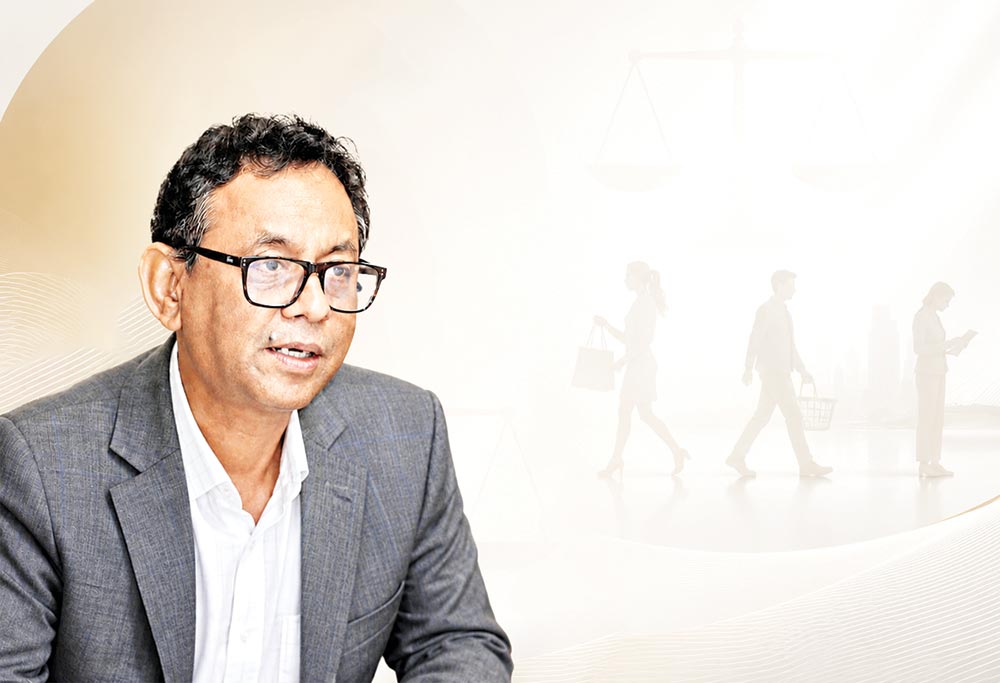 From food adulteration to shady dealings in the service sector, from irregularities in healthcare to unchecked fees in education, ordinary citizens find themselves short-changed at nearly every turn. The Consumers Association of Bangladesh has spent decades fighting to change that. Ahsan Uddin Bhuiyan speaks to AHM Shafiquzzaman, President of the Consumers Association of Bangladesh (CAB) and Chief Executive Officer of Gonoshasthaya Kendra, about the state of consumer protection in the country. The former secretary and former Director General of the Department of Consumer Affairs sat down with The Daily Observer to discuss where consumer protection stands today.
Observer: Consumers in this country seem to be losing out on almost every front. Could you tell us about CAB's work in this area?
Shafiquzzaman: Frankly, we haven't organised our efforts as well as we should, and public awareness remains limited. Part of the problem is structural. In wealthier countries, both buyers and sellers are generally well-informed. Here, the reverse is true. From the moment a product enters the supply chain-whether locally made or imported-it passes through countless hands taking their cut. By the time it reaches the shelf, it is often counterfeit in some form. Genuine products are scarce, prices go unchecked, standards are weak, and consumers steadily lose what little protection they have.
CAB has been campaigning on these issues since 1970, rallying consumers across the country. We are affiliated with Consumers International and operate as an NGO, driven largely by volunteers. I have chaired the central committee for the past year, supported by 64 district committees and about 130 upazila committees comprising teachers, lawyers, journalists and other public-spirited citizens.
Our first task is to build awareness by organising people. That sustained pressure eventually led to the National Consumer Rights Protection Act, 2009, and the creation of a dedicated directorate, which I later headed as Director General for about two and a half years. We have used everything from social media campaigns to grassroots outreach to warn people about dangerous products. Consumers who feel cheated can also lodge complaints. While the process is not fully judicial, it functions as a quasi-judicial mechanism with the authority to impose administrative fines.
"We have specialised courts for violence against women and electricity disputes; consumer rights deserve specialized court or tribunal too"
Observer: You mentioned the 2009 Act. How robust is it and is there room for reform?
Shafiquzzaman: The push for consumer protection legislation began in 1976, though the Act was not passed until 2009. Establishing the department and recruiting staff took several more years, by which time much ground had already been lost. Since then, the landscape has changed dramatically. E-commerce has surged, cybercrime has emerged, and the 2009 law is no longer fit for purpose.
I helped draft amendment proposals. The Act now covers ten sectors, but we identified at least five more that should be included, notably tourism, education, and healthcare issues such as drug adulteration and unregulated diagnostic charges.
The greater problem, however, is manpower. The department remains chronically understaffed. Officers are recruited as non-cadre Assistant Directors through the Public Service Commission. Of the first batch of eighteen, only two have become Directors and seven or eight Deputy Directors. Many will complete 32 or 34 years of service and retire as Assistant Directors. Take Jabbar Mondal. He has earned immense public respect, yet under the present system he, too, is likely to retire at the rank he entered. These officers work under relentless pressure, often facing threats from powerful business interests, with little prospect of promotion or adequate resources. That is enough to sap the resolve of even the most dedicated.
Seventeen districts still have no officer, while most others rely on a single Assistant Director and one computer operator. In Dinajpur alone, covering 13 upazilas can mean travelling 200 to 300 kilometres between Ghoraghat and Birganj. Two people simply cannot police such a vast area. Counterfeit goods flood the markets, and effective monitoring is impossible under these conditions.
Observer: The fines collected through mobile courts and enforcement drives conducted by the Directorate of National Consumer Rights Protection go into the government coffers. Do victims ever receive any compensation?
Shafiquzzaman: Our law gives us three core mandates. First, raising awareness through leaflets, seminars and, above all, digital outreach. We rely heavily on Facebook, YouTube and live online campaigns to reach 180 million consumers who are routinely cheated.
Second, direct enforcement against counterfeit and adulterated products. Third, a complaints mechanism. We introduced the Consumer Complaint Management System (CCMS), allowing anyone with a smartphone to photograph a problem, add a brief description and file a complaint online. The system automatically generates a case number and hearing date. Since its launch, complaints have increased roughly tenfold.
Observer: Do you think Bangladesh needs a dedicated consumer court?
Shafiquzzaman: Directorate officers do not have magistracy powers. Unlike executive magistrates under the Mobile Court Act, they cannot imprison offenders, only impose administrative fines. There has been discussion about granting them such powers, but I'm not convinced that is the right approach.
The law does give the Director General discretion in serious cases, yet taking on powerful business lobbies is never easy, as governments often heed their interests. There is also a structural gap: individuals cannot go directly to civil court; only an Assistant Director can file a case. Given how much has changed since 2009, I believe consumers should have direct access to judicial remedies.
Observer: Looking at Scandinavian countries, where consumer awareness runs high - what's your advice for us?
Shafiquzzaman: It begins with self-awareness as citizens. We speak of climate funds while cutting down our own forests and polluting our rivers. Our patience and civic values have eroded so badly that, at times, we seem driven by primitive instincts. In developed countries, which rank high on human rights indices, food adulteration is almost unthinkable. Here, we mix industrial dyes into food, reuse burnt cooking oil, and sell counterfeit fertilisers and pesticides that poison our soil and water. All for marginal profit, at the expense of a nation's health. Few families remain untouched by cancer or kidney disease linked to such contamination.
Observer: The current government appears more receptive on these issues. Any message for them?
Shafiquzzaman: Ultimately, responsibility rests with the government, which governs on the people's mandate. When rice prices rise without reason and the state stays silent, one must ask whose interests it serves. We have endured an eighteen-month interim period and now have an elected government-but has corruption ended? Has street-level extortion, which adds 30 per cent to product prices, stopped? We accepted higher electricity tariffs, yet theft and system losses persist, and meter readers continue to build mansions.

Loading...
Loading...



Editor : Iqbal Sobhan Chowdhury
Published by the Editor on behalf of the Observer Ltd. from Globe Printers, 24/A, New Eskaton Road, Ramna, Dhaka.
Editorial, News and Commercial Offices : Aziz Bhaban (2nd floor), 93, Motijheel C/A, Dhaka-1000.
Phone: PABX- 41053001-06; Advertisement: 41053012; 01793317829, 01550707291, E-mail: [email protected], [email protected] Online: email: [email protected] 41053014; 01550707297 Advertisement: 01550707296
Published by the Editor on behalf of the Observer Ltd. from Globe Printers, 24/A, New Eskaton Road, Ramna, Dhaka.
Editorial, News and Commercial Offices : Aziz Bhaban (2nd floor), 93, Motijheel C/A, Dhaka-1000.
Phone: PABX- 41053001-06; Advertisement: 41053012; 01793317829, 01550707291, E-mail: [email protected], [email protected] Online: email: [email protected] 41053014; 01550707297 Advertisement: 01550707296


