



| HEADLINE |

|
When the lights go out: Bangladesh’s disappearing cinema halls
Published : Monday, 3 August, 2026 at 3:23 PM
Sakia Kawser Siddique


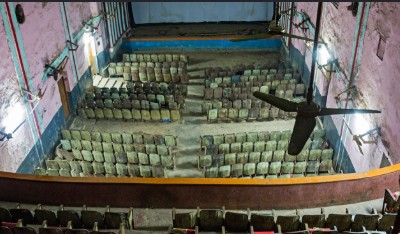
For generations, cinema halls were more than places to watch films in Bangladesh. They were gathering places where audiences experienced movies together, and where generations grew up with the big screen.
Today, that familiar landscape is steadily disappearing.
The latest examples have come from Rangpur and Bhairab, where two historic cinema halls have closed. Shapla Talkies in Rangpur permanently ceased operations after its final screening on July 31, while Madhumati Cinema Hall in Bhairab, Kishoreganj, also closed and demolition began immediately afterwards.
Their closures are the latest signs of a long-running crisis in Bangladesh's traditional cinema exhibition sector, where falling audiences, financial losses and a shortage of commercially viable films have made it increasingly difficult for single-screen halls to survive.
Rangpur's final curtain
Established in 1978, Shapla Talkies served generations of cinema-goers in Rangpur for nearly five decades.
It screened its final film on July 31 and has now permanently closed. The hall's management cited the prolonged shortage of commercially viable Bangladeshi films, saying Eid releases alone could not sustain the business throughout the year. There are also plans to repurpose the property.
The closure effectively ends Rangpur's era of traditional single-screen cinema.
The city once had several cinema halls, including Shapla Talkies, Dorodi Hall, Oriental, Lakshmi Talkies, Noor Mahal and China Talkies. They gradually disappeared, leaving Shapla as the last surviving hall.
Bhairab loses another historic hall
The same story has unfolded in Bhairab.
Madhumati Cinema Hall, one of the town's historic theatres, officially closed in late July 2026, with demolition beginning immediately afterwards. Hall authorities attributed the decision to mounting financial losses and debt, particularly after difficulties during the past two Eid seasons. Its final screening was Saif Chandan's Malik.
Bhairab once had four cinema halls " Chobighor, Palash, Madhumati and Darshan.
Chobighor was later converted into a shopping centre, while Palash was demolished for residential and educational development. With Madhumati now gone, only Darshan remains among the town's traditional halls, according to recent reporting.
The closure demonstrates how quickly a town's cinema-going infrastructure can shrink.
Purobi falls in Mymensingh
In March 2025, Purobi Cinema Hall in Mymensingh was demolished, leaving Chhayabani as the city's last standing cinema hall.
Purobi was established shortly after Bangladesh's independence and had been part of Mymensingh's cinema culture for decades. Its demolition came after years of decline in the city's traditional cinema exhibition sector.
The Daily Star reported that Mymensingh once had five cinema halls " Ajanta, Chhayabani, Alaka, Purobi and the Sena Auditorium. Over the years, one after another disappeared, leaving Chhayabani as the city's last remaining hall.
Purobi's demolition shows another pressure facing traditional cinemas: when a hall can no longer generate enough revenue, the property may become more valuable for redevelopment than for film exhibition.
When closure is not always the end
Not every cinema hall that closes stays closed.
Modhuban Cineplex in Bogura shut down for several months because of a shortage of films but was scheduled to reopen ahead of Eid in March 2026 with Shakib Khan-starrer Prince.
Its experience is important because it demonstrates the precarious nature of the cinema business. A hall can remain physically intact and still be unable to operate when there are not enough commercially viable films to attract audiences.
Modhuban therefore represents a different part of the crisis " not the disappearance of a cinema building, but the difficulty of keeping a screen economically active.
Dhaka's Geet and Sangeet go dark
The capital has not escaped the problem.
Geet and Sangeet, two of Dhaka's oldest single-screen theatres, shut down operations again in August 2025 amid a shortage of quality Bangladeshi films and declining audience turnout.
Their closure was described as indefinite, rather than permanent. Hall authorities left open the possibility of reopening during Eid if the situation improved.
The two halls had also closed in December 2024 because of mounting business losses linked to a shortage of quality local films and a broader downturn in cinema-going culture. They reopened ahead of Eid-ul-Fitr in 2025, only to shut again later that year.
Their story highlights an important distinction: some cinema halls are not disappearing permanently but are caught in a cycle of opening and closing dictated by the availability of films and audience demand.
The film shortage problem
Across these cases, one problem repeatedly emerges: there are not enough films capable of sustaining cinema halls throughout the year.
Shapla Talkies' management said Eid releases alone could not keep the hall running year-round.
Geet and Sangeet cited the shortage of quality Bangladeshi releases and declining audience turnout for their repeated shutdowns.
Modhuban's temporary closure also came amid a shortage of films.
This creates a difficult cycle. When audiences do not come regularly, ticket revenue falls. With lower revenue, owners have less capacity to maintain or modernise halls. Poorer facilities can then make it harder to attract audiences.
More than empty seats
The decline of traditional cinemas is not simply a story about empty seats.
Cinema halls have historically been part of the cultural and social life of district towns. They provided relatively accessible entertainment and a shared public experience.
Their disappearance changes the cultural landscape of those communities.
In Rangpur, the closure of Shapla means the city's long chapter of traditional single-screen cinema has effectively ended.
In Mymensingh, the demolition of Purobi left Chhayabani as the city's last standing cinema hall.
In Bhairab, the closure of Madhumati has left another town with fewer traditional screens than it once had.
And in Dhaka, Geet and Sangeet illustrate how even long-established halls can be forced into indefinite shutdowns.
The multiplex question
Bangladesh's audiences have not stopped watching films. The success of individual releases continues to demonstrate that people will go to cinemas when a film creates sufficient interest.
But the exhibition landscape is changing.
Multiplexes offer modern facilities, improved projection and sound, comfortable seating and a different overall experience. Traditional single-screen halls often lack the resources to compete on the same terms.
That does not necessarily mean one model will replace the other.
A multiplex in a major city cannot fully substitute for a neighbourhood cinema hall in a district town. For many people outside major urban centres, the disappearance of a local hall means losing one of the few nearby places where films can be watched on the big screen.
A shrinking network
Recent closures show that the problem is spread across the country rather than confined to Dhaka.
Rangpur has lost Shapla Talkies. Bhairab has lost Madhumati. Mymensingh has lost Purobi. Bogura's Modhuban has already experienced a prolonged closure before reopening. Dhaka's Geet and Sangeet have repeatedly gone dark.
Each case is different, but together they show the pressure on Bangladesh's traditional cinema exhibition sector.
Some halls are demolished. Some are converted into other types of properties. Some close temporarily and return when a commercially successful film arrives.
Others simply stop operating.
Can the single-screen cinema survive?
The survival of traditional cinema halls will require more than keeping their buildings standing.
They need films capable of drawing audiences throughout the year, sustainable business models and facilities that reflect changing expectations.
The latest closures also show the urgency of the problem.
Shapla Talkies survived for nearly five decades before permanently closing. Madhumati's closure has added another historic hall to the list of cinemas lost to financial pressure. Purobi has already been demolished, while Modhuban and Geet-Sangeet demonstrate that even halls that remain physically intact can struggle to keep their screens running.
The challenge, therefore, is not merely to preserve cinema halls as buildings.
It is to rebuild the ecosystem that makes people want and can afford to walk through their doors.
For now, the pattern is clear.
One hall closes. Another is demolished. Another becomes something else. Another goes dark and waits for a film strong enough to bring audiences back.
And with every screen that disappears, a piece of Bangladesh's shared cinema-going history disappears with it.
Loading...
Loading...
Also read









Editor : Iqbal Sobhan Chowdhury
Published by the Editor on behalf of the Observer Ltd. from Globe Printers, 24/A, New Eskaton Road, Ramna, Dhaka.
Editorial, News and Commercial Offices : Aziz Bhaban (2nd floor), 93, Motijheel C/A, Dhaka-1000.
Phone: PABX- 41053001-06; Advertisement: 41053012; 01793317829, 01550707291, E-mail: [email protected], [email protected] Online: email: [email protected] 41053014; 01550707297 Advertisement: 01550707296
Published by the Editor on behalf of the Observer Ltd. from Globe Printers, 24/A, New Eskaton Road, Ramna, Dhaka.
Editorial, News and Commercial Offices : Aziz Bhaban (2nd floor), 93, Motijheel C/A, Dhaka-1000.
Phone: PABX- 41053001-06; Advertisement: 41053012; 01793317829, 01550707291, E-mail: [email protected], [email protected] Online: email: [email protected] 41053014; 01550707297 Advertisement: 01550707296


