



| HEADLINE |

|
We used to know everything, now we know nothing (except one thing)
Published : Tuesday, 4 August, 2026 at 10:50 PM
Shahman Abir


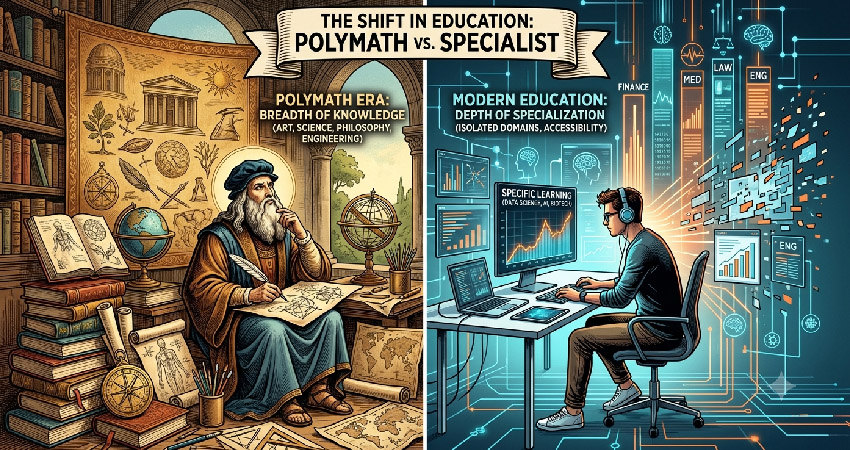
AI Image
The polymath era is commonly referred to as the timeline of pre-industrial and Renaissance societies, in which people used to gather broader perspectives, on almost ‘everything.’ As distribution of information in that period was scarce and slow-moving, people used to read books, journals, and travelogues to collect wisdom and apply it in real life.
Figures like Aristotle, Leonardo da Vinci, Ibn Sina, and Benjamin Franklin meaningfully contributed across various topics - art, science, philosophy, and engineering. In the case of the archaic education system, it was structured around breadth: rhetoric, math, philosophy, and even natural science together.
However, the modern education system emphasizes ‘specific’ learning curvature, as information has become very much accessible and easy to comprehend. In today's world, a single lifetime is not enough to acquire the vast ocean of wisdom single-handedly.
Contrarily, modern education only focuses on ‘specific specialization’" - speculating you may be a doctor, but never an engineer. The routes are troublesome for pursuing both streams at the same time.
Now for the turning point: why did this curvature shift? It is a pivotal question that must be discussed in this digitized, AI-driven world.
In the modern day, information explodes. The invention of the printing press, the scientific and industrial revolutions, the internet, and lastly AI - all of these have made the availability of information increase exponentially. Anyone can Google or use ChatGPT for anything, and most of the time, they can acquire precise information regarding the topic.
If this is the case, why is the current education system not reverting to the polymath era? It may seem a reasonable question; however, the answer may feel shockingly simple.
The first obstacle the polymath education system must conquer is the division of labor. Repeated tasks have pushed the economy toward specialization.
Furthermore, a time-intensive labor schedule has made it impossible for the current workforce to dive into the vast sea of insights.
The introduction of institutionalized disciplines in universities has categorized knowledge into departments. This has formalized boundaries between fields and is economically profitable, as students would enroll into a discipline to acquire specific knowledge. A key note on this take: knowledge depth is still expanding. For this reason, mastering a skill requires more years, making cross-domain mastery increasingly rare.
Old models of education featured a shallow curve - broad competence was present, but depth was missing everywhere. The new models feature a narrow and steep curve - deep expertise in one vertical, with only a shallower general path elsewhere.
Theoretically, there are multiple barriers to becoming a generalist; however, it may be possible to become one in this digitized era. Complex, cross-disciplinary problems are frequently emerging - for example, public health, climate change, or AI ethics - that need expertise across various disciplines. These problems cannot be solved by a narrow specialist alone.
Additionally, the internet and AI tools cost less than before. This has enabled the acquisition of surface-level knowledge across many areas once again - indicating a potential re-awakening of generalist ideologies.
All this discussion leads to a complex situation when it comes to reaching a verdict on the revival of generalist ideologies. Generalists are definitely creative and analogical, for they possess knowledge of many things. Nevertheless, one must never become Marlowe's Faustus - for the quest of knowing all may result in eternal doom.
Loading...
Loading...
Also read





Editor : Iqbal Sobhan Chowdhury
Published by the Editor on behalf of the Observer Ltd. from Globe Printers, 24/A, New Eskaton Road, Ramna, Dhaka.
Editorial, News and Commercial Offices : Aziz Bhaban (2nd floor), 93, Motijheel C/A, Dhaka-1000.
Phone: PABX- 41053001-06; Advertisement: 41053012; 01793317829, 01550707291, E-mail: [email protected], [email protected] Online: email: [email protected] 41053014; 01550707297 Advertisement: 01550707296
Published by the Editor on behalf of the Observer Ltd. from Globe Printers, 24/A, New Eskaton Road, Ramna, Dhaka.
Editorial, News and Commercial Offices : Aziz Bhaban (2nd floor), 93, Motijheel C/A, Dhaka-1000.
Phone: PABX- 41053001-06; Advertisement: 41053012; 01793317829, 01550707291, E-mail: [email protected], [email protected] Online: email: [email protected] 41053014; 01550707297 Advertisement: 01550707296


