



| HEADLINE |

|
Shigella infections among Dhaka children largely undetected


A large number of Shigella infections among young children in Dhaka are going undetected due to limitations in conventional laboratory testing, researchers have found.
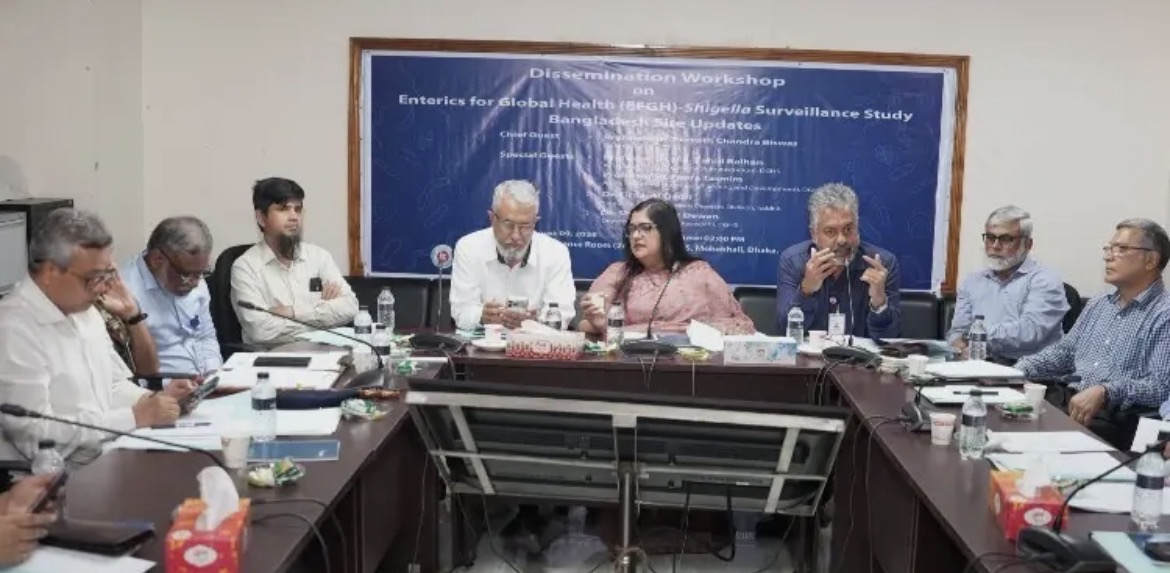
Researchers from icddr,b presented the findings at a high-level meeting at the Directorate General of Health Services (DGHS) in Dhaka on Sunday.
The findings were presented as part of the Enterics for Global Health Shigella Surveillance Study, along with recommendations to improve the detection and management of Shigella infections.
According to the study, the molecular qPCR test, which is more sensitive than conventional stool culture, detected more than twice as many Shigella infections from the same samples.
While conventional stool culture detected Shigella in around 5.9 percent of children, the qPCR test identified infections in 11.6 percent of the samples.
Researchers said the findings indicate that a substantial number of infections may remain undiagnosed when conventional testing methods are used.
Shigella can cause diarrhoea, dysentery, high fever and prolonged illness. Repeated or severe infections can also affect children’s physical development and contribute to stunting.
The study also found a high level of antimicrobial resistance (AMR) among Shigella bacteria in Bangladesh. Around six out of every 10 Shigella samples tested showed resistance to multiple antibiotics, indicating multidrug resistance.
The researchers also found extensively drug-resistant (XDR) Shigella in around one in 10 samples, making treatment increasingly difficult for physicians.
icddr,b senior scientists Dr Ferdousi Qadri and Dr Farhana Khanom jointly presented the key findings and recommendations of the study.
The meeting began with a welcome address by Dr Shah Newaz Dewan, director of planning and research at the DGHS.
Professor Dr Jalal Uddin Mohammad Rumi, director (administration) of the DGHS, and Professor Dr Foara Tasnim, additional director general (planning and development) of the DGHS, also spoke at the meeting.
Representatives from the Institute of Epidemiology, Disease Control and Research (IEDCR), World Health Organization, UNICEF, IFRC, city corporations and other national and international organisations attended the meeting.
To improve the prevention, diagnosis and treatment of Shigella infections, icddr,b recommended strengthening monitoring of antibiotic resistance and preventing the unnecessary use of antibiotics.
It also recommended ensuring proper use of oral saline, zinc and appropriate antibiotics in diarrhoea treatment, expanding access to modern diagnostic tests, and strengthening training for healthcare workers on the management of childhood illnesses.
SKS






Published by the Editor on behalf of the Observer Ltd. from Globe Printers, 24/A, New Eskaton Road, Ramna, Dhaka.
Editorial, News and Commercial Offices : Aziz Bhaban (2nd floor), 93, Motijheel C/A, Dhaka-1000.
Phone: PABX- 41053001-06; Advertisement: 41053012; 01793317829, 01550707291, E-mail: [email protected], [email protected] Online: email: [email protected] 41053014; 01550707297 Advertisement: 01550707296


