



| HEADLINE |

|

Four notable celestial events are coinciding around August 12
Published : Wednesday, 12 August, 2026 at 12:41 PM
Sakia Kawser Siddique


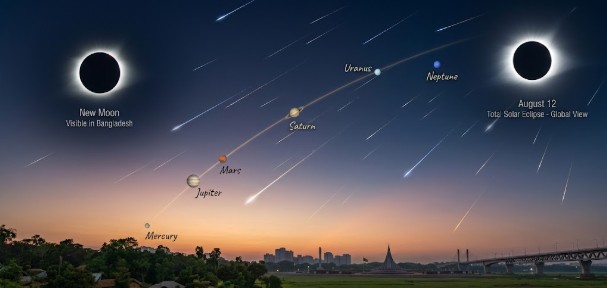
The sky is unusually busy today, August 12, as four notable celestial events coincide: a total solar eclipse, the peak of the annual Perseid meteor shower, a New Moon and a six-planet alignment.
The combination has sparked interest online, with claims that four natural phenomena are occurring on Earth today. Astronomers, however, describe these as celestial or astronomical events** rather than natural phenomena occurring on Earth.
More importantly for Bangladesh, not all four will be visible from the country.

Total solar eclipse
The most dramatic event is a total solar eclipse, as the Moon passes between the Sun and Earth and completely blocks the Sun for observers within the narrow path of totality.
According to NASA, the total eclipse will sweep across parts of northern Russia, Greenland, Iceland, northern Spain and a small corner of Portugal. A partial eclipse will be visible from wider areas of the Northern Hemisphere.
Bangladesh is outside the eclipse’s visibility zone, meaning people in the country will not be able to see either the total or partial phases of the August 12 eclipse.
Anyone observing the eclipse from an area where it is visible should use certified eclipse glasses or an appropriate solar viewer. Ordinary sunglasses are not safe for viewing the Sun.

Perseid meteor shower peaks
The Perseid meteor shower reaches its peak on the night of August 12 and into the early hours of August 13.
The Perseids occur every year as Earth passes through debris left behind by Comet Swift-Tuttle. As tiny particles enter the atmosphere at high speed, they burn up and create bright streaks of light across the sky.
NASA says the shower can produce as many as 50 to 100 meteors per hour under suitable viewing conditions. This year is particularly favourable because the New Moon will leave the sky dark, making meteors easier to see.
The meteor shower can be observed from Bangladesh, provided skies are clear and the viewing location is sufficiently dark. NASA recommends finding a dark location, allowing the eyes time to adjust to the darkness and simply watching the sky.

New Moon
The Moon reaches its New Moon phase on August 12.
At New Moon, the Moon is positioned approximately between Earth and the Sun, with the illuminated side facing away from Earth. It therefore becomes largely invisible from Earth.
This is also why this year's Perseid peak is expected to have particularly dark skies. NASA specifically notes that the New Moon will provide favourable conditions for watching the meteor shower.

Six planets appear in a broad arc
A six-planet alignment is also taking place around August 12, with Jupiter, Mercury, Mars, Uranus, Saturn and Neptune appearing along the ecliptic in the pre-dawn sky.
The term “alignment” can be misleading. The planets are not actually arranged in a straight line in space. Rather, they appear along a broad arc in the sky because their orbits lie roughly in the same plane and they are being viewed from Earth.
The event will not mean six bright planets are all easily visible to the naked eye. Mars and Saturn are among the easiest to spot, while Mercury and Jupiter are much lower and more difficult to see. Uranus and Neptune generally require binoculars or a telescope.
What can people in Bangladesh see?
For Bangladesh, the Perseid meteor shower is the most accessible of the four events.
The August 12 solar eclipse will not be visible from Bangladesh, while the New Moon itself will not appear as a visible disc.
Some of the planets involved in the alignment can be observed from Dhaka in the pre-dawn hours. Current skywatching data show Mars and Saturn as observable before sunrise, while Mercury and Jupiter will be much harder to spot because of their proximity to the Sun. Uranus and Neptune require optical aid.
No cause for alarm
The coincidence of these events does not signal an unusual danger to Earth.
Solar eclipses, meteor showers, lunar phases and planetary alignments are predictable astronomical events. Their occurrence around the same date is a striking coincidence, but it does not indicate an impending natural disaster or any unusual threat to the planet.
So, while August 12 is an unusually interesting date for skywatchers, the claim that “four natural phenomena will happen on Earth today” needs some correction.

Loading...
Loading...
Also read









Editor : Iqbal Sobhan Chowdhury
Published by the Editor on behalf of the Observer Ltd. from Globe Printers, 24/A, New Eskaton Road, Ramna, Dhaka.
Editorial, News and Commercial Offices : Aziz Bhaban (2nd floor), 93, Motijheel C/A, Dhaka-1000.
Phone: PABX- 41053001-06; Advertisement: 41053012; 01793317829, 01550707291, E-mail: [email protected], [email protected] Online: email: [email protected] 41053014; 01550707297 Advertisement: 01550707296
Published by the Editor on behalf of the Observer Ltd. from Globe Printers, 24/A, New Eskaton Road, Ramna, Dhaka.
Editorial, News and Commercial Offices : Aziz Bhaban (2nd floor), 93, Motijheel C/A, Dhaka-1000.
Phone: PABX- 41053001-06; Advertisement: 41053012; 01793317829, 01550707291, E-mail: [email protected], [email protected] Online: email: [email protected] 41053014; 01550707297 Advertisement: 01550707296


