



| HEADLINE |

|

Iran war threatens education as families struggle to survive
Published : Monday, 17 August, 2026 at 2:06 PM
Observer Online Desk


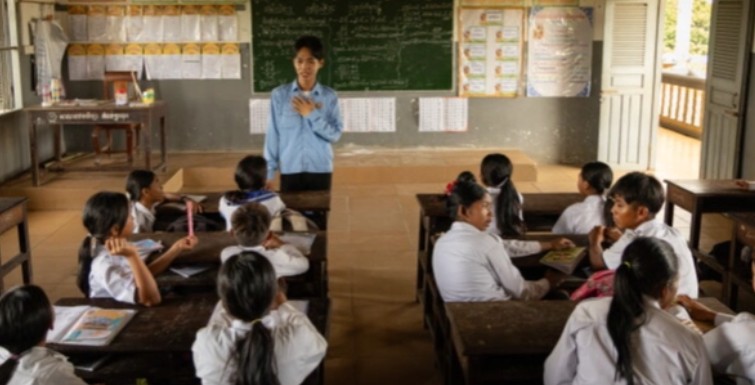
Sou Sreynich, 13, dreams of becoming a teacher, but she knows she has fallen behind in her education.
She did not start attending school until she was 10, several years later than most Cambodian children. Her mother delayed sending her because she feared the boat ride to school could be dangerous before Sreynich was old enough to swim. Such concerns are common among families living on Cambodia's Tonle Sap, Southeast Asia's largest freshwater lake.
Now, rising fuel prices linked to the Iran war are creating another obstacle. Unlike the widespread school shutdowns seen during the COVID-19 pandemic, the conflict's effect on education is less obvious. However, poor families are being hit hardest as transportation becomes more expensive and governments face increasing pressure on their education budgets.
Life on Tonle Sap already depends heavily on boats. Climate change has made conditions even more difficult by causing increasingly unpredictable floods and droughts. Teachers at Sreynich's school say 10 students have drowned there over the years.
If the conflict continues, as many as 23.4 million additional children could fall into poverty by the end of the year, according to a recent UNICEF report. Around 80% of those children are expected to live in Africa and Asia.
Each morning, fuel-powered boats travel through Kampong Prahok, often operated by students only slightly older than the children they transport. The boats stop beside floating homes as students in school uniforms climb aboard, carefully protecting their books and backpacks from the water.
Sreynich's family, like many others around Tonle Sap, depends mainly on fishing. They supplement their income by picking chilies and cleaning fish for other people. But higher fuel costs have made it impossible for them to travel farther into the lake, where fish are more abundant.
When the family struggles financially, Sreynich sometimes misses one or two days of school to help her parents earn money. She worries about falling further behind but remains determined to finish her education.
Poor families face difficult choices
For families already struggling to survive, higher prices caused by the war are forcing them to decide whether limited money should go toward food, fuel, housing and electricity or toward keeping their children in school.
Sabrina Hervey of the Qatar-based Education Above All Foundation said the conflict could cause millions of children to leave school or prevent others from enrolling altogether.
In parts of Southeast Asia, some children are already leaving school to work.
In Vietnam, sisters Ly, 16, and Nhi, 13, come from a fishing family with nine children. Their education has repeatedly been interrupted because their parents have struggled to provide for the family.
Their father lost his fishing job after rising diesel costs made it too expensive for boat owners to operate. With the family already carrying debt, his temporary jobs were not enough to support all nine children.
The two girls eventually left school and moved to Hanoi, where they worked long hours at a restaurant. Their jobs exposed them to dangerous conditions involving sharp equipment, hot surfaces and heavy lifting. For 13-year-old Nhi, working was also a violation of Vietnam's child labor laws.
The Hanoi-based Blue Dragon Children's Foundation stepped in during April, helping the sisters return to school.
Michael Brosowski of the organization said the effects of the war have developed gradually but are having serious consequences. When families reach a financial crisis, they often choose to keep some children in school while sending others to work. Children who leave school become more vulnerable to exploitation, trafficking and homelessness.
Rising fuel costs affect education systems
Higher energy prices are increasing the cost of nearly every aspect of education. Transportation for students and teachers is becoming more expensive, while schools must pay more for basic supplies such as pencils and chalk. Aid workers also face higher costs when traveling to isolated communities.
Governments are under similar pressure because food and energy bills are rising, leaving fewer resources available for education.
On Tonle Sap, where almost everything must be transported by boat, costs were already higher than elsewhere in Cambodia.
Samphors Vorn of the nonprofit Aide et Action, which supports Sreynich's school, said even operating the school's computer laboratory has become significantly more expensive.
Conflict threatens education gains around the world
Developing countries that depend heavily on imported fuel have been particularly vulnerable to the economic effects of the war. Higher fertilizer prices and declining remittances are adding further pressure to already fragile economies.
Bangladesh, whose economy was already facing difficulties, is also at risk of losing progress made in reducing poverty and improving education.
A U.N. Development Programme report warned that increased fuel costs and government spending on subsidies could put additional pressure on Bangladesh's finances, leaving less money available for health care and education.
Girls may face even greater risks in some South Asian countries because struggling families often prioritize boys' education. Arshad Malik of Save the Children International warned that worsening economic conditions could lead to more girls leaving school and an increase in child marriages.
According to UNICEF, South Asia is home to 45% of the world's child brides, the largest share of any region.
School meal programs could also be affected. More than 466 million children worldwide receive at least one meal at school each day, according to the U.N. World Food Programme. These meals encourage children to remain in school while improving concentration, learning and healthy development.
However, such programs could face growing financial pressure as the conflict disrupts fertilizer supplies and increases transportation costs. The impact may be especially severe in parts of West and Central Africa, which depend heavily on imported food.
Health and aid workers in northern Nigeria are already reporting that more children are suffering from malnutrition again.
Hervey said she is deeply concerned about how much worse the situation could become if the economic effects of the conflict continue.
Loading...
Loading...
Also read






Editor : Iqbal Sobhan Chowdhury
Published by the Editor on behalf of the Observer Ltd. from Globe Printers, 24/A, New Eskaton Road, Ramna, Dhaka.
Editorial, News and Commercial Offices : Aziz Bhaban (2nd floor), 93, Motijheel C/A, Dhaka-1000.
Phone: PABX- 41053001-06; Advertisement: 41053012; 01793317829, 01550707291, E-mail: [email protected], [email protected] Online: email: [email protected] 41053014; 01550707297 Advertisement: 01550707296
Published by the Editor on behalf of the Observer Ltd. from Globe Printers, 24/A, New Eskaton Road, Ramna, Dhaka.
Editorial, News and Commercial Offices : Aziz Bhaban (2nd floor), 93, Motijheel C/A, Dhaka-1000.
Phone: PABX- 41053001-06; Advertisement: 41053012; 01793317829, 01550707291, E-mail: [email protected], [email protected] Online: email: [email protected] 41053014; 01550707297 Advertisement: 01550707296


