



| HEADLINE |

|

From Ladyland to Dhaka’s Pink Buses
Published : Saturday, 22 August, 2026 at 12:00 AM
Sayma Sultana


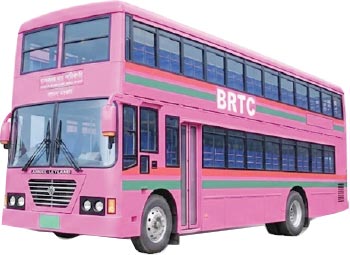 For millions of women navigating Dhaka’s bustling streets, the daily commute is rarely just a journey. It is often an exercise in risk management�"choosing which bus to take, where to stand, when to travel and how much personal space can be protected in an overcrowded vehicle. In such a reality, the emergence of women-only “pink buses” offers something undeniably valuable: safety.
For female students, workers and professionals, these buses can mean the simple dignity of reaching a destination without harassment, unwanted physical contact or constant anxiety. They can also open doors to education, employment, healthcare and economic participation.
But they raise a more difficult question about the city itself: Are we making public transport safer for women, or asking women to retreat into safer corners of an unsafe public sphere?
The distinction matters.
More than a century ago, Begum Rokeya explored precisely this question in Sultana’s Dream (1905). Her fictional Ladyland was not simply a place where women were protected from danger, but a radical reimagining of who had the right to occupy public space. Women moved freely through clean, technologically advanced surroundings, while men were confined to the domestic mardana. Rokeya inverted the logic of purdah: instead of restricting women for their protection, she removed men from public space so that women could experience unrestricted freedom.
The significance of Ladyland, therefore, lies not in its futuristic air-cars, but in an idea that the burden of safety should not permanently fall on those who are vulnerable.
Charlotte Perkins Gilman’s Herland (1915) offers another version of this imagined world. Its roads and public spaces do not require women to live behind defensive barriers because the social conditions that produce male domination have been fundamentally altered. Mobility does not depend on segregation because safety is embedded in the society itself.
Marge Piercy’s Woman on the Edge of Time (1976) similarly imagines a future where transportation and public infrastructure are communal, accessible and woven into everyday life.
The four works differ dramatically in setting, politics and imagination. Yet they share a common principle: women’s liberation is not ultimately achieved by creating smaller, safer spaces within an unchanged public world. It requires transforming the conditions of the public world itself.
That is where Dhaka’s pink buses present an important paradox.
On one hand, segregated transport can be a necessary response to an unsafe reality. If a woman can travel safely on a pink bus rather than avoid public transport altogether, the intervention has real value. On the other hand, segregation can unintentionally shift the responsibility for safety back onto women. Instead of asking why harassment occurs on ordinary buses, women are asked to find a different bus. Instead of making public spaces safer for everyone, we create designated safe spaces within them.
This creates what might be called the pink bus paradox: a measure can expand women’s freedom in the short term while exposing the limits of equality in the wider transport system.
The question, therefore, is not whether pink buses are “good” or “bad,” but what role they should play in the journey towards a safer and more equitable city.
If women-only buses are treated as the solution, the city risks normalising the idea that women need separate spaces to move safely. But as part of a broader transition towards gender-responsive transport, they can serve a more meaningful purpose: keeping women mobile today while building a city where segregation becomes less necessary tomorrow.
Because mobility is more than movement. It is opportunity.
A woman who cannot travel safely may be unable to take a job, attend university, access healthcare, run a business or participate fully in public life. Unsafe transport carries a social and economic cost, shifting the burden of insecurity onto women who must avoid certain routes, hours or modes of travel. The ultimate goal should therefore be to reverse that equation.
Instead of expecting women to constantly calculate risk, urban systems should reduce the risk itself through safer bus stops, better lighting, reliable transport, trained workers, effective complaint mechanisms, stronger enforcement against harassment, accessible last-mile connections and gender-responsive planning. It must also recognise that women are not a single category. The mobility needs of a university student, a garment worker travelling before dawn, a woman with a disability, an older woman or a mother with children can be very different. A truly inclusive transport system must respond to these differences rather than assume one designated vehicle can solve them all.
This is perhaps where Begum Rokeya’s vision remains most relevant.
Rokeya did not imagine air-cars so that women could hide from the world. She imagined them because women had a right to move through the world without restriction. Ladyland was not about creating a better enclosure for women but a society in which they no longer needed one.
Dhaka’s pink buses should therefore be seen neither as a failure of liberation nor its final achievement. They are a response to a real and urgent problem�"and, at the same time, a reminder of the structural work that remains unfinished. The measure of progress should not be how many separate spaces we create for women to feel safe, but how little they need to think about safety before claiming their right to move.
Perhaps the true destination lies somewhere between Dhaka's pink buses and Rokeya’s Ladyland: a city where a woman can board any bus, at any hour, on any route, not because she has found a protected corner, but because the entire city has become worthy of her freedom.
The writer is a development professional
Loading...
Loading...



Editor : Iqbal Sobhan Chowdhury
Published by the Editor on behalf of the Observer Ltd. from Globe Printers, 24/A, New Eskaton Road, Ramna, Dhaka.
Editorial, News and Commercial Offices : Aziz Bhaban (2nd floor), 93, Motijheel C/A, Dhaka-1000.
Phone: PABX- 41053001-06; Advertisement: 41053012; 01793317829, 01550707291, E-mail: [email protected], [email protected] Online: email: [email protected] 41053014; 01550707297 Advertisement: 01550707296
Published by the Editor on behalf of the Observer Ltd. from Globe Printers, 24/A, New Eskaton Road, Ramna, Dhaka.
Editorial, News and Commercial Offices : Aziz Bhaban (2nd floor), 93, Motijheel C/A, Dhaka-1000.
Phone: PABX- 41053001-06; Advertisement: 41053012; 01793317829, 01550707291, E-mail: [email protected], [email protected] Online: email: [email protected] 41053014; 01550707297 Advertisement: 01550707296


