



| HEADLINE |

|

Hawkers return to footpaths soon after eviction
Published : Saturday, 29 August, 2026 at 12:00 AM
Tanvir Raihan


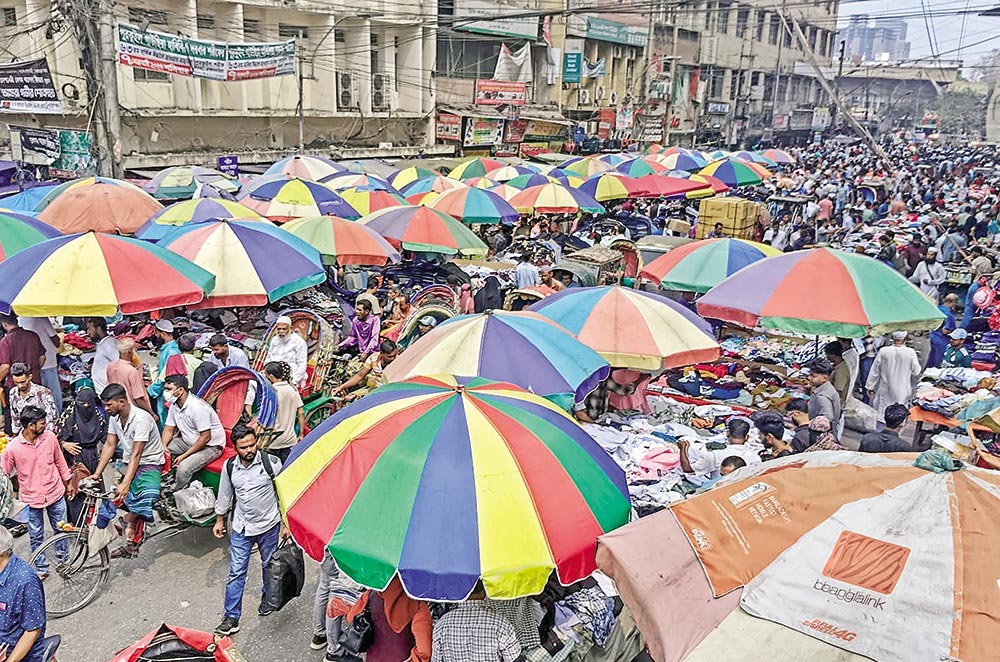 Despite repeated eviction drives by the Dhaka North City Corporation (DNCC) and Dhaka South City Corporation (DSCC), hawkers are returning to many cleared footpaths within days, raising questions over the effectiveness of eviction, rehabilitation and post-drive monitoring.
In some areas, vendors reportedly return within hours, while in others they re-establish their businesses within a day or two. Even where authorities have marked designated vending spaces with white circles, some vendors allegedly extend their stalls beyond the boundaries, occupying pedestrian space and road edges.
As a result, pedestrians are increasingly forced to walk on busy roads, contributing to congestion and public suffering.
Since April, the Dhaka Metropolitan Police (DMP) and the two city corporations have conducted several drives against illegal occupation of footpaths and roads. Yet reports from areas including Gulistan and Paltan suggest that vendors have returned to some cleared locations shortly after eviction.
This raises a basic question: who monitors the footpaths after an eviction drive?
If a cleared area can be reoccupied within 24 to 72 hours, the problem is clearly not limited to eviction. It also points to weaknesses in enforcement and continuous monitoring.
Both city corporations have introduced measures to regulate hawker activities by assigning specific locations and operating hours. Digital identity cards have also been introduced for registered vendors.
At the end of April, 302 hawkers received cards in the first phase, 202 in Mirpur under DNCC and 100 in Gulistan under DSCC.
According to DNCC data, a list of 829 mobile vendors was prepared for the main roads in Mirpur-10, Mirpur-1 and Mirpur-2. In the first phase, 202 vendors were selected for relocation to designated areas.
Under DSCC, 100 hawkers from Gulistan were initially selected for rehabilitation near the Link Road adjacent to Ramna Bhaban.
However, complaints suggest that designated spaces have not prevented vendors from returning to their former locations or expanding beyond marked areas. Tables, racks, merchandise and customer gatherings often leave little space for pedestrians.
The preparation of rehabilitation lists has also raised concerns.
Several reports have alleged that some long-time hawkers were excluded while new individuals received designated spaces. Allegations have also surfaced involving local political figures, hawker leaders, law enforcement personnel and some city corporation officials.
There have further been allegations that some allocated spaces are later rented out to others.
These allegations have not been established through court rulings or publicly disclosed independent investigations. Therefore, no individual or organisation can be held responsible without evidence.
However, urban experts say repeated allegations underline the need for a transparent digital database showing each vendor's identity, previous location, allocated space and operating hours.
The informal economy surrounding footpath businesses has also come under scrutiny.
Reports have alleged that hawkers in some areas are required to make daily or monthly payments to intermediaries controlling vending spaces.
A previous report indicated that more than 1,000 makeshift stalls operate along a roughly 2.5-kilometre stretch from Shyambazar through Bahadur Shah Park to Laxmibazar in Old Dhaka.
An investigative report published in July also alleged that syndicates collecting monthly payments were involved in controlling sections of the footpath trade. It raised allegations involving politically connected individuals and some law enforcement personnel.
As no independent government investigation into these allegations has been made public, they remain allegations.
For pedestrians, however, the consequences are immediate.
During eviction drives, footpaths often become temporarily clear. Once enforcement teams leave, vendors gradually return.
“Footpaths are meant for pedestrians. But now we often have to squeeze through vendors and customers. Eventually, there is no option but to walk on the road,” said a pedestrian.
Residents say hawkers' livelihoods should be protected through viable alternatives, but not at the expense of pedestrians' right to public space.
The occupation also affects traffic. Pedestrians are pushed onto roads, customers gather beside stalls, and loading and unloading frequently obstruct vehicle movement.
DSCC Administrator Mohammad Abdus Salam has said hawkers will not be allowed to occupy footpaths and roads.
During an eviction drive in Segunbagicha on Thursday, he said surprise and spot operations would continue and authorities would also inspect illegal structures and trade licences.
Earlier, he said registered hawkers could be allowed to operate on wider footpaths while keeping sufficient space open for pedestrians. He also mentioned plans for holiday and night markets.
DNCC has similarly taken steps to relocate hawkers to designated areas in Mirpur and said eviction drives would continue if vendors return to their former locations after the transition period.
Urban experts say eviction alone cannot provide a sustainable solution. Digital registration, designated vending zones, time-based markets and continuous monitoring are needed.
The real test for Dhaka's footpath management is therefore not simply how many hawkers authorities can remove, but whether they can prevent illegal occupation from returning.
Without effective post-eviction monitoring, the capital risks remaining trapped in the same cycle: eviction, temporary clearance, return and renewed occupation.
Loading...
Loading...
Also read



Editor : Iqbal Sobhan Chowdhury
Published by the Editor on behalf of the Observer Ltd. from Globe Printers, 24/A, New Eskaton Road, Ramna, Dhaka.
Editorial, News and Commercial Offices : Aziz Bhaban (2nd floor), 93, Motijheel C/A, Dhaka-1000.
Phone: PABX- 41053001-06; Advertisement: 41053012; 01793317829, 01550707291, E-mail: [email protected], [email protected] Online: email: [email protected] 41053014; 01550707297 Advertisement: 01550707296
Published by the Editor on behalf of the Observer Ltd. from Globe Printers, 24/A, New Eskaton Road, Ramna, Dhaka.
Editorial, News and Commercial Offices : Aziz Bhaban (2nd floor), 93, Motijheel C/A, Dhaka-1000.
Phone: PABX- 41053001-06; Advertisement: 41053012; 01793317829, 01550707291, E-mail: [email protected], [email protected] Online: email: [email protected] 41053014; 01550707297 Advertisement: 01550707296


