



| HEADLINE |

|
Tk 12cr govt buffalo farm at Fakirhat faces security, infrastructure woes
Weak boundary wall, grass theft; no drainage or concrete pond
Published : Sunday, 27 September, 2026 at 12:00 AM
Our Correspondent


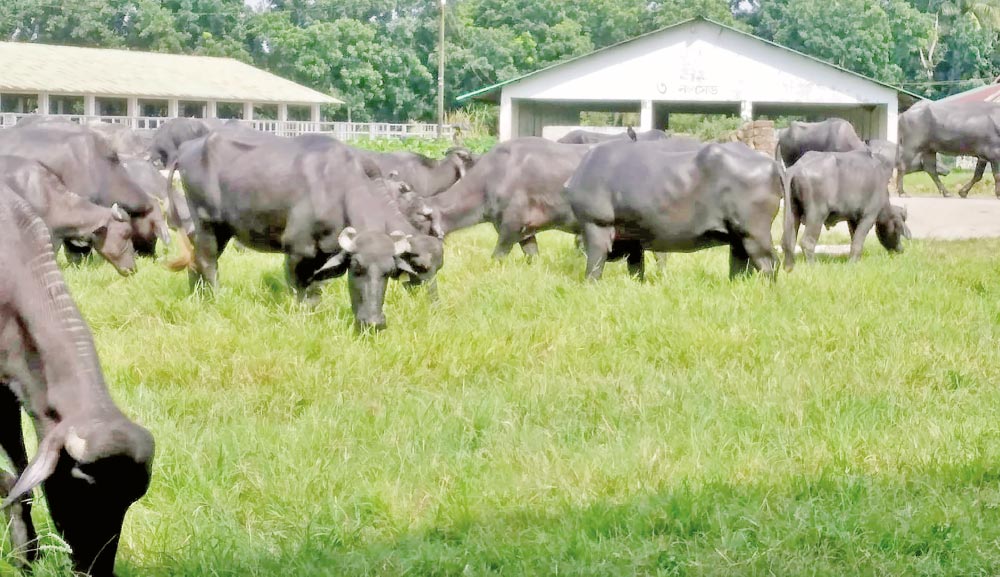 FAKIRHAT, BAGERHAT, Sept 26: The government Buffalo Breeding and Development Farm in Fakhirat is facing security and infrastructure problems, despite housing around 290 buffaloes worth an estimated Tk 12 crore.
There are large gaps under parts of the farm's nearly four-kilometre boundary wall, raising the risk of buffaloes getting out. In some places, there is no boundary wall at all, with bamboo fencing being used instead.
Parts of the old wall have also become lower as soil and land around it have been raised. Taking advantage of the weak boundary, local people allegedly enter the farm and cut nutrient-rich grass cultivated as feed for the buffaloes.
The farm was established on about 95 acres in Piljanga of Fakhirat in the 1984-85 fiscal year with funding from the Asian Development Bank. Its main objectives are breeding improved buffaloes, developing breeds and increasing milk and meat production.
The farm currently has around 290 buffaloes, including about 250 Indian Murrah buffaloes. It also has Italian Mediterranean, Jafarabadi and Nili-Ravi breeds.
Most recently, 120 improved Murrah buffaloes were imported from India at a cost of around Tk 6 crore.
Of the 52 sanctioned revenue posts at the farm, only 10 officials and employees are currently working. Although 22 outsourcing workers were recently recruited, the shortage of skilled manpower remains.
A section of the boundary wall covering around two kilometres was built several years ago, but there are large gaps at its base in several places. This creates a risk of buffaloes escaping.
There is no wall along some other sections, where bamboo fencing has been put up. The remaining two kilometres of old boundary wall was originally about five feet high, but in many places it has become even lower because surrounding land has been raised.
Farm officials said some local people enter the farm by climbing over the wall both during the day and at night. They allegedly cut and take away improved grass cultivated as buffalo feed.
The farm produces improved varieties of grass, including Pangchong, Red Pangchong and Napier. Officials said the weak boundary makes it difficult to protect the feed resources. Unauthorised entry also raises concerns about the safety of the buffaloes, machinery and other assets.
Parts of the farm's 95 acres are low-lying. Unless those areas are raised and levelled, it is difficult to produce enough quality green fodder, limiting the farm's scope to increase its own feed production.
Waste management is another major problem. Around 290 buffaloes produce large quantities of dung and urine every day, but the farm lacks adequate drainage to remove wastewater mixed with animal waste.
As a result, muddy and unhygienic conditions develop in different parts of the farm. Officials said a planned drainage system could allow the waste to be used as an organic input in agricultural land.
There are also shortcomings in buffalo healthcare and breeding management. Although modern research and diagnostic facilities are needed for disease diagnosis, treatment, breeding management and breed improvement, the farm does not have a fully equipped laboratory.
There is also no permanent veterinary surgeon, forcing the farm to depend on doctors brought in from outside to treat sick buffaloes.
The farm also lacks adequate facilities for routine physical care of the animals. There is no concrete pond or suitable wallowing facility for buffaloes to cool themselves and bathe during hot weather.
Dr Md Hasan Ali, Fakhirat Upazila Livestock Officer and Veterinary Surgeon, said such facilities were necessary to maintain the health and productivity of the valuable improved breeds.
New development projects and adequate funding are needed to address the infrastructure problems, officials said. But due to inadequate development allocations, the farm has been unable to repair the boundary wall, raise low-lying land or develop necessary facilities such as drainage and a concrete pond.
Local residents urged the authorities to take immediate steps to modernise the country's only government buffalo breeding and development farm.
Sheikh Al Mamun, Senior Assistant Director of the farm, said, “The farm is struggling with limited manpower and various other challenges. Despite this, we are trying to work towards the government's goal of increasing meat and milk production. At present, infrastructure improvements, including repairs to the boundary wall, are urgently needed.”
Loading...
Loading...
Also read



Editor : Iqbal Sobhan Chowdhury
Published by the Editor on behalf of the Observer Ltd. from Globe Printers, 24/A, New Eskaton Road, Ramna, Dhaka.
Editorial, News and Commercial Offices : Aziz Bhaban (2nd floor), 93, Motijheel C/A, Dhaka-1000.
Phone: PABX- 41053001-06; Advertisement: 41053012; 01793317829, 01550707291, E-mail: [email protected], [email protected] Online: email: [email protected] 41053014; 01550707297 Advertisement: 01550707296
Published by the Editor on behalf of the Observer Ltd. from Globe Printers, 24/A, New Eskaton Road, Ramna, Dhaka.
Editorial, News and Commercial Offices : Aziz Bhaban (2nd floor), 93, Motijheel C/A, Dhaka-1000.
Phone: PABX- 41053001-06; Advertisement: 41053012; 01793317829, 01550707291, E-mail: [email protected], [email protected] Online: email: [email protected] 41053014; 01550707297 Advertisement: 01550707296


