



| HEADLINE |

|

Gas crisis: If supply is adequate, where is the gas going?
Published : Saturday, 3 October, 2026 at 6:00 PM
Maliha Tabassum


File Photo
Bangladesh's liquefied petroleum gas (LPG) market has entered a confusing phase. Consumers across different areas are struggling to find 12kg cylinders, retailers are charging hundreds of taka above the government-fixed price, and yet importers and regulators say the country has adequate supplies. On September 30, Petrobangla said Bangladesh had secured 19 LNG cargoes for October and November 10 for October and nine for November and that there would be no LNG import shortage during those two months.
The contradiction has prompted the government to investigate whether LPG and LNG is being withheld from the market.
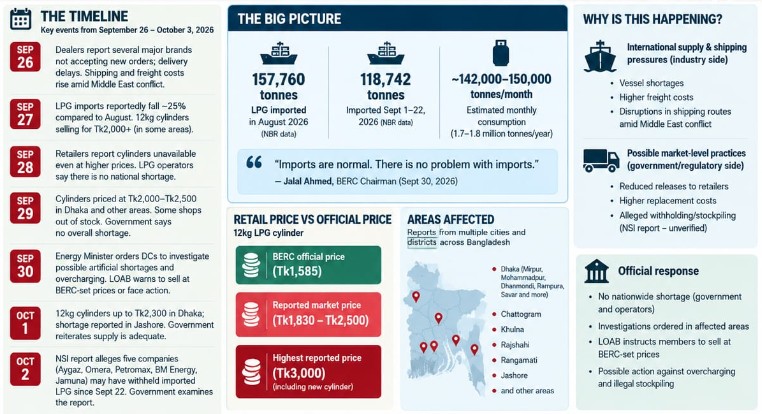
The Bangladesh Energy Regulatory Commission (BERC) fixed the retail price of a 12kg LPG cylinder at Tk1,585 for September. But by September 26, consumers were reportedly paying Tk2,100-2,200, while some were unable to find cylinders even at those prices. Dealers told local media that supplies were running about 30 percent below normal demand.
The problem did not remain confined to Dhaka.
On October 3, an LPG supply crunch was reported in Rangamati, where drivers queued for hours at filling stations and some were unable to obtain the amount of gas they needed. Station operators said supplies were inadequate and could not say when fresh supplies would arrive.
The numbers tell a different story
Available import figures do not immediately point to a nationwide collapse in LPG supplies.
According to National Board of Revenue data presented to the government, Bangladesh imported 157,760 tonnes of LPG in August and 118,742 tonnes between September 1 and 22. The country's estimated annual consumption is around 1.7 to 1.8 million tonnes, or roughly 142,000 to 150,000 tons a month.
By September 30, BERC officials told The Daily Star that imports had reached around 126,000 tonnes for the month. BERC chairman Jalal Ahmed said, "Imports are normal. There is no problem with imports."
LOAB later put September imports at approximately 156,000 tons, compared with 158,000 tons in August, and said the volume was sufficient to meet domestic demand.
That raises the central question: If the country is receiving enough LPG, why are consumers facing shortages?
From import shortage to distribution problem
The industry's first explanation was international supply disruption.
On September 27, LPG importers and BERC sources told that imports had fallen to around 120,000 tonnes at that point, about 25 percent below August's roughly 160,000 tonnes. Importers attributed the pressure to vessel shortages, disruptions along shipping routes and higher freight costs amid the conflict in the Middle East.
Dealers also reported higher procurement costs.
On September 26, dealers said several major brands were not accepting new orders, while some others were taking several days to deliver cylinders. Meghna Fresh LPG's chief marketing officer said shipping and related costs had increased sharply amid disruption around the Strait of Hormuz.
But the explanation became more complicated as updated import figures emerged.
Reports point that at least four LPG industry representatives said fresh cargo costs had risen sharply. According to those representatives, some operators had reduced supplies to retailers because the current BERC price did not reflect their higher replacement costs. They were waiting for the next monthly price adjustment before increasing releases.
This would mean that the immediate problem may not necessarily be a lack of LPG entering Bangladesh, but how much of the imported product is being released into the retail market and at what price.
Consumers pay nearly 40% more
The difference between the regulated price and the retail market became substantial.
The September BERC price was Tk1,585 for a 12kg cylinder. The Daily Star spoke to at least 10 consumers who said they had recently paid around Tk2,000 or more. Some paid as much as Tk2,200 to Tk615, or nearly 39 percent, above the regulated price.
By October 1, it was reported that cylinders were being sold for as much as Tk2,300 in some places. Some consumers said they could not find their usual brands and had to purchase other brands at substantially higher prices.
The price gap was therefore not simply a matter of the official rate failing to change quickly. Consumers were already paying substantially more before BERC announced its next monthly adjustment.
Government starts looking for an explanation
On September 30, Power, Energy and Mineral Resources Minister Iqbal Hassan Mahmood Tuku ordered deputy commissioners to investigate the complaints.
The minister said there was no overall shortage of LPG in the country, but acknowledged that artificial shortages might be occurring in some areas. He asked district administrations to investigate why shortages were being reported despite normal supply and why consumers were being charged above BERC's official price.
The government also instructed officials to submit evidence-based reports and said action would be taken against anyone found creating artificial shortages or overcharging consumers.
LOAB subsequently instructed its members, distributors, dealers and retailers to sell LPG at BERC-set prices. It warned that overcharging and unauthorised stockpiling could lead to legal action.
A new allegation emerges
The most serious development came on October 2.
An NSI report reportedly submitted to the Energy Ministry alleged that five major companies: Aygaz, Omera, Petromax, BM Energy and Jamuna. these companies had restricted the release of imported LPG from around September 22, potentially contributing to an artificial shortage.
Energy Minister Iqbal Hassan Mahmood confirmed receiving the report.
However, the allegation has not been established as fact. The report is an intelligence assessment, and the government investigation was still underway as of October 3. The companies should therefore be given an opportunity to respond before any allegation of deliberate withholding is presented as a finding.
There is another significant development: a group of LOAB members itself sought a government investigation into alleged withholding of imported cargo. The group asked for an importer-by-importer review of inventories and the release of cargo allegedly being held by major importers.
The unanswered question
The available evidence presents three apparently conflicting realities.
First, consumers in several parts of the country are reporting genuine difficulty obtaining LPG and are paying substantially above the BERC-set price.
Second, import and stock figures cited by the government and industry do not clearly show a nationwide shortage. LOAB says September imports were almost identical to August levels.
Third, industry representatives say higher international procurement and shipping costs have made the regulated price commercially difficult, while the government is investigating whether LPG is being deliberately withheld from parts of the market.
The result is a supply chain whose weak point has yet to be conclusively identified.
Is LPG actually insufficient at the national level? Is imported LPG reaching bottlers but not retailers? Are some operators reducing releases because of higher replacement costs? Or is part of the shortage being artificially created through withholding or stockpiling?
As of October 3, the government had ordered investigations but had not publicly established which explanation was responsible for the nationwide retail disruption.
Meanwhile, consumers are paying the price.
For a 12kg cylinder officially priced at Tk1,585, paying Tk2,000 means an additional Tk415. At Tk2,300, the premium reaches Tk715 which is a 45 percent increase over the regulated price.
And in Rangamati, the issue was no longer just price: consumers and drivers were reportedly spending hours searching for LPG.
The government's district-level investigations, together with an importer-by-importer examination of stocks and cargo releases, may determine whether Bangladesh's latest LPG crisis is fundamentally a problem of supply, distribution, pricing or market control.
At the same time, reports have documented long queues and disruptions at CNG filling stations. Earlier shortages were linked to low pressure and disruptions at LNG facilities, with stations in some areas unable to operate normally.
Loading...
Loading...
Also read








Editor : Iqbal Sobhan Chowdhury
Published by the Editor on behalf of the Observer Ltd. from Globe Printers, 24/A, New Eskaton Road, Ramna, Dhaka.
Editorial, News and Commercial Offices : Aziz Bhaban (2nd floor), 93, Motijheel C/A, Dhaka-1000.
Phone: PABX- 41053001-06; Advertisement: 41053012; 01793317829, 01550707291, E-mail: [email protected], [email protected] Online: email: [email protected] 41053014; 01550707297 Advertisement: 01550707296
Published by the Editor on behalf of the Observer Ltd. from Globe Printers, 24/A, New Eskaton Road, Ramna, Dhaka.
Editorial, News and Commercial Offices : Aziz Bhaban (2nd floor), 93, Motijheel C/A, Dhaka-1000.
Phone: PABX- 41053001-06; Advertisement: 41053012; 01793317829, 01550707291, E-mail: [email protected], [email protected] Online: email: [email protected] 41053014; 01550707297 Advertisement: 01550707296


