



| HEADLINE |

|

Graduate Unemployment Rising, Talent Leaving the Country
Published : Wednesday, 28 October, 2026 at 6:28 PM
Observer Special


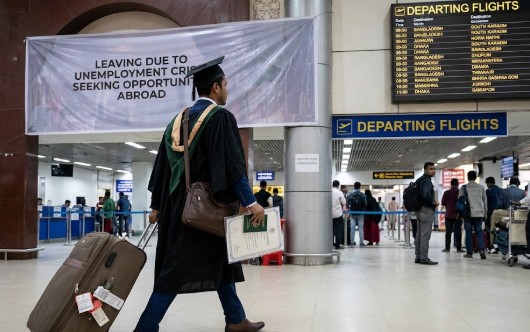
Bangladesh’s young people face two major crises today. On the one hand, many are unable to find jobs that match their qualifications even after completing higher education. On the other, a large number of talented young people are leaving the country in search of better education, employment and a secure future.
Every year, thousands of graduates and postgraduates emerge from universities across the country. Many spend long periods looking for work, while some are compelled to take up jobs that have little to do with their academic qualifications.
Meanwhile, some of the young people whose talent and skills could have helped strengthen the domestic economy are settling abroad. Behind these parallel trends lie weaknesses in the education system, limited employment opportunities and a failure to recognise and reward merit.
The question is whether Bangladesh is adequately prepared for the very people expected to shape its future.
Bangladesh’s education system is struggling to keep pace with rapid technological advances and changes in the global economy. Much of the existing system remains theoretical and dependent on rote learning. Yet modern industry, business and technology require practical knowledge, problem-solving abilities and the capacity to adapt to new technologies.
Many young people discover the gap between what they have learnt and what employers expect only when they enter the job market. As a result, the number of educated unemployed continues to grow, while domestic companies are compelled to recruit foreign professionals for various important positions because of a shortage of suitably skilled workers. This contradiction exposes the lack of coordination between education and the economy.
The shortage of jobs commensurate with qualifications, relatively low salaries, inadequate professional recognition and limited research opportunities are among the reasons talented people seek opportunities abroad. The state spends substantial public funds on educating students at institutions such as the University of Dhaka, Bangladesh University of Engineering and Technology (BUET) and the country’s medical colleges.
Many of these students pursue higher education abroad and begin their careers there, while some eventually settle permanently. Their skills and labour then contribute to the economies of other countries. Studying or working abroad, however, is not inherently a problem. Knowledge and experience acquired overseas can also contribute to Bangladesh’s development. The difficulty arises when the lack of suitable opportunities for employment, research and professional advancement at home discourages talented people from returning.
Disillusionment over the recognition of merit further intensifies this trend. When an engineer, doctor or researcher finds that personal connections, lobbying or political influence carry greater weight than competence and professional ability, a loss of confidence is inevitable. Appeals to patriotism alone cannot persuade people to stay if safe working conditions, transparent recruitment, professional independence and research opportunities remain inadequate. If this situation persists, critical sectors of the economy could face a shortage of skilled personnel. It could also undermine the development of future leadership.
Education reform must be the first priority in addressing this crisis. The excessive emphasis on academic degrees needs to give way to a greater focus on technical and vocational education. Technical training should become an integral part of mainstream education, with opportunities for hands-on learning introduced from the school and college levels. Vocational courses must be designed to equip students with the practical skills required in the workplace and, where possible, enable them to create employment for themselves.
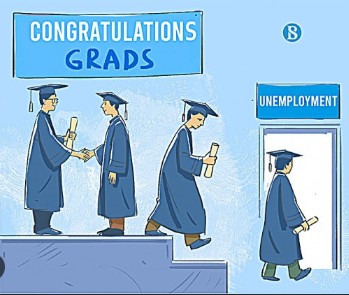
University curriculam also need urgent revision. Students should have greater opportunities to learn about artificial intelligence, data science, automation and other emerging technologies. However, adding new subjects to the syllabus will not be enough. Laboratories, practical training, industry internships and workplace-based learning must be expanded so that students can learn to solve real-world problems. Effective collaboration between universities and the private sector would help bridge the gap between education and employment.
Continuity in education policy is equally important. When policy priorities change with successive governments, the implementation of long-term plans is disrupted. Education reform must be treated as a national priority, above partisan considerations. A permanent framework involving academics, industrialists, researchers and relevant professionals should be established to ensure that the education system evolves in response to changing needs.
At the same time, the economic base must be broadened to create more jobs. The government cannot provide employment for such a large population on its own. The private sector must therefore become the principal driver of job creation.
Creating an investment-friendly environment, reducing administrative hurdles to starting a business and improving access to affordable financing are essential steps. Bangladesh must also reduce its excessive dependence on the ready-made garment industry and attract greater domestic and foreign investment into promising sectors such as information technology, pharmaceuticals, light engineering, renewable energy, agro-based industries and other emerging fields. The development of new sectors would expand employment opportunities for skilled and educated young people.
Greater attention must also be paid to nurturing young entrepreneurs. It is unrealistic to expect everyone to become a job seeker. Some must become entrepreneurs and create employment for others. To make this possible, startups need access to loans on favourable terms, effective mentoring, risk capital and technical support. The effective use of high-tech parks and the removal of bureaucratic obstacles to setting up new businesses are also essential. A healthy entrepreneurial environment would give young people the opportunity to turn innovative ideas into viable economic ventures.
Bangladesh’s lag in technical and vocational education also deserves serious attention. Various published estimates put the share of technical and vocational education at 73 per cent in Germany, 66 per cent in Japan, 65 per cent in Singapore, 60 per cent in Australia, 55 per cent in China and 50 per cent in South Korea. The figure for Malaysia is 46 per cent. In the European Union, the participation rate in vocational education at the upper-secondary level is 49.4 per cent.
In Bangladesh, institutional estimates generally place enrolment in technical and vocational education at around 14 to 16 per cent. These figures include short-term courses and general trade training. According to various estimates based on internationally comparable criteria, the share of formal technical education is still around 9 to 10 per cent. It is important to establish whether these figures use the same definitions and measurement methods. Nevertheless, differences in methodology do not diminish the need to expand the reach of vocational education in Bangladesh.
Increasing the number of educational institutions or producing more graduates every year cannot, by itself, serve as a measure of development. Educational quality, job-ready skills, industrialisation and investment opportunities must be addressed as parts of a common strategy. Young people need an education that prepares them for employment while also equipping them to acquire new knowledge and adapt to changing circumstances.
Bangladesh’s greatest asset is its young population. Making the most of this resource requires an effective connection between the education system and the economy. The country must ensure that merit is recognised, workplaces are safe, research opportunities are available and professional advancement is possible.
It is neither feasible nor desirable to stop talented people from going abroad altogether. The more urgent task is to build a Bangladesh where young people have sufficient opportunities to shape their own futures and are also encouraged to return with the knowledge and experience they have gained overseas.
Creating such an environment would enable their talent to play a more effective role in the development of the country’s economy and society.
sks

Loading...
Loading...
Also read








Editor : Iqbal Sobhan Chowdhury
Published by the Editor on behalf of the Observer Ltd. from Globe Printers, 24/A, New Eskaton Road, Ramna, Dhaka.
Editorial, News and Commercial Offices : Aziz Bhaban (2nd floor), 93, Motijheel C/A, Dhaka-1000.
Phone: PABX- 41053001-06; Advertisement: 41053012; 01793317829, 01550707291, 01550707296
E-mail: [email protected], [email protected]. [email protected], [email protected], [email protected], [email protected], Online-email: [email protected]


